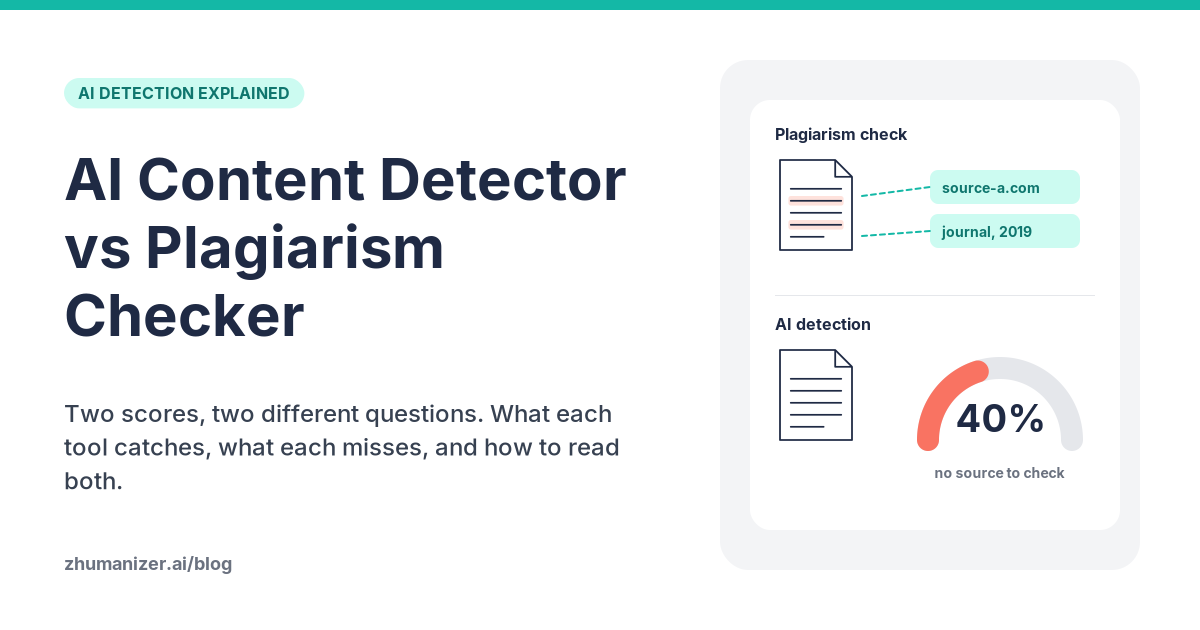
Your report comes back with two numbers: a 12% similarity score and a 40% AI score. Which one should worry you? Are they measuring the same thing twice?
They aren't. A plagiarism checker and an AI detector ask completely different questions, work in completely different ways, and produce very different kinds of evidence. Mixing them up is one of the most common reasons students panic over the wrong number, and one of the easiest ways for an instructor or editor to misread a report.
Key takeaways
- A plagiarism checker asks: does this text match something that already exists? It shows you the matching source.
- An AI detector asks: does this text look statistically like machine writing? It gives a probability with no source to point to.
- Plagiarism checkers mostly miss AI writing, because chatbots generate new word sequences rather than copying.
- AI detectors don't look for copying at all. A passage lifted word for word from a human-written article is still human-written.
- On Turnitin, the two scores are calculated separately and mean different things.
The short answer
| Plagiarism checker | AI content detector | |
|---|---|---|
| Question it answers | Does this text match existing sources? | Does this text look machine-generated? |
| How it works | Compares your text against a database of web pages, publications, and past submissions | Runs your text through language models trained to spot patterns typical of AI output |
| What it shows | Matching passages, linked to the sources they match | A percentage or label, sometimes with highlighted sentences |
| Evidence you can check | Yes: you can open the source and compare | No: there's no source, only a statistical judgment |
| Common false alarms | Properly quoted and cited text, reference lists, stock phrases, your own earlier work | Formal or formulaic writing, second-language writing, short texts, heavily edited drafts |
| What it misses | Newly generated AI text, heavy paraphrasing, translated sources | Copied human writing, and edited or paraphrased AI text |
How a plagiarism checker works
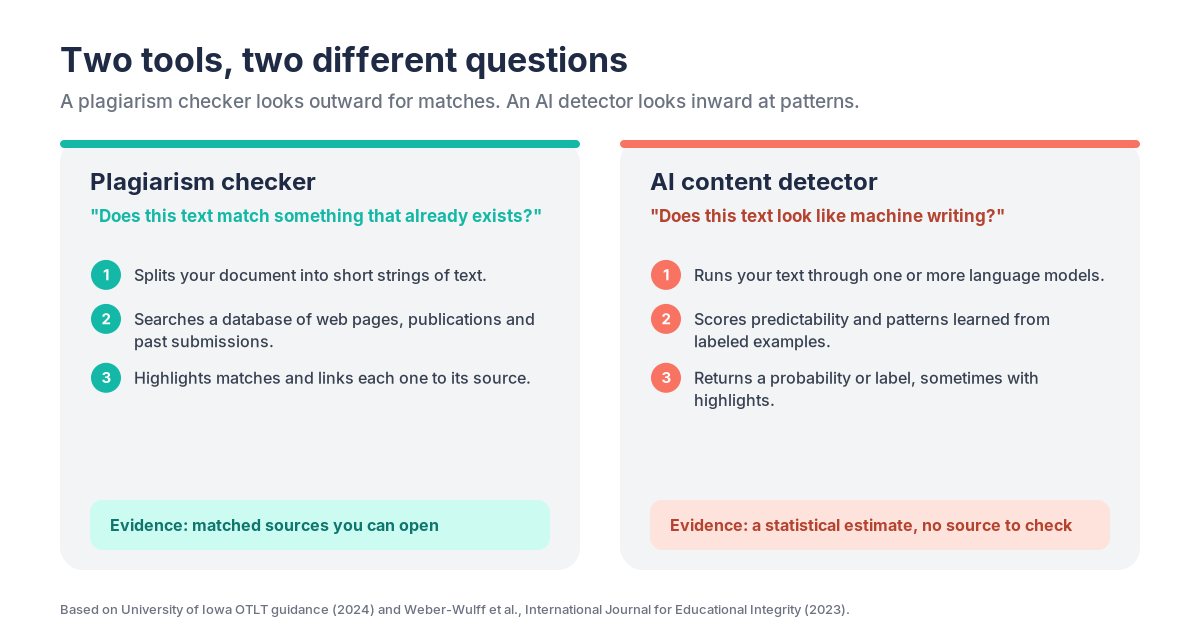
A plagiarism checker breaks your document into short strings of text and searches for the same strings in its index. When it finds overlaps, it highlights them, links each one to the matching source, and adds up a similarity percentage.
The University of Iowa's teaching office describes it simply: a plagiarism checker like Turnitin "will scan the submitted text and compare it to a massive database of previously collected work. There is no likelihood or probability involved in these tools, they look for matches and flag the matches for instructors to decide if these matches constitute plagiarism" (University of Iowa).
That last part matters. A similarity score is not a plagiarism verdict. A 25% match might be a correctly quoted and cited source, a bibliography, a standard methods paragraph, or a draft you submitted to the same system last term. Text-matching tools have their own error problems too. Earlier research found they miss some plagiarism and "will also mark non-plagiarised content as plagiarism" (Weber-Wulff et al., 2023, summarizing Foltýnek et al., 2020).
The difference is that every match can be checked. An instructor can open the source, put it next to the submission, and see exactly what overlaps.
How an AI detector works
An AI detector has no database of sources to compare against. Instead, it analyzes the text itself: how predictable the word choices are to a language model, how uniform the sentences are, and patterns a trained classifier has learned to associate with machine writing. The full breakdown is in the guide to how AI detectors work.
The output is a probability, not a match. As Washington Post columnist Geoffrey Fowler put it, quoted in the same Iowa guidance, "With AI, a detector doesn't have any 'evidence' — just a hunch based on some statistical patterns."
That's the core difference. Researchers who tested 14 detection tools put it this way: although text-matching software has false positives and false negatives, "at least it is possible to provide evidence of potential misconduct. In the case of the detection tools for AI-generated text, this is not the case" (Weber-Wulff et al., 2023).
Why plagiarism checkers miss AI writing
A chatbot doesn't copy and paste. It generates text one word at a time by sampling from probabilities, so its output is usually a fresh sequence of words that doesn't exist anywhere else. There's nothing for a plagiarism checker to match.
A 2023 study in npj Digital Medicine shows this clearly. Researchers generated 50 scientific abstracts with ChatGPT and ran them, along with the 50 real abstracts whose titles they used as prompts, through both kinds of tool (Gao et al., 2023):
- On a plagiarism checker, the real abstracts had a median "plagiarized" score of 62.5%, because they were already published online. The ChatGPT abstracts scored a median of 0%.
- On an AI output detector, the ChatGPT abstracts had a median "fake" score of 99.98%. The real abstracts scored 0.02%.
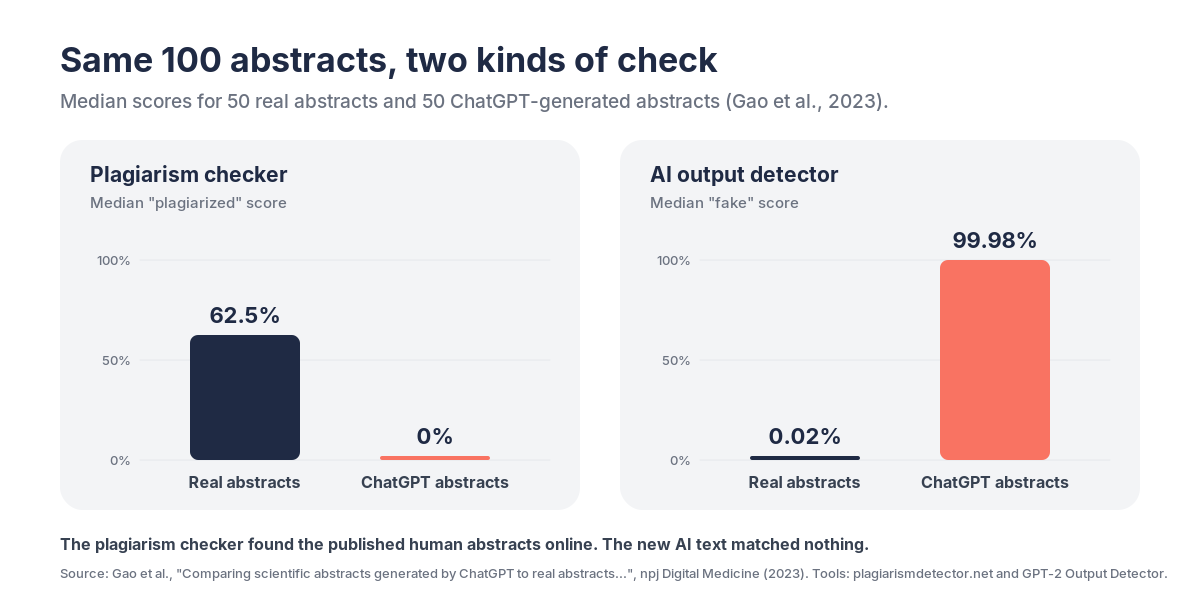
The plagiarism checker rated the AI text as more original than the human text. That's not a bug in the checker. It's doing exactly what it was built to do.
Another study, summarized in the 14-tool review, fed 50 ChatGPT-generated essays into Turnitin and iThenticate and found 40 of them were rated as highly original. The reviewers added that using text-matching software to detect machine-generated text "makes little sense because of the stochastic nature of the word selection" (Weber-Wulff et al., 2023).
There are exceptions. The same review notes that ChatGPT-paraphrased text (where the model rewrites an existing source) produced high match rates in one study, and that Turnitin often returned high similarity values for ChatGPT-generated program code and output. When AI stays close to an existing source, some of that source can still show through.
Why AI detectors don't catch plagiarism
The reverse problem is just as real. Copy three paragraphs from a 2015 magazine article and run them through an AI detector. The text was written by a human, so a detector should, in principle, call it human. Plagiarism and AI generation are separate problems, and a clean AI score says nothing about whether the words are original.
Detectors can also go wrong in the other direction on copied material. Very famous text, which language models saw often during training, can look "too predictable." Gonzaga University's faculty guide notes that detectors have flagged parts of the Bible and the US Constitution as AI (Gonzaga). The false positives guide covers more of these failure patterns.
Reading the two scores together
When a tool reports both numbers, the combinations tell different stories. None of them is proof on its own.
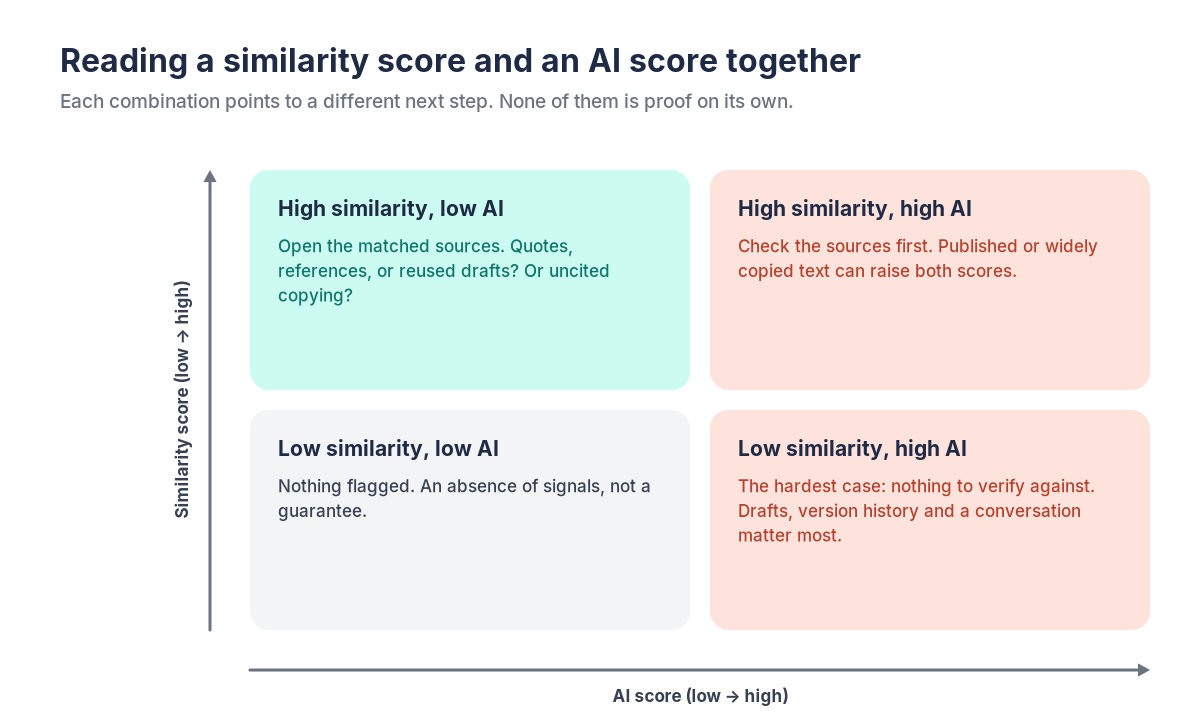
- Low similarity, low AI score. Nothing flagged. That's not a guarantee of anything, just an absence of signals.
- High similarity, low AI score. Look at the matches. Are they quotes with citations, a reference list, or a reused earlier draft? Or uncited passages from someone else's work? The sources are right there to check.
- Low similarity, high AI score. This is the hardest case, because there's nothing to verify against. It could be AI writing, or it could be a false positive on predictable human prose. Drafts, version history, and a conversation matter far more than the number. If it's your work, see why your writing was flagged as AI.
- High similarity, high AI score. Start with the matched sources. Published or widely copied text can raise both scores at once.
Where you'll see both: Turnitin
Turnitin is the most common place students and instructors meet both checks in one product, and it keeps them separate. Its documentation states that the AI percentage "is different from and independent of the similarity score," and that AI writing highlights don't appear in the Similarity Report (Turnitin Guides).
A few details that trip people up:
- The AI score only covers "qualifying text," meaning prose sentences in long-form writing. Bullet points, tables, code, and poetry aren't reliably scored.
- AI scores between 1% and 19% display as an asterisk instead of a number, because Turnitin found a higher incidence of false positives in that range.
- Turnitin says its AI model "should not be used as the sole basis for adverse actions against a student."
Several universities have now made the split official by turning off the AI score while keeping similarity checking. Curtin University disabled Turnitin's AI writing detection from 1 January 2026, noting that "the regular text-matching originality checks will remain active" (Curtin University). The University of the Free State discontinued AI detection from 1 July 2026, while "Turnitin's similarity-checking tools will remain in use" (UFS). For a wider look at which schools use what, see what AI detector universities use.
Which one do you actually need?
If you're a student, a plagiarism check before submission (where your school allows it) can catch a missing citation or a quote you forgot to mark. An AI score is far less actionable. If your own writing gets a high one, don't rewrite it in a panic. Keep your drafts and notes, and follow your school's process.
If you're an educator, treat similarity matches as leads you can verify and AI scores as, at most, a reason for a conversation. Both kinds of report need human judgment, but only one comes with evidence attached.
If you publish content, a plagiarism or duplicate-content check protects you from accidental copying and scraped text. Whether search engines care if a page was AI-assisted is a separate question, covered in can Google detect AI content.
For background on detection tools in general, read how AI detectors work.
Using AI to help draft where it's permitted? The Zhumanizer AI Humanizer turns stiff AI-assisted drafts into clear, natural writing in your voice. It doesn't replace citations: quote and credit your sources properly, and remember that no tool can guarantee a particular detector score.
A note on responsible use
Plagiarism and undisclosed AI use are both integrity issues, and neither tool is a substitute for your institution's or employer's rules. Follow your school's, employer's, or publisher's AI and citation policies, and disclose AI assistance wherever it's required.
FAQ
What is the difference between an AI detector and a plagiarism checker?
A plagiarism checker compares your text with a database of existing sources and shows you where it matches. An AI detector analyzes the writing itself to estimate whether it was machine-generated, and it has no source to point to. One finds copying; the other estimates authorship style.
Can a plagiarism checker detect AI-generated text?
Usually not. Chatbots generate new word sequences rather than copying, so there's typically nothing to match. In one study, ChatGPT-written abstracts scored a median 0% on a plagiarism checker while the real abstracts they were based on scored 62.5%.
Can an AI detector detect plagiarism?
No. AI detectors don't compare text with sources. Copied human writing is still human writing, so a detector may pass it. You need a plagiarism or similarity checker to find copied material.
Is Turnitin's AI score the same as its similarity score?
No. Turnitin says its AI percentage is different from and independent of the similarity score, and AI highlights don't appear in the Similarity Report. The similarity score shows matching sources; the AI score estimates how much qualifying prose looks AI-generated.
Which is more reliable, an AI detector or a plagiarism checker?
They're reliable in different ways. Plagiarism checkers have false positives too, but every match links to a source anyone can check. AI detector scores are probabilities with no source attached, which is why vendors and researchers warn against using them as the only evidence.