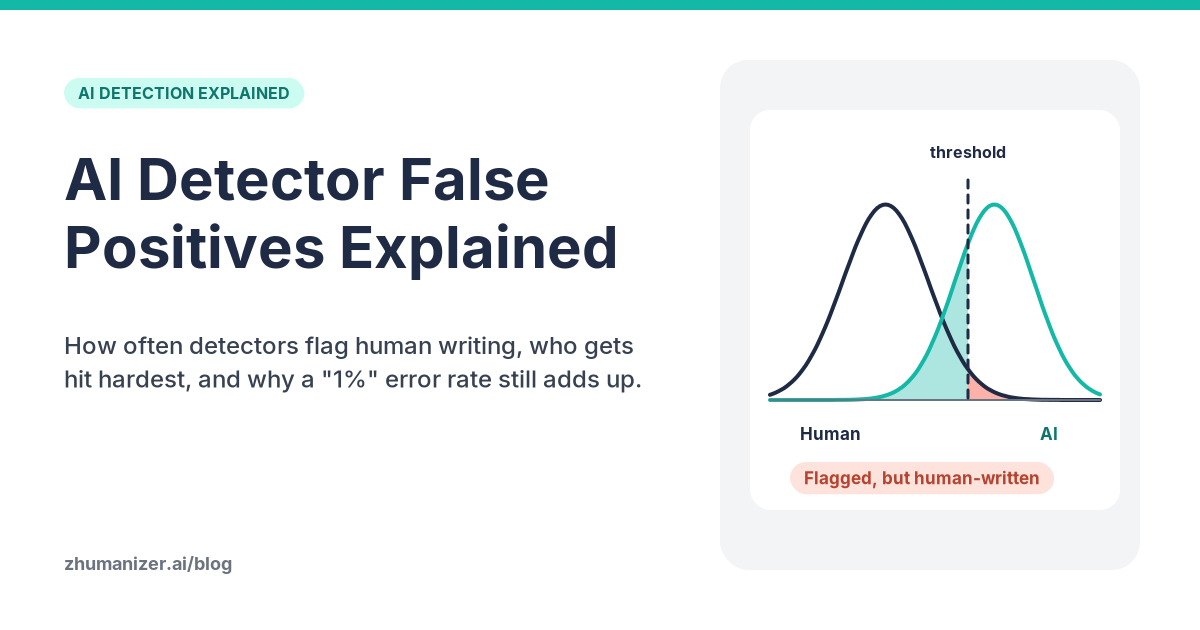
 Ask five AI detector companies how often their tools wrongly flag human writing and you'll hear numbers like 1%, 0.2%, or "about 1 in 10,000." Ask independent researchers and you'll get answers ranging from near zero to more than 60%, depending on whose writing they tested.
Both sets of numbers can be accurate. They just answer different questions.
This guide looks at false positives as a system problem: how often they happen, why the published rates disagree so much, which writers absorb most of the errors, and why a "small" error rate still produces hundreds of wrongly flagged people at a single university. If you've personally just been flagged and need a step-by-step response, start with why your writing was flagged as AI instead.
Key takeaways
- A false positive is human-written text labeled as AI-generated. Turnitin's own definition is "incorrectly identifying fully human-written text as AI-generated."
- Vendor-reported rates are usually 1% or lower. Independent studies range far wider because they test harder, messier, or more diverse writing.
- Errors cluster around predictable writing: non-native English, formulaic academic prose, translated or tool-polished text, and short samples.
- At institutional scale, a 1% rate means hundreds or thousands of flagged students, which is why several universities have switched the feature off.
How often do AI detectors produce false positives?
Here's what the published record says, split by who did the measuring.
Vendor-reported rates (each company testing its own tool):
| Detector | Reported false positive rate | Source |
|---|---|---|
| Turnitin | Under 1% at document level (for documents with over 20% AI writing); about 4% at sentence level | Turnitin |
| GPTZero | 1% | GPTZero |
| Copyleaks | 0.2% | Copyleaks |
| Pangram | About 1 in 10,000 | Pangram |
Independent and third-party findings:
- OpenAI's own classifier mislabeled human-written text as AI 9% of the time on its challenge set. OpenAI withdrew it in July 2023 "due to its low rate of accuracy" (OpenAI).
- Seven detectors on non-native English essays produced an average false positive rate of 61.3% on TOEFL essays, while performing almost perfectly on essays by US eighth-graders (Liang et al., Patterns, 2023).
- A 14-tool academic test found the false accusation risk ranged from 0% (Turnitin) to 50% (GPTZero) on its human-written documents, with risk rising "dramatically" for machine-translated texts (Weber-Wulff et al., 2023).
- Scientific abstracts from 1980 to 2023, which no chatbot could have written for most of that period, were run through an open-source RoBERTa-based detector. Up to 8.69% got a better-than-even AI probability, and in 1990 to 1994 about 1 in 20 abstracts scored above 90% (Rashidi et al., Journal of Pathology Informatics, 2023).
- A 2025 NBER working paper found the opposite story for leading commercial tools: GPTZero and Originality.ai kept false positive rates at or below 1% on medium and long passages and below 3% on short ones, while the open-source RoBERTa baseline misclassified 30% to 69% of human text (Jabarian and Imas, NBER, 2025).
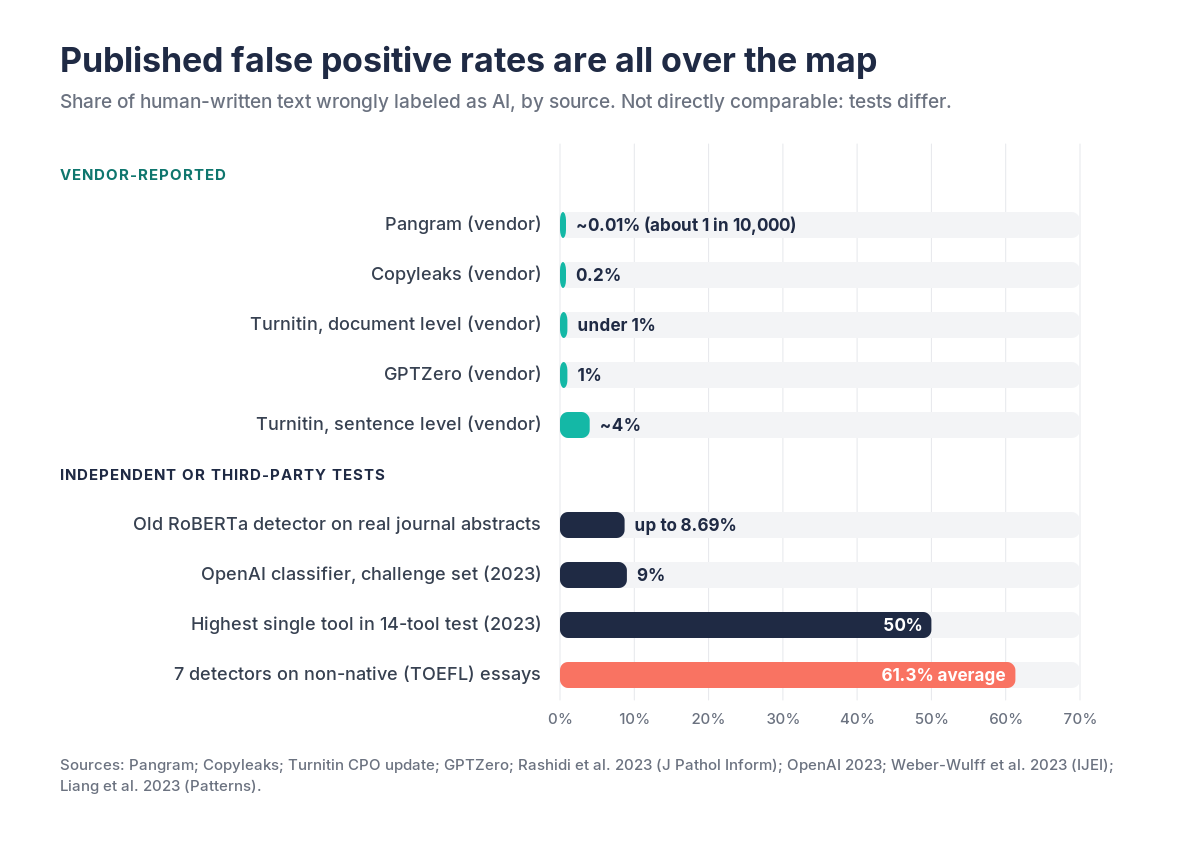
Rates come from different tests, text types, and years, so they can't be ranked against each other. The spread itself is the point.
Why the numbers disagree so much
Every false positive rate is tied to the test that produced it. Change any of these and the number moves:
- Who wrote the human samples. Native-speaker essays and TOEFL essays behave very differently, as the Liang study showed.
- Text length. Turnitin raised its minimum from 150 to 300 words after finding more false positives in short documents (Turnitin). The NBER study saw the same pattern for short passages.
- Document vs sentence level. Turnitin's under-1% figure is per document. Its sentence-level rate is about 4%, and a highlighted sentence is what students actually see.
- The threshold. Most tools tune their cutoff to keep false positives low. OpenAI said it did exactly that for its web app, marking text as AI only "if the classifier is very confident."
- The year. Detectors and language models both change constantly. A 2023 result may not describe a 2026 tool, in either direction.
That last point cuts both ways. The 2023 studies capture a period when many teachers were already using early tools on real students, and those decisions happened. Newer independent work suggests the best commercial detectors have improved on clean, long-form text. The open question is how they perform on the messy writing real people produce: edited, translated, polished, collaborative, and short.
Small rates, big numbers: the scale problem
A 1% false positive rate sounds like a rounding error. At institutional scale it isn't.
When Vanderbilt University disabled Turnitin's AI detector in 2023, it did the math publicly. Vanderbilt had submitted 75,000 papers to Turnitin in 2022. At the 1% rate Turnitin claimed at launch, "around 750 student papers could have been incorrectly labeled as having some of it written by AI" (Vanderbilt University).
Washington State University ran the same calculation in 2026. Turnitin analyzed 148,547 WSU assessments in fall 2024 alone, so even a 1% rate implies "almost 1,485 assessments were likely flagged by Turnitin as AI generated when they were not" (WSU Office of the Provost).
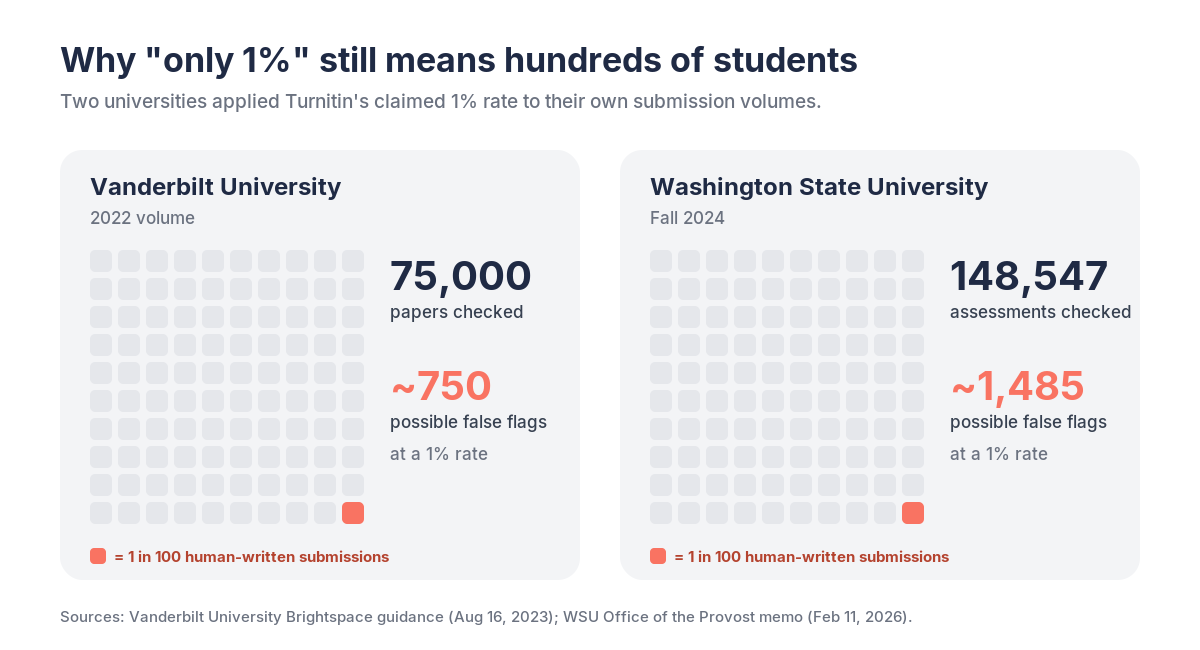
Calculations published by Vanderbilt University (2023) and Washington State University (2026).
Scale also changes how much a single flag means. When only a small share of a class actually used AI improperly, the honest writers far outnumber the cheaters, so even a low error rate can make up a large share of all the flags an instructor sees. The Alliance for Forensic Integrity and Provenance calls this the base-rate problem, and it's why a flag should start an inquiry rather than end one.
There's a human cost hidden in those totals. Between 2023 and 2025, 33% of WSU academic integrity hearing board cases involving alleged AI use ended with a finding of not responsible because the detector output was submitted "independent of any other supporting evidence" (WSU). Every one of those cases started with a flag.
Who gets hit hardest
False positives don't fall evenly. They cluster around writing that a language model finds easy to predict.
| Group or situation | What the evidence shows | Source |
|---|---|---|
| Non-native English writers | 61.3% average false positive rate on TOEFL essays across seven detectors; 97.8% flagged by at least one | Liang et al., 2023 |
| Machine-translated human writing | Detection accuracy dropped 20% compared with human text written in English | Weber-Wulff et al., 2023 |
| Formulaic academic and scientific prose | Up to 8.69% of real journal abstracts scored over 50% AI on an open-source detector | PMC, 2023 |
| Short submissions | OpenAI called its classifier "very unreliable" under 1,000 characters; Turnitin needs 300+ words | OpenAI, Turnitin Guides |
| Writers who polish with AI tools | Human-written research letters went from 97–100% classified human to 75–85% classified AI after a "readability" polish | Wang et al., summarized in Angelier, 2026 |
| Mixed human and AI documents | 54% of Turnitin's sentence-level false positives sit right next to genuinely AI-written text | Turnitin |
A few of these deserve more context.
The non-native writer question is real but not fixed in size. Turnitin published its own study finding no statistically significant bias against English language learners for documents of 300 words or more, though it did find a significant gap for shorter documents (Turnitin). A 2026 review notes that a rerun of the Liang essays on a newer commercial detector still found a disparity (23.1% false positives for TOEFL essays against 0% for native speakers), just a smaller one, and no disadvantage at all in a Czech-language test (Angelier, 2026). The honest summary is that the effect depends on the tool, the language, and the length of the text.
Polishing is a gray zone. If you write a draft and an AI tool rewrites it for "flow," some of the final wording really did come from a machine. The AI and Ethics review treats this as a definitional boundary case rather than a pure false positive, and argues the fix is clearer policy about which tools are allowed. Grammar checkers sit in the same gray zone, which is why disclosure matters.
Neurodivergent writers are a concern, with thinner evidence. WSU's memo says other studies have placed false positive rates higher "especially for students who are neurodivergent or have English as a second language." The 2026 review is more cautious, calling the added risk for disabled writers "plausible" but not yet shown experimentally. One documented case did reach a courtroom: a student with autism at Adelphi University, flagged at 100% by Turnitin, had his integrity violation annulled by a New York court in January 2026 (Newby v Adelphi Univ.).
Why false positives happen at all
The mechanics explain why no threshold setting can make them disappear.
Human and AI writing overlap. Detectors score features like predictability and variation. Most AI text is predictable, but so is plenty of human text. Where the two distributions overlap, any cutoff will catch some humans. (The perplexity and burstiness deep dive shows this with real numbers, including a famous human-written text that scores as extremely predictable.)
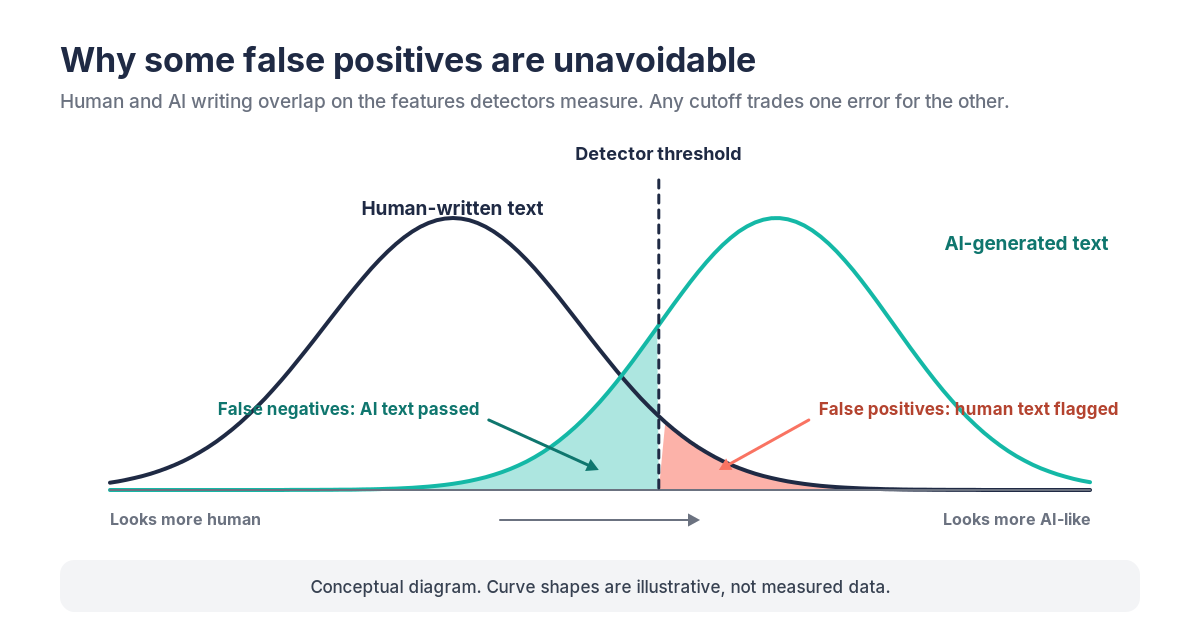
Moving the threshold right lowers false positives but lets more AI text through. Moving it left does the reverse. Overlap guarantees some error either way.
Thresholds trade one error for another. Push the cutoff higher and fewer humans get flagged, but more AI text slips through. Interestingly, the 14-tool study found most detectors were tuned toward calling text human, so in that test false negatives were the bigger problem overall (Weber-Wulff et al., 2023). That's a deliberate choice in education, where a wrong accusation does more harm.
Training-data familiarity. Language models have read enormous amounts of published text, so famous or widely copied passages look extremely predictable to them. Gonzaga University's faculty guide notes detectors have flagged parts of the Bible and the US Constitution (Gonzaga).
Distribution shift. A classifier only knows the kinds of text it was trained on. OpenAI warned that neural classifiers "are known to be poorly calibrated outside of their training data" and can be "extremely confident in a wrong prediction." A detector trained mostly on student essays may misread legal memos, recipes, or poetry.
Tools disagree. Because each detector has its own model, data, and threshold, the same text can land on both sides of the line. In a documented 2026 audit, one human-written manuscript was rated anywhere from "0% human" to "Human Generated" across five commercial tools on the same day (Angelier, 2026).
For a fuller tour of the methods behind these scores, see how AI detectors work.
What institutions are doing about it
The response has shifted from "trust the score" toward "never rely on the score alone."
- Turnitin itself says its AI score "should not be used as the sole basis for adverse actions against a student" (Turnitin Guides).
- Vanderbilt (2023), Waterloo (2025), Cape Town (2025), Curtin (2026), Washington State (2026), and the University of the Free State (2026) have switched off Turnitin's AI detection while keeping plagiarism checking. The full list, with each university's own announcement, is in what AI detector universities use.
- Process evidence is replacing scores: version histories, drafts, short oral check-ins, and clearer disclosure rules for permitted tools.
For editors and clients outside education, the same logic applies. NPR's reporting quoted Clarkesworld publisher Neil Clarke's rule of thumb: "Submissions should end in rejection, not an accusation" (NPR).
What writers can do to reduce their risk
You can't control the detector, but you can control the evidence.
- Keep version history on in Google Docs or Word, and draft in one file.
- Disclose the tools you used, especially grammar checkers, translators, and rewrite features.
- Favor specifics over safe generalities. Real examples, named sources, and concrete numbers make writing both better and less uniform.
- Know your policy before you submit, not after you're flagged.
Working with AI-assisted drafts where it's allowed? The Zhumanizer AI Humanizer helps turn stiff, generic phrasing into natural writing in your voice, with Academic, Professional, and SEO modes. It's a revision aid, not a guarantee of any detector score, and it works best after you've added your own thinking and examples.
A note on responsible use
Knowing that detectors make mistakes is not a license to ignore the rules. If your school or employer bans AI-generated work, follow that rule. Where AI help is allowed, disclose it as required. False positives are a reason for fair process, not a loophole.
FAQ
What is a false positive in AI detection?
It's when a detector labels human-written text as AI-generated. Turnitin defines it as "incorrectly identifying fully human-written text as AI-generated." The opposite error, AI text passing as human, is a false negative.
What is the false positive rate of AI detectors?
It depends on the tool and the test. Vendors report rates from about 0.01% to 1% at the document level, and Turnitin reports about 4% at the sentence level. Independent studies have found anything from near zero on clean, long text to 61.3% on essays by non-native English writers.
Are AI detectors biased against non-native English speakers?
Some have been. A Stanford study found seven detectors flagged 61.3% of TOEFL essays on average. Turnitin's own study found no significant bias for documents of 300+ words, and newer research shows a smaller gap with some tools. Results vary by detector, language, and text length.
Why does a 1% false positive rate matter?
Because institutions process huge volumes. Vanderbilt estimated that 1% of its 75,000 yearly papers would mean about 750 false flags, and Washington State estimated nearly 1,485 from one semester's 148,547 assessments.
Can you prove a false positive?
Usually with process evidence rather than another detector score. Version history, dated drafts, outlines, research notes, and the ability to explain your reasoning carry far more weight than any percentage. Most vendors and universities say a score alone shouldn't decide a case.