You wrote every word. The detector says 80% AI. Now a teacher, editor, or client wants an explanation.
That exact situation landed in NPR's reporting in October 2026. Sally McGraw, a nonfiction ghostwriter with more than 20 years in the job, sent a writing sample to a prospective client and got back an email saying several AI detectors had flagged it as machine-generated. She hadn't used AI at all. "I was floored," she told NPR.
If that's you right now, take a breath. A flag is a statistical guess about your text. It isn't a finding about you. This guide explains what the detector actually measured, the most likely reasons your writing tripped it, and the practical steps that protect you over the next 48 hours.
The short version
- Detectors score how predictable and uniform text looks to a language model. They don't see who wrote it.
- Clean, formal, second-language, short, translated, or heavily edited writing is especially easy to misread.
- Your best defense is process evidence: version history, drafts, notes, and your ability to talk through the work.
- Don't rewrite the flagged text in a panic. Save the original first.
What the detector actually measured
Most AI detectors run your text through a language model and ask, roughly, "Is this the kind of thing I would have written?" If most of your word choices were the ones a model expected, the text gets a low perplexity score and starts to look machine-made. Many tools also check how much that predictability varies from sentence to sentence, which is called burstiness. (The perplexity and burstiness explainer walks through both with real numbers.)
Newer detectors add trained classifiers that learn patterns from millions of labeled examples. But the core limitation doesn't change. As a 2026 review in AI and Ethics puts it, detectors observe "statistical or learned properties of submitted text, not provenance itself" (Angelier, 2026).
In plain English: the tool never saw you write. It saw the finished text and compared it with patterns. For the full picture of the methods involved, see how AI detectors work.
7 reasons honest writing gets flagged as AI
Work through these like a checklist. Most false flags involve more than one.
1. You write cleanly and conventionally
Academic and professional writing is built on stock phrasing. "The findings of this study have important implications for future research." Students are taught to write that way, and it's exactly the kind of high-probability sentence a model produces too. The AI and Ethics review uses that very sentence as an example of prose that "may therefore receive low perplexity from a reference model irrespective of who wrote it."
Lab reports, legal summaries, cover letters, and product descriptions all carry the same risk. Formula is the point of those formats.
2. English isn't your first language
This is the best-documented cause. Stanford researchers ran 91 TOEFL essays written by non-native English speakers through seven detectors. The average false positive rate was 61.3%, and 97.8% of the essays were flagged by at least one detector. The same tools were near-perfect on essays by US eighth-graders (Liang et al., Patterns, 2023).
Why? Writers working in a second language often lean on common words and safe sentence structures. Lower lexical variety means lower perplexity. Later studies have found smaller gaps with some newer tools, so the size of the effect depends on the detector (Angelier, 2026). The risk is still real enough that Stanford's senior author advised against relying on detectors "in educational settings, especially where there are high numbers of non-native English speakers" (Stanford HAI).
3. You used Grammarly, a translator, or a "rewrite" button
Editing tools change your sentence structure, vocabulary, and rhythm. Originality.ai's own help center lists Grammarly, Microsoft Editor, QuillBot, DeepL, and generative rewrite features as things that "can significantly change sentence structure, vocabulary, rhythm, and predictability," so a document "may therefore contain AI-like patterns even when the author wrote the original draft" (Originality.ai).
Translation has the same effect. In a 14-tool study, human-written text that had been machine-translated into English was classified with 20% lower accuracy than text written directly in English (Weber-Wulff et al., 2023).
Turnitin also says its English model now looks specifically for text modified by "AI paraphrasing" and "AI bypasser" tools, naming QuillBot as an example of a word spinner (Turnitin Guides).
4. The sample is short
Short text gives a detector very little to work with. OpenAI described its own (now withdrawn) classifier as "very unreliable on short texts (below 1,000 characters)" (OpenAI). Turnitin won't produce a score at all below 300 words of qualifying prose (Turnitin Guides). A 150-word discussion post pasted into a free checker is a coin toss with extra steps.
5. Your text (or something close to it) is already published
Language models were trained on huge amounts of published writing, so they find familiar text "unusually predictable," as University of Pennsylvania professor Chris Callison-Burch explained to NPR. Science writer Janelle Shane tested excerpts from her own 2019 book and got a 98.7% machine-generated rating from one detector. Gonzaga University's faculty guide notes detectors have flagged portions of the Bible and the US Constitution for the same reason (Gonzaga University).
If you're submitting something you've posted before, such as a blog post, thesis chapter, or portfolio piece, this one may apply.
6. Your style overlaps with "AI tells"
Some habits are common to both people and chatbots. Callison-Burch listed several that can push a result toward AI: the word "delve," frequent em dashes, ideas grouped in threes, sentences opening with adverbs like "notably" or "crucially," and asking a question only to answer it immediately (NPR). He added that detectors weigh patterns across a whole piece, so one em dash doesn't sink you. A page full of them might.
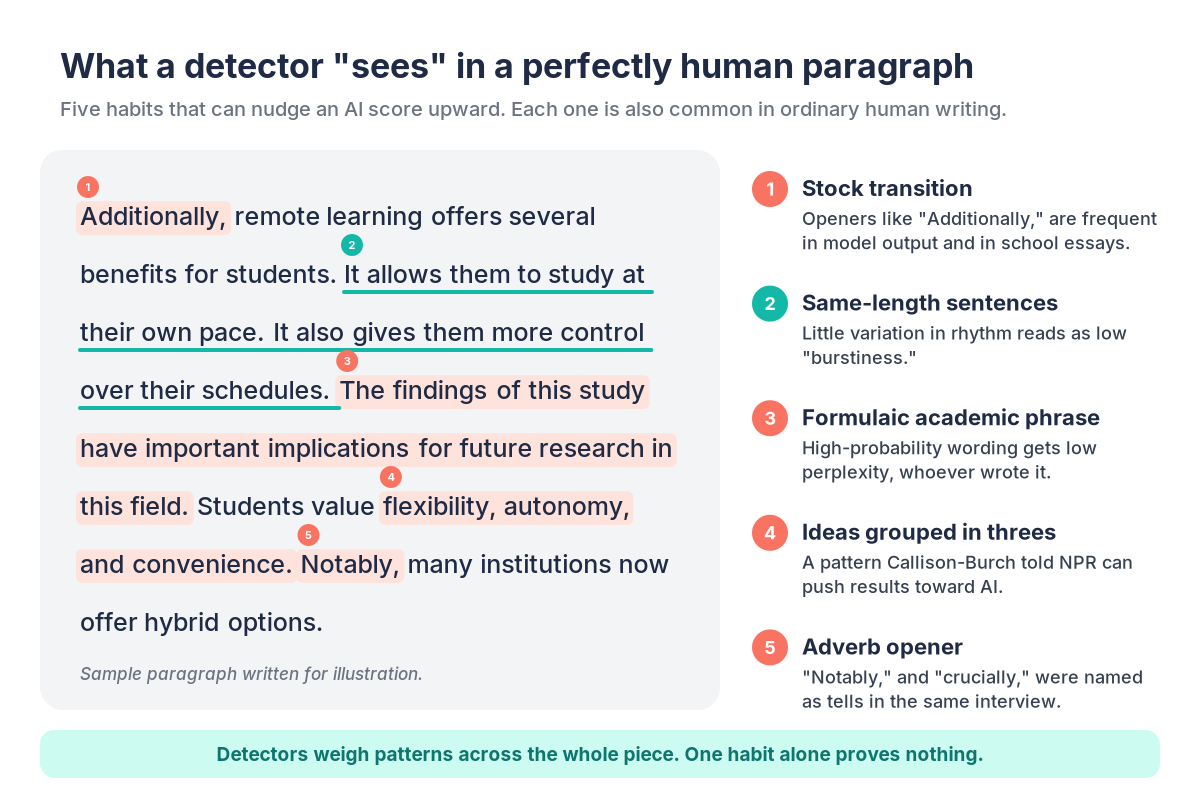
Habits flagged in NPR's interview with Chris Callison-Burch and in the Liang et al. and Angelier studies. None of them prove anything on their own.
7. You got a different tool's opinion
Detectors disagree, sometimes wildly. In a documented audit, a single human-written academic manuscript was submitted to five commercial detectors on the same day. Results ranged from "0% human" on one tool to "Human Generated" on another (Angelier, 2026). If your school's tool and a free checker disagree about your essay, that's normal, and it's worth pointing out.
How to read the score in front of you
Before you respond, figure out what the number means. Tools report very different things.
- Turnitin shows the percentage of qualifying prose it thinks is AI-generated. Scores between 1% and 19% are now hidden behind an asterisk (*%) because Turnitin found more false positives in that range (Turnitin Guides). Its own figures put the sentence-level false positive rate at about 4% (Turnitin).
- Originality.ai warns that "a result of 90% AI does not necessarily mean that AI wrote 90% of the document" (Originality.ai).
- Free checkers often won't say what model they use, what threshold they apply, or what the percentage represents.
Even the vendors say a score isn't proof. Turnitin states its detector "should not be used as the sole basis for adverse actions against a student." Originality.ai says no detector should be the sole basis for "a disciplinary, employment, publishing, or academic decision."
The bigger picture on how often this goes wrong, and who gets hit hardest, is covered in AI detector false positives explained.
What to do in the next 48 hours
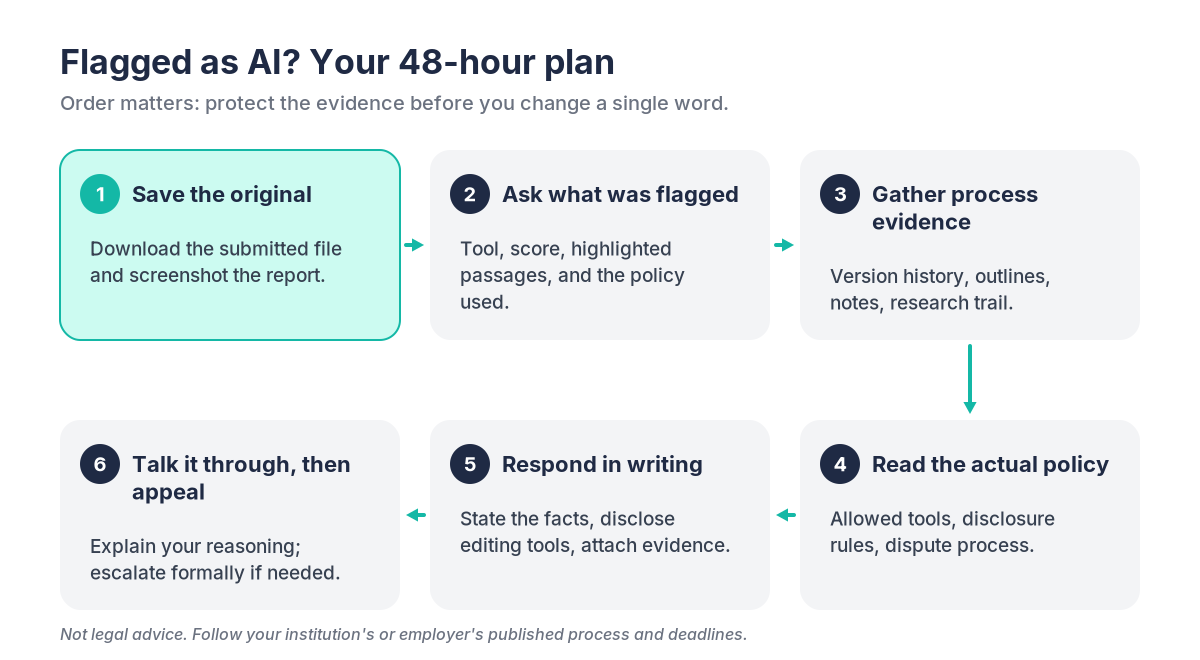
Step 1: Save the original before you touch anything
Download the exact file you submitted. Screenshot the report if you can see it. Don't "fix" the flagged paragraphs yet, because a rewritten version can look like you're hiding something.
Step 2: Ask exactly what was flagged
Reply politely and in writing. Ask which tool was used, what the score was, which passages were highlighted, and what policy applies. You can't answer an accusation you haven't seen.
Step 3: Gather your process evidence
This is what actually settles most cases. Look for:
- Version history in Google Docs (File > Version history) or Microsoft Word (via OneDrive or SharePoint).
- Earlier drafts, outlines, and handwritten notes.
- Research trails: browser history, saved PDFs, library loans, source annotations.
- Feedback you received from a tutor, writing center, or classmate, with dates.
- Older writing samples that show your usual voice.
A document that grew over several sessions, with false starts and deletions, tells a story no detector score can.
Step 4: Read the actual policy
Find your school's academic integrity policy, the course syllabus, or your client contract. Check what AI use is allowed, what must be disclosed, and how disputes are handled. Some universities explicitly bar detector scores from being the only evidence. Washington State University, for example, says it won't allow "any AI detector as the sole source of support for a case against a student" (WSU Office of the Provost).
Step 5: Respond calmly, with facts
Keep it short and specific. Something like:
"I wrote this essay myself and didn't use AI to generate any of it. I used Grammarly for spelling and comma suggestions, which the syllabus allows. I've attached my Google Docs version history, my outline from March 3, and my source notes. I'm happy to meet and walk through how I developed the argument."
Mention any editing tools honestly. Hiding a Grammarly pass and having it surface later does far more damage than disclosing it up front.
Step 6: Offer a conversation, then use the appeal process
Explaining your reasoning out loud is often the most convincing evidence of all. If that doesn't resolve it, file a formal appeal and keep every message in writing.
The record suggests appeals are worth pursuing. At WSU, 33% of academic integrity hearing board cases about alleged AI use between 2023 and 2025 ended in a finding of not responsible because the detection result was submitted without any other supporting evidence (WSU). In January 2026, a New York court annulled an Adelphi University integrity finding that had started with a Turnitin AI score of 100%, calling the violation "without valid basis and devoid of reason" (Matter of Newby v Adelphi Univ.).
How to lower the odds of a false flag next time
None of this is about gaming a detector. It's about writing in a way that's clearly yours and keeping receipts.
Draft in one place with history switched on. A single Google Doc or OneDrive file that shows your work evolving is the strongest protection there is.
Put yourself in the text. Specific examples, numbers you found, a source you argued with, a detail from your own experience. Models write in generalities. You don't have to.
Let your rhythm vary naturally. Read the draft aloud. If every sentence is about the same length, break one up. Let a short one land.
Cut the filler transitions. Stock connectors and tidy wrap-up lines add nothing a reader needs. If a paragraph still works without its first sentence, drop that sentence.
Disclose the tools you used. If grammar checkers or AI brainstorming are allowed, say so in a short note at the end. Transparency removes the guesswork.
Test with care, not obsession. Running a draft through two or three checkers can show you which passages read as generic. Treat the results as editing hints.
Using AI as a drafting assistant where it's allowed? The Zhumanizer AI Humanizer can help you smooth stiff, generic phrasing in an AI-assisted draft so it reads in your own voice, with modes for academic, professional, and SEO writing. No tool can guarantee a particular detector score, and it's no substitute for your own revision and your own ideas.
A quick note on responsible use
This article is for people who did the work and got misjudged. If your school, employer, or publisher prohibits AI-generated content, follow that rule. Where AI help is allowed, disclose it the way the policy asks. Detectors are imperfect, but integrity policies still apply, and the honest path is also the one that holds up best in an appeal.
FAQ
Why does my own writing get flagged as AI?
Detectors look for predictable word choices and uniform sentence patterns, not proof of authorship. Formal academic prose, second-language writing, short texts, translated text, and drafts polished with tools like Grammarly can all look statistically similar to AI output, even when a person wrote every word.
Can Grammarly make my writing look like AI?
It can. Originality.ai lists Grammarly, QuillBot, DeepL, and generative rewrite features among the tools that change sentence structure, vocabulary, and rhythm enough to create AI-like patterns. Basic spelling fixes are low risk. Accepting full-sentence rewrites raises the odds. Disclose any tools you used if your policy asks you to.
Is an AI detection score proof that I cheated?
No. Turnitin says its score should not be the sole basis for adverse action against a student, and Originality.ai says the same for academic, employment, and publishing decisions. A score is a signal that may justify a conversation. Evidence of your writing process carries far more weight.
What should I send if I'm falsely accused of using AI?
Send a short written reply that states you wrote the work, discloses any editing tools you used, and attaches process evidence: version history, outlines, notes, and earlier drafts. Offer to meet and explain your reasoning. If it isn't resolved, use the formal appeal process.
Should I rewrite my essay so it passes the detector?
Not before you've saved the original and responded. Rewriting a flagged piece can look like concealment and destroys the evidence you need. For future work, focus on drafting with version history on and adding specific, personal detail rather than chasing a score.
Why do different AI detectors give different results for the same text?
Each tool uses different models, training data, and thresholds, and reports a different kind of percentage. In one documented audit, five commercial detectors rated the same human-written manuscript anywhere from "0% human" to "Human Generated."