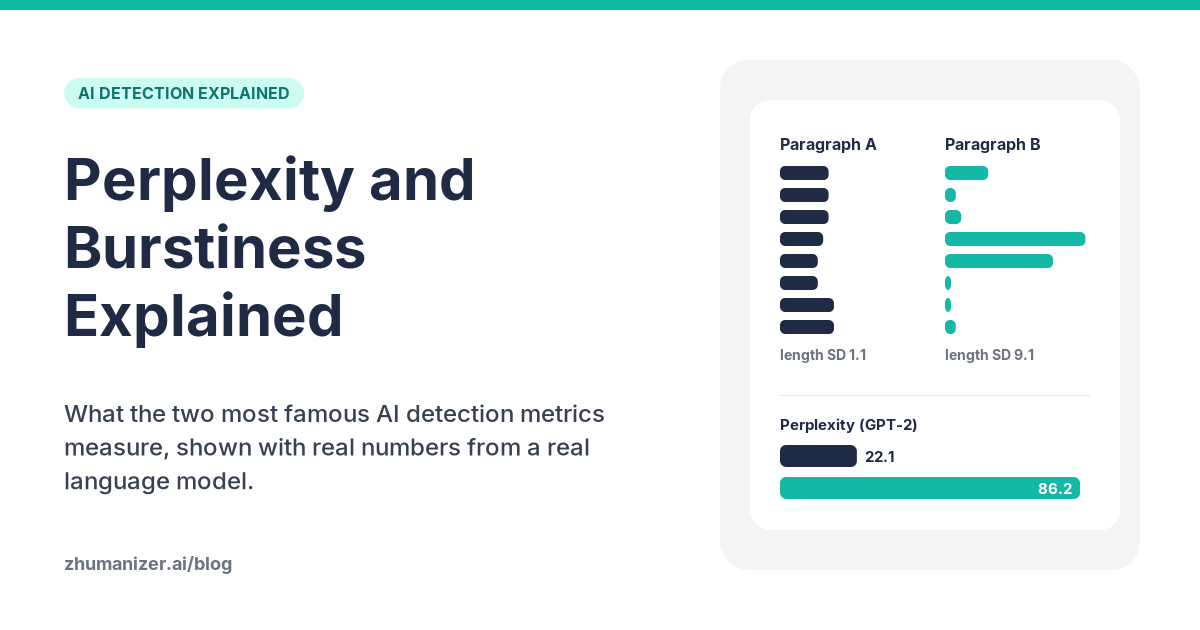
Almost every article about AI detection mentions perplexity and burstiness. Almost none of them show you an actual perplexity score.
This one does. Every number below comes from running real sentences through GPT-2, a small open-source language model that early AI detectors were commonly built on. You'll see what the metrics measure, why they once seemed like a clean way to catch machine text, and why the biggest detection companies have since moved past them.
If you want the wider picture first, the guide to how AI detectors work covers all six detection methods. This post zooms in on two of them.
Key takeaways
- Perplexity measures how predictable text is to a language model. Lower means more predictable.
- Burstiness measures variation: how much sentence length, structure, or predictability changes across a document.
- Uniform, predictable text scores low on both, which detectors once read as a sign of AI.
- Plenty of honest human writing is also uniform and predictable, which is where false positives come from.
Start with a guessing game
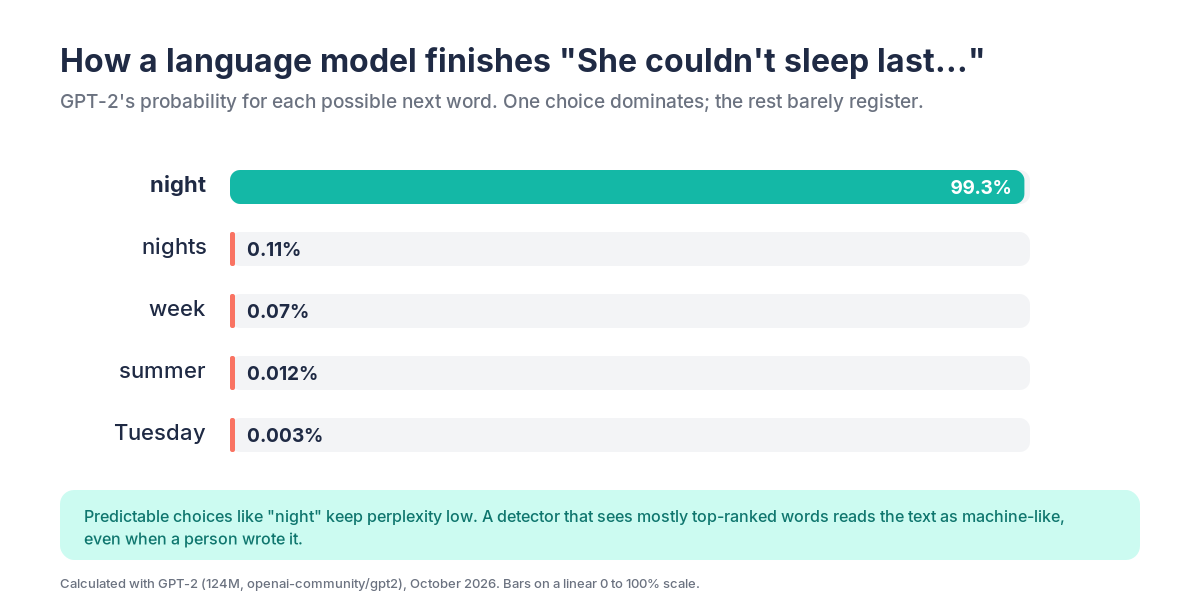
Finish this sentence: She couldn't sleep last...
You probably said "night." So does the model. GPT-2 gives "night" a 99.3% chance of being the next word. The runners-up barely register.
Now a looser prompt: It's pouring outside, so grab an...
"Umbrella" is still the top pick, but only at 22.9%. "Ice" gets 5.3%. "Apple" gets 1.7%. "Orchestra" gets less than 0.01%.
That's the raw material for perplexity. A language model doesn't know whether a word is right. It only knows how likely the word was, given everything before it.
From word odds to a perplexity score
Perplexity takes those word-by-word probabilities and rolls them into one number for a whole sentence or document. Technically it's the exponentiated average negative log-likelihood of the tokens (Hugging Face). In plain terms:
- For each word (or word piece), take the probability the model gave it.
- Measure the "surprise" of each one. Rare words carry big surprise, expected words carry almost none.
- Average the surprise across the text.
- Convert that average back into a more readable scale.
The result reads like a branching factor. A perplexity of 27 means the model was, on average, about as unsure as if it were choosing between 27 equally likely options at every step.
Here are three sentences that start the same way:
| Sentence | GPT-2 perplexity |
|---|---|
| She couldn't sleep last night. | 27.4 |
| She couldn't sleep last summer because the flat was too hot. | 59.3 |
| She couldn't sleep last pleased to meet you. | 146.7 |
The first is the obvious completion. The second is perfectly normal English with a less expected turn. The third is nonsense, and the model is confused by it.
Notice what perplexity doesn't measure: quality, truth, or who wrote it. The second sentence is more specific and more interesting than the first. It just happens to be less predictable.
What burstiness measures
Perplexity scores a passage. Burstiness asks how much the scores change inside it.
The term gets used in two closely related ways:
- Structural burstiness: variation in sentence length and shape. Short, long, fragment, long again.
- Perplexity burstiness: variation in predictability from sentence to sentence. GPTZero described burstiness as "a measure of how much the perplexity varies over the entire document," noting that language models tend to write "with a very consistent level of AI-likeness" (GPTZero Support).
Turnitin's technical paper puts it more simply: burstiness "measures the deviation from norm of statistics such as sentence length" (Turnitin).
A worked example: two paragraphs on the same topic
Paragraph A is deliberately written in a generic, chatbot-style register:
Remote work offers many benefits for employees and employers. It allows workers to save time on daily commuting. It also gives them more flexibility in their schedules. Companies can reduce costs related to office space. However, remote work also presents some challenges. Communication can become more difficult across teams. It is important to set clear expectations from the start. Overall, remote work can be successful with the right approach.
Paragraph B covers similar ground in a looser, more personal style:
Going remote saved Dana ninety minutes a day. That's it. That's the headline. But that first winter she barely spoke to anyone who wasn't a cat, and sprint planning turned into forty-minute monologues from whoever had the best microphone. The fix, eventually, was a rule nobody liked: cameras on for the first five minutes, then do whatever you want. Odd? Sure. It worked.
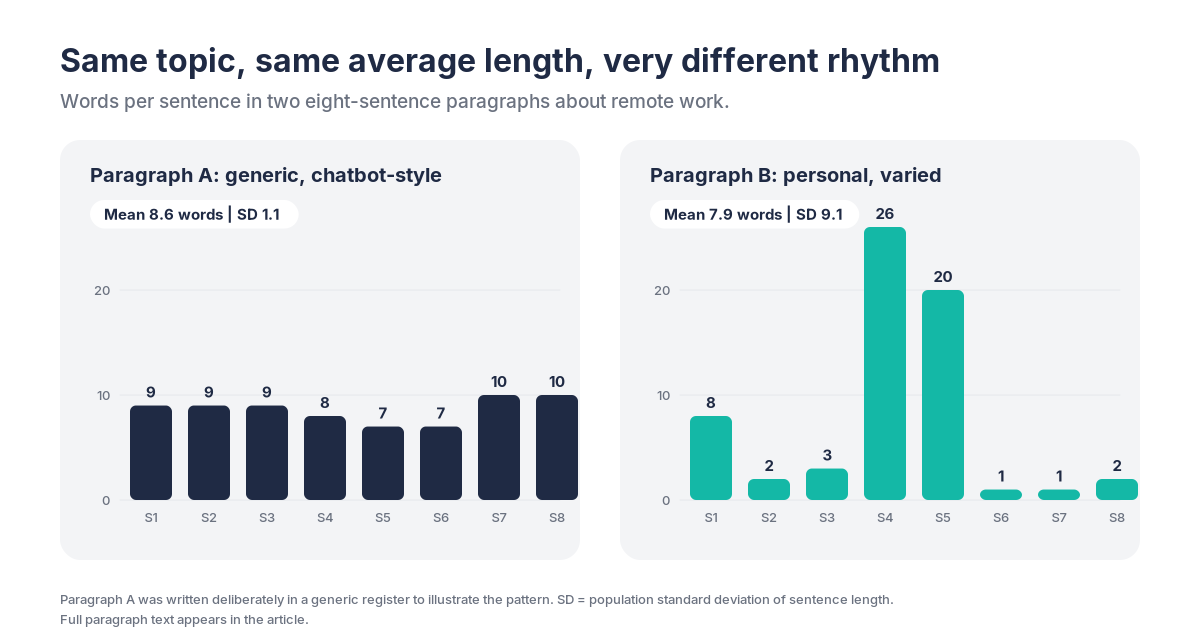
Both have eight sentences and roughly the same average length (8.6 words versus 7.9). The rhythm is where they split.
| Paragraph A (generic) | Paragraph B (personal) | |
|---|---|---|
| Sentence lengths (words) | 9, 9, 9, 8, 7, 7, 10, 10 | 8, 2, 3, 26, 20, 1, 1, 2 |
| Average sentence length | 8.6 | 7.9 |
| Standard deviation of length | 1.1 | 9.1 |
| Whole-paragraph perplexity (GPT-2) | 22.1 | 86.2 |
Paragraph A is flat. Every sentence lands within three words of the others, and the model finds the whole thing easy to predict. Paragraph B swings from one-word fragments to a 26-word sentence, and its perplexity is roughly four times higher.
That's the pattern early detectors were built to spot: low perplexity plus low burstiness looked like a machine.
Why detectors leaned on these two numbers
Language models build text one token at a time from a probability distribution. Turnitin's technical paper explains that their output tends to have "much more consistent sequential probability" than human writing on the same topic, because models "select the most probable word tokens to continue the topic, giving it a more formulaic structure." Perplexity and burstiness were the simplest way to measure that difference.
They were also cheap. A small model like GPT-2 can score an essay in seconds. Researchers at Stanford noted that most of the detectors they tested in 2023 used GPT-2 as their underlying model "due to its accessibility and reduced computational demands" (Liang et al.).
GPTZero's early versions used both metrics alongside other features of the document, and the company still explains them in its help center.
Where the metrics break
The worked example above is tidy. Real writing isn't. Here's where perplexity and burstiness give the wrong answer.
Famous text looks "too predictable"
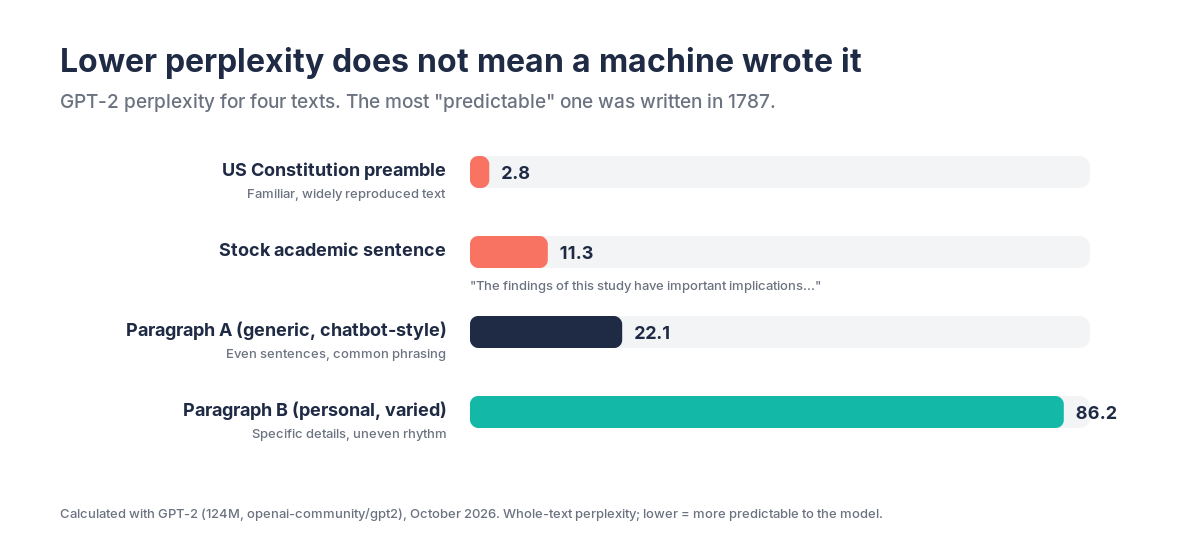
Run the preamble of the US Constitution through GPT-2 and you get a perplexity of 2.8. That's far lower than the generic remote-work paragraph. The model has seen the preamble countless times in its training data, so it can practically recite it. Gonzaga University's faculty guide notes that detectors have flagged parts of the Bible and the US Constitution as AI (Gonzaga).
Formal writing is built from stock phrases
The sentence "The findings of this study have important implications for future research." scores 11.3 on its own. Students are taught to write exactly that way. A 2026 review in AI and Ethics uses this sentence as an example of prose that "may therefore receive low perplexity from a reference model irrespective of who wrote it" (Angelier, 2026).
Second-language writers get penalized
In the Stanford study, seven detectors flagged 61.22% of real TOEFL essays as AI on average. The essays all seven detectors agreed on had significantly lower perplexity than the rest. When researchers simplified the word choices in native US eighth-grade essays, the average false positive rate jumped from 5.19% to 56.65%. When they enriched the vocabulary of the TOEFL essays, it fell to 11.77% (Liang et al.). The authors' warning was direct: practitioners "should exercise caution when using low perplexity as an indicator of AI-generated text." The false positives guide covers who else gets caught.
Short sentences are noisy
Score Paragraph B one sentence at a time and the numbers bounce wildly. "That's it." scores 23.4. "Sure." on its own scores 432.9. The opening sentence scores 1,942.3, largely because the model had no way to predict the name "Dana." A single name, number, or bit of jargon can swing a short sample. OpenAI said its own classifier was "very unreliable" on texts under 1,000 characters (OpenAI).
Generation settings change the numbers
Many AI tools have a "temperature" setting. Higher temperature makes the model pick from further down its list of likely words, which raises perplexity (Gonzaga). The same model can produce low- or high-perplexity text depending on how it's configured.
The score depends on the scoring model
Every number in this post comes from GPT-2. A larger or newer model would produce different numbers for the same text, and a detector built on one model can disagree with a detector built on another.
Do detectors still use perplexity and burstiness?
The big commercial ones mostly don't, at least not as the main signal. GPTZero's help center now states: "As of autumn 2023, GPTZero no longer uses perplexity and burstiness for its AI detection because we migrated to a deep-learning based architecture." Turnitin calls them "useful measures" but says simple statistics like these "do not capture many higher order deviations," which is why it uses transformer classifiers instead.
The metrics haven't disappeared, though. They still explain a lot of detector behavior, smaller free tools may still rely on them, and deep-learning classifiers can pick up on similar patterns without being told to. That's why understanding them is useful even if your school's detector never prints a perplexity score.
What this means for your writing
None of this is a recipe for beating a detector, and no tool can promise a particular score on every checker. But the same habits that make prose less uniform also make it better to read:
- Use the specific word. "Ninety minutes a day" beats "save time." Concrete details are less predictable because they're yours.
- Let sentence length follow the thought. A short sentence for a punchline, a longer one when the idea needs room.
- Cut stock transitions and summary lines. "Overall, X can be successful with the right approach" adds nothing a reader needs.
- Keep your drafts. If you're ever flagged, version history matters more than any score. The guide on why writing gets flagged as AI walks through what to do next.
Working from an AI-assisted draft where your rules allow it? The Zhumanizer AI Humanizer rewrites flat, uniform AI-assisted text into clearer, more natural prose, with modes for academic, professional, and SEO writing. Add your own examples and check every fact before you publish or submit.
For the other detection methods beyond these two metrics, see how AI detectors work.
A note on responsible use
Understanding perplexity helps you write more clearly and explain a false flag. It doesn't change the rules. Follow your school's, employer's, or publisher's AI policy and disclose AI assistance wherever it's required.
How these numbers were calculated
All figures were calculated in October 2026 with the 124M-parameter GPT-2 model (openai-community/gpt2) using the Hugging Face Transformers library. Next-word probabilities are the model's probability for the full word after the given prompt. Perplexity is the exponentiated average negative log-likelihood over all tokens, scored from a start-of-text token. Sentence lengths count whitespace-separated words; standard deviation is the population standard deviation. Different models, tokenizers, or settings will give different numbers.
FAQ
What is perplexity in AI detection?
Perplexity measures how predictable a piece of text is to a language model. Low perplexity means the model could easily guess each next word, which early detectors treated as a sign of AI. It doesn't measure quality or authorship, and formal or familiar human writing can also score low.
What is burstiness in writing?
Burstiness describes variation across a document: in sentence length and structure, or in how predictable each sentence is. Human writing often mixes short and long sentences and shifts in predictability. Text with very even sentences and consistent predictability has low burstiness.
What is a good perplexity score for human writing?
There isn't a universal cutoff. Perplexity depends on the model doing the scoring, the topic, the length of the text, and how formal it is. In GPT-2 tests, the US Constitution preamble scored 2.8 while a casual human-style paragraph scored 86.2, so a low number alone proves nothing.
Does GPTZero still use perplexity and burstiness?
GPTZero says that as of autumn 2023 it no longer uses perplexity and burstiness for detection, after moving to a deep-learning architecture. It still explains the concepts because they help show why detectors make the decisions they do.
Why do perplexity-based detectors flag non-native English writers?
Writers working in a second language often use a narrower range of common words and sentence patterns, which lowers perplexity. A Stanford study found detectors flagged a majority of TOEFL essays as AI, and essays flagged by every detector had significantly lower perplexity than the others.