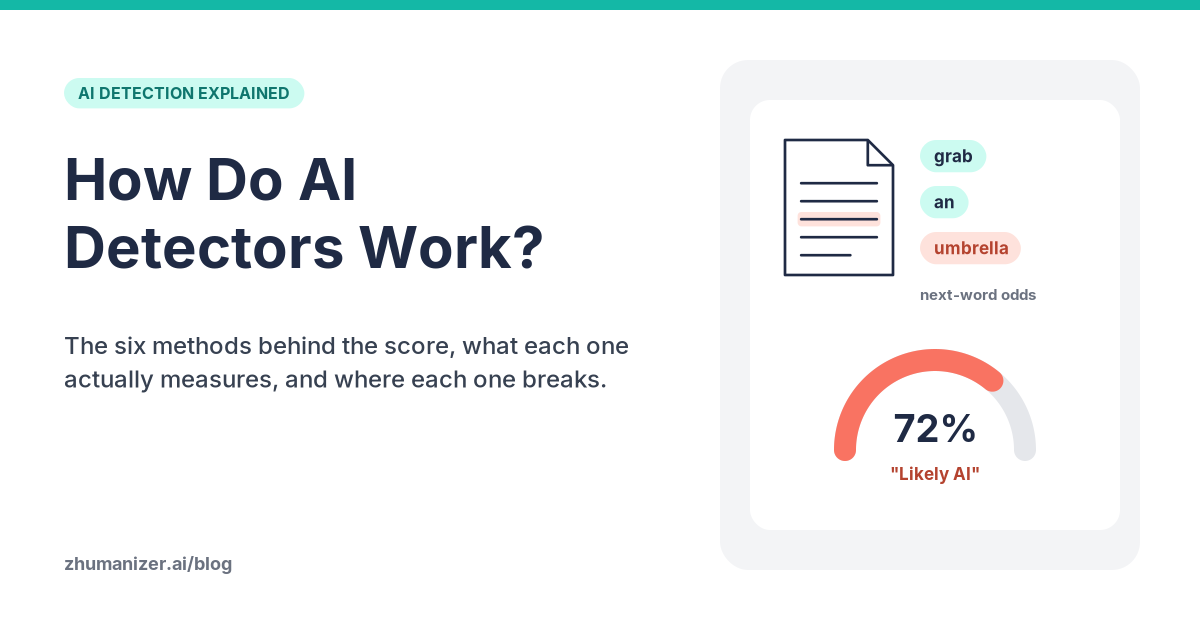
You paste 900 words into a checker. A few seconds later it says "72% AI." What happened in those few seconds?
Less magic than the interface suggests. An AI detector doesn't recognize ChatGPT's handwriting or look up your text in a secret database of chatbot replies (with one narrow exception covered below). It measures statistical properties of the words in front of it and compares them with patterns learned from examples of human and machine writing.
This guide walks through the full pipeline, then breaks down the six main detection methods in use today, what each one is good at, and where each one breaks. If you want the slower, worked-example version of the two most famous metrics, the perplexity and burstiness deep dive runs real numbers through a real model.
Key takeaways
- Most detectors score how predictable your text is to a language model, then feed that and other signals into a trained classifier.
- Commercial tools have mostly moved from simple statistics to deep-learning classifiers. GPTZero says it stopped using perplexity and burstiness for detection in autumn 2023.
- Watermarking and retrieval work differently: they look for a signal the AI provider planted or stored at generation time. They only work for participating models.
- Every method can be fooled by editing and paraphrasing, and every method can misfire on predictable human writing.
What happens when you click "check"
Different tools use different recipes, but nearly all of them follow the same basic pipeline.
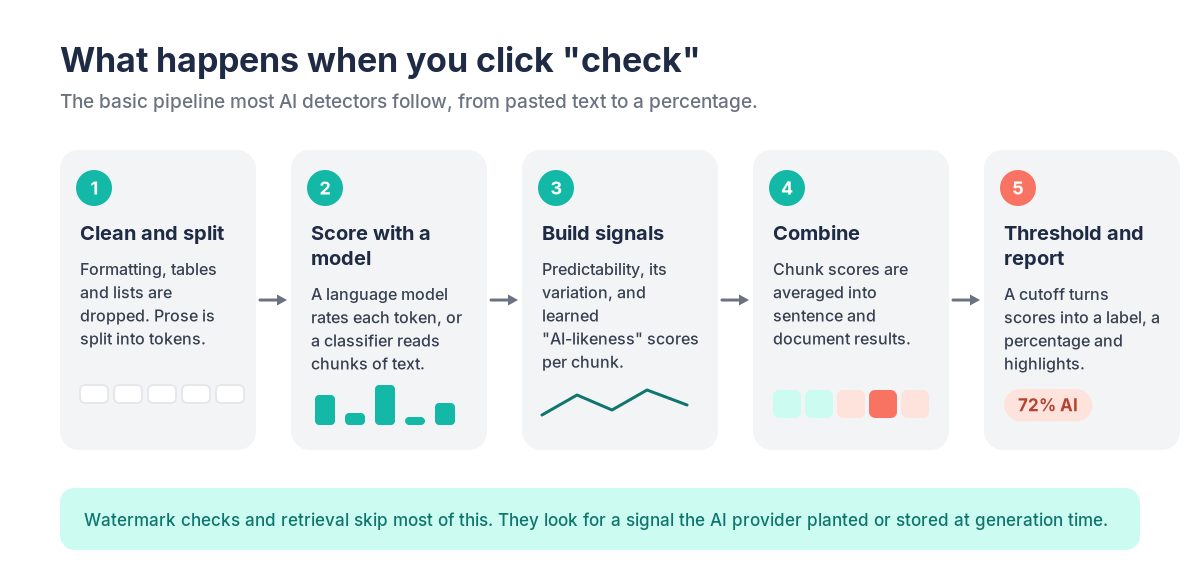
- Clean and split the text. Formatting is stripped and the prose is broken into tokens (words and word pieces). Many tools ignore tables, bullet lists, and code. Turnitin, for example, only scores "qualifying text," meaning prose sentences in long-form writing (Turnitin Guides).
- Score with a model. A language model reads the tokens and produces numbers: how likely each word was, how the text compares with learned examples, or both.
- Turn numbers into signals. These might be perplexity, its variation across sentences, or a learned "AI-likeness" score per chunk.
- Combine and aggregate. Chunk-level scores are averaged into sentence and document results.
- Apply a threshold and report. The tool converts the result into a label, a percentage, and highlighted passages.
Turnitin has published unusually specific detail about step 4. Its transformer model reads "a segment window of text that spans roughly a few hundred words (about five to ten sentences)," sliding forward one sentence at a time. Each window gets a score between 0 and 1, and each sentence's final prediction is a weighted average of the windows that contain it (Turnitin model architecture paper, hosted by the University at Buffalo).
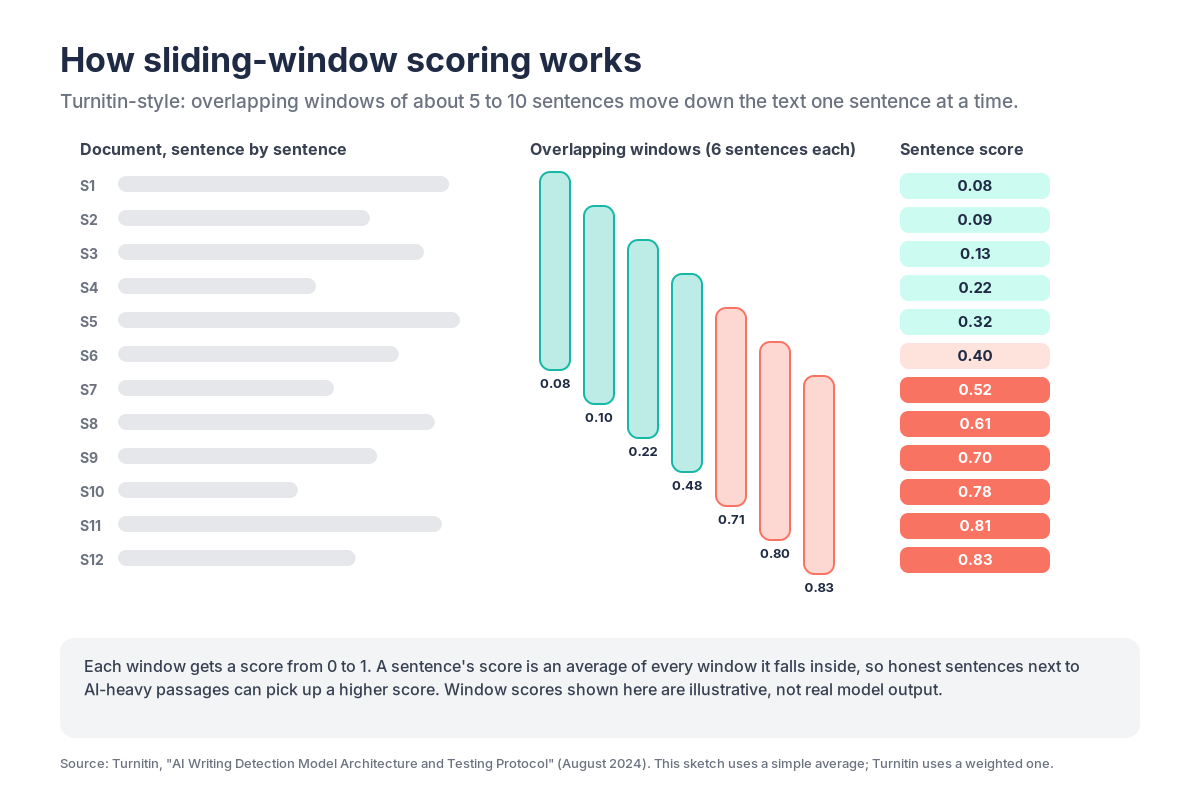
Based on Turnitin's published model architecture and testing protocol.
That design explains a few things users notice. Sentences next to genuinely AI-written passages are more likely to get highlighted, because they share windows with them. Turnitin reports that 54% of its sentence-level false positives sit right next to actual AI writing (Turnitin). It also explains why short documents are unreliable: there just aren't enough windows.
Method 1: Token probability
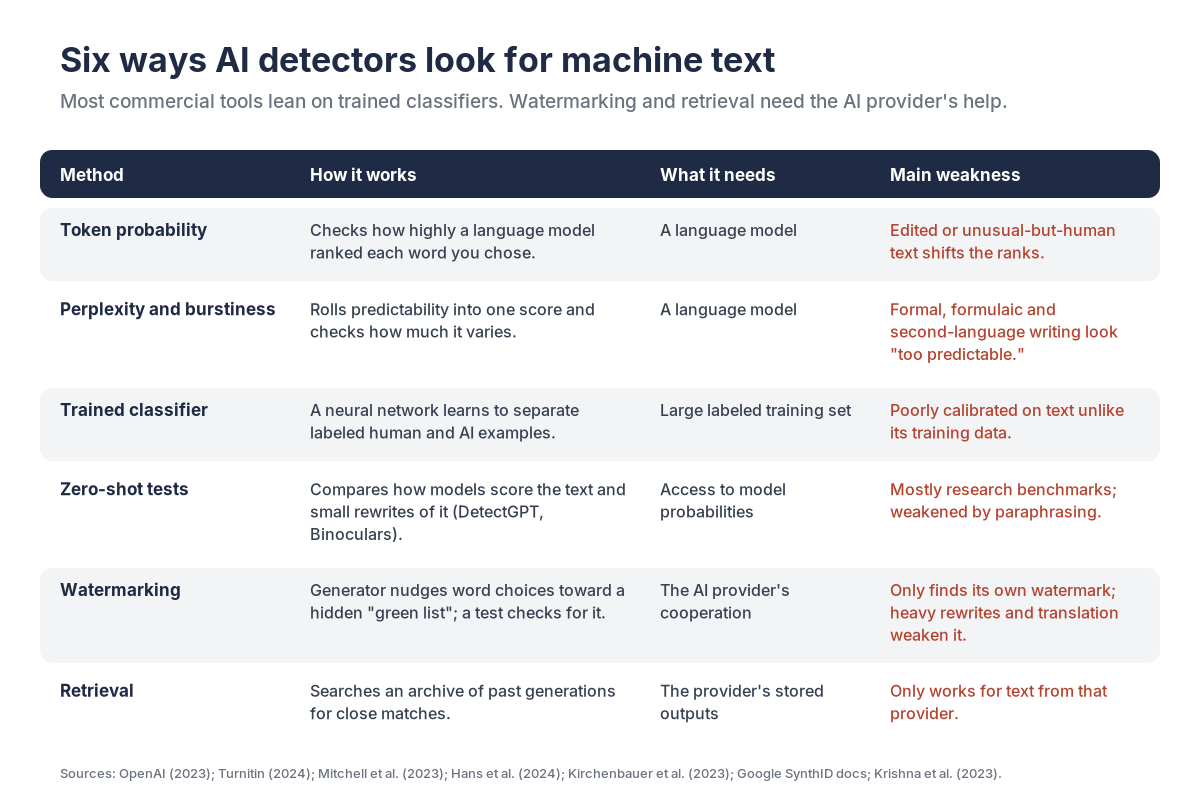
Language models write one token at a time, choosing from a ranked list of likely next words. A detector can run your text through a similar model and check, word by word, how highly ranked each of your choices was.
Here's a real example. Fed the phrase "It's pouring outside, so grab an," the open-source GPT-2 model rates umbrella as the most likely next word at about 22.9%. Apple gets about 1.7%. Orchestra gets less than 0.01%. (Calculated with the 124M-parameter GPT-2 model.)
Text that keeps choosing top-ranked words looks machine-made. Text full of lower-ranked but sensible choices looks human. The idea goes back to GLTR, a 2019 research tool that color-coded each word by how highly a model ranked it. In the authors' study, those color codes raised untrained people's detection rate for fake text from 54% to 72%.
Method 2: Perplexity and burstiness
Perplexity rolls those word-level probabilities into a single number for a passage. Formally, it's the exponentiated average negative log-likelihood of the tokens (Hugging Face). Practically, low perplexity means "this text was easy to predict."
Burstiness measures how much that predictability, or the sentence structure, varies across the document. GPTZero described it as "a measure of how much the perplexity varies over the entire document," noting that language models tend to write "with a very consistent level of AI-likeness" (GPTZero Support).
These two metrics made GPTZero famous in early 2023, and many explainers still present them as the way detectors work. That's out of date for the bigger commercial tools. GPTZero's own help center now says: "As of autumn 2023, GPTZero no longer uses perplexity and burstiness for its AI detection because we migrated to a deep-learning based architecture." Turnitin's technical paper similarly describes perplexity and burstiness as "useful measures" that "do not capture many higher order deviations," which is why it uses a transformer classifier instead.
They're still the clearest way to understand why detectors behave the way they do, and simpler free checkers may still rely on them.
Method 3: Trained classifiers
This is the workhorse of modern commercial detection. A classifier is a neural network, usually a transformer, trained on large sets of labeled human and AI text until it learns to tell them apart on its own.
- OpenAI's short-lived detector was "a language model fine-tuned on a dataset of pairs of human-written text and AI-written text on the same topic" (OpenAI).
- Turnitin runs two transformer models: AIW-2 for AI-generated writing and AIR-1 for text that has been rewritten by AI paraphrasing tools.
- Originality.ai says it pre-trained its own transformer language model on 160GB of text, using an ELECTRA-style generator and discriminator setup, then fine-tuned it on millions of labeled samples (Originality.ai).
Classifiers pick up signals nobody could list by hand: rhythm, hedging habits, transition patterns, how ideas are sequenced. Their big weakness is the training data. OpenAI warned that neural classifiers "are known to be poorly calibrated outside of their training data" and can be "extremely confident in a wrong prediction." A model trained mostly on student essays may misread legal writing, poetry, or translated text, and it needs retraining every time a new chatbot changes its style.
Method 4: Zero-shot detection
Zero-shot methods need no labeled training set. They exploit quirks in how language models score their own output.
DetectGPT compares how a model rates a passage against slightly reworded versions of it. Machine-written text tends to sit at a local peak of the model's probability, so small edits make it look less likely; human text doesn't behave that way as consistently. On fake news articles from a 20B-parameter model, DetectGPT improved detection from 0.81 to 0.95 AUROC over the best earlier zero-shot baseline (Mitchell et al., 2023).
Binoculars compares how two related language models see the same text. Its authors report detecting over 90% of ChatGPT-generated samples at a 0.01% false positive rate without training on any ChatGPT data (Hans et al., 2024).
These are research results on benchmark data. They show up more in papers than in the tools teachers actually use, but they influence how commercial products are built.
Method 5: Watermarking
Everything above is detective work after the fact. Watermarking is different: the AI provider hides a statistical signal in the text while generating it, so a matching detector can check for it later.
The classic design, from Kirchenbauer et al. (2023), works by "selecting a randomized set of 'green' tokens before a word is generated, and then softly promoting use of green tokens during sampling." Human writers hit green words only at the chance rate. Watermarked text hits them far more often, and a simple statistical test can spot it.
Google's SynthID-Text put this into production. According to Google DeepMind's paper in Nature, it has been used to watermark Gemini, and a live test across nearly 20 million Gemini responses found no drop in quality (Dathathri et al., 2024). In May 2025 Google announced a SynthID Detector portal and said over 10 billion pieces of content had already been watermarked across its AI products (Google).
The limits matter just as much:
- A watermark detector only recognizes its own watermark. It says nothing about text from models that don't use it.
- Google's documentation says SynthID Text survives light edits, but detector confidence "can be greatly reduced when an AI-generated text is thoroughly rewritten, or translated to another language," and the watermark is less effective on factual responses (Google AI for Developers).
- The absence of a watermark doesn't prove a human wrote something.
Method 6: Retrieval and text search
The narrow exception mentioned at the top. If an AI provider stores what its model generates, it can later search that archive for close matches to a suspect passage. Researchers who built this defense found it detected 80% to 97% of paraphrased generations while misclassifying only 1% of human-written text, using a database of 15 million generations (Krishna et al., 2023). The catch: it has to be run by the company that generated the text.
Some commercial tools blend a version of this idea into a larger system. GPTZero, for example, has described its upgraded model as combining several "indicators," including "text search and deep learning detection approaches" (GPTZero).
How the score turns into a percentage
Two tools can look at the same essay and print the same number while meaning completely different things.
- Turnitin reports the share of qualifying prose its model thinks is AI-generated, or AI-generated and then paraphrased. Scores from 1% to 19% now display only as an asterisk because they're less reliable (Turnitin Guides).
- Originality.ai says its current model estimates the document's makeup, so "30% Likely AI means the system estimates that roughly 30% of the text is AI-generated, not that it is only 30% confident." Earlier versions reported confidence scores instead (Originality.ai).
- Many free checkers never say which model they use, what threshold they apply, or what their percentage measures.
None of them can tell you which chatbot was used. Fresno State's guidance on Turnitin puts it simply: the tool "cannot identify which AI tool was used" (Fresno State).
Where every method breaks
Each method has its own failure modes, but two problems cut across all of them.
Editing and paraphrasing. In a 14-tool study, accuracy on AI text that had been lightly edited by a person fell to 42%, and on machine-paraphrased AI text it fell to 26% (Weber-Wulff et al., 2023). Across six major detectors, mean accuracy dropped from 39.5% to 17.4% once simple evasion techniques were applied (Perkins et al., 2024). A paraphrasing model cut DetectGPT's detection rate from 70.3% to 4.6% and also evaded watermarking, GPTZero, and OpenAI's classifier (Krishna et al., 2023). The RAID benchmark, with more than 6 million generations, concluded that detectors "are easily fooled by adversarial attacks, variations in sampling strategies, repetition penalties, and unseen generative models" (Dugan et al., ACL 2024).
Predictable human writing. Every method that relies on predictability can misfire on writers who are predictable for honest reasons: second-language writers, formulaic academic prose, short submissions, translated text. A Stanford study found seven detectors flagged 61.3% of TOEFL essays on average (Liang et al., 2023). The false positives guide covers who gets hit and why in detail.
Vendors have been improving. Several now publish strong benchmark results, and a 2025 NBER working paper found leading commercial detectors kept false positive rates at or below 1% on medium and long passages (Jabarian and Imas, 2025). But benchmark conditions rarely match the edited, mixed, real-world writing these tools are pointed at.
What to do with a detector score
Treat it as a signal to look closer, not as a verdict. Turnitin itself says its score "should not be used as the sole basis for adverse actions against a student."
- If you're a writer who got flagged, see why your writing was flagged as AI for a step-by-step response.
- If you're reviewing someone else's work, combine the score with drafts, version history, and a conversation.
- If you're publishing AI-assisted content, focus on accuracy, specifics, and original insight rather than chasing a number.
To see how AI detection differs from plagiarism checking, read AI detector vs plagiarism checker.
Drafting with AI where it's allowed? The Zhumanizer AI Humanizer helps rewrite stiff, generic AI-assisted drafts into clear, natural prose in your voice, with Academic, Professional, and SEO modes. Pair it with your own examples and fact-checking. No tool can promise a particular score on every detector.
A note on responsible use
Understanding detectors helps you write better and defend honest work. It doesn't change the rules you're working under. Follow your school's, employer's, or publisher's AI policy, and disclose AI assistance wherever it's required.
FAQ
How do AI detectors work?
Most run your text through a language model to measure how predictable each word is, then pass those signals into a trained classifier that compares your text with examples of human and AI writing. The result is aggregated into sentence and document scores and reported as a percentage. A few systems also check for watermarks or search archives of generated text.
What is perplexity in AI detection?
Perplexity measures how predictable a passage is to a language model. Low perplexity means the words were easy to predict, which detectors associate with AI. Formal or formulaic human writing can also have low perplexity, which is one reason false positives happen.
Do AI detectors still use perplexity and burstiness?
Some simpler tools do. GPTZero says it stopped using them for detection in autumn 2023 after moving to a deep-learning architecture, and Turnitin uses a transformer classifier because those metrics miss higher-order patterns. They remain useful for understanding why detectors behave as they do.
How does Turnitin detect AI writing?
Turnitin's transformer model scores overlapping windows of roughly five to ten sentences, sliding forward one sentence at a time. Sentence scores are weighted averages of those windows, and the report shows the share of qualifying prose predicted to be AI-generated or AI-paraphrased. It needs at least 300 words of prose.
Can AI detectors tell which AI tool wrote a text?
Generally no. Classifier-based detectors estimate whether text looks machine-generated, not which product produced it. Watermark detectors such as SynthID can only recognize content from models that embed their specific watermark.
Can AI detectors be fooled?
Independent research shows that editing and paraphrasing sharply reduce detection rates, and benchmarks describe detectors as easily fooled by adversarial changes. That's also why scores shouldn't be treated as proof. Follow your institution's AI policy rather than trying to beat a tool.