If you're a student, you probably want a simple answer: which tool is my school running on my essays? The most likely answer is Turnitin. But that's less useful than it sounds, because a fast-growing list of universities have Turnitin and have deliberately switched its AI detector off.
This guide covers what universities actually use, what instructors see when they do use it, which schools have walked away from AI detection and why, and how to find out what your own school does. Every institutional policy below is linked to the university's own announcement or a news report quoting it.
Key takeaways
- Turnitin is the most widely used tool because it's already built into university learning platforms for plagiarism checking. Its AI writing detection is a separate feature that schools can switch on or off.
- Some instructors use standalone tools such as GPTZero, Copyleaks, or Originality.ai, but several universities restrict or discourage that.
- Universities including Vanderbilt, Waterloo, Cape Town, Curtin, Washington State, and the University of the Free State have disabled AI detection while keeping plagiarism checking. NTU Singapore is switching off at the end of 2026.
- Even schools that still use detectors generally say a score can't be the only evidence of misconduct.
The short answer: mostly Turnitin
Turnitin dominates because universities already pay for it as a plagiarism checker, wired into learning platforms such as Canvas. According to Turnitin's own technical paper, its tools are built into learning management system workflows "across 16,000 institutions, 185 countries and used by more than 70 million students," and its AI detector had processed more than 250 million submissions as of mid-2024 (Turnitin).
That doesn't mean every Turnitin school uses the AI feature. It's licensed and configured separately:
- At CU Boulder, Turnitin's AI checker launched as a free beta in Canvas in April 2023. When the free trial ended in December 2023, continuing it "would have required additional funding." An advisory group "unanimously recommended not to support" it, and the university didn't upgrade its license (CU Boulder OIT).
- At Washington State University, the provost's office cancelled the AI detection contract in February 2026 while keeping "the Turnitin plagiarism software package" available in Canvas (WSU).
- At Fresno State, the AI feature is being piloted in 2025–26, funded through the Chancellor's Office (Fresno State).
So "my school uses Turnitin" tells you about plagiarism checking. Whether AI detection is on is a separate question.
What instructors see in a Turnitin AI report
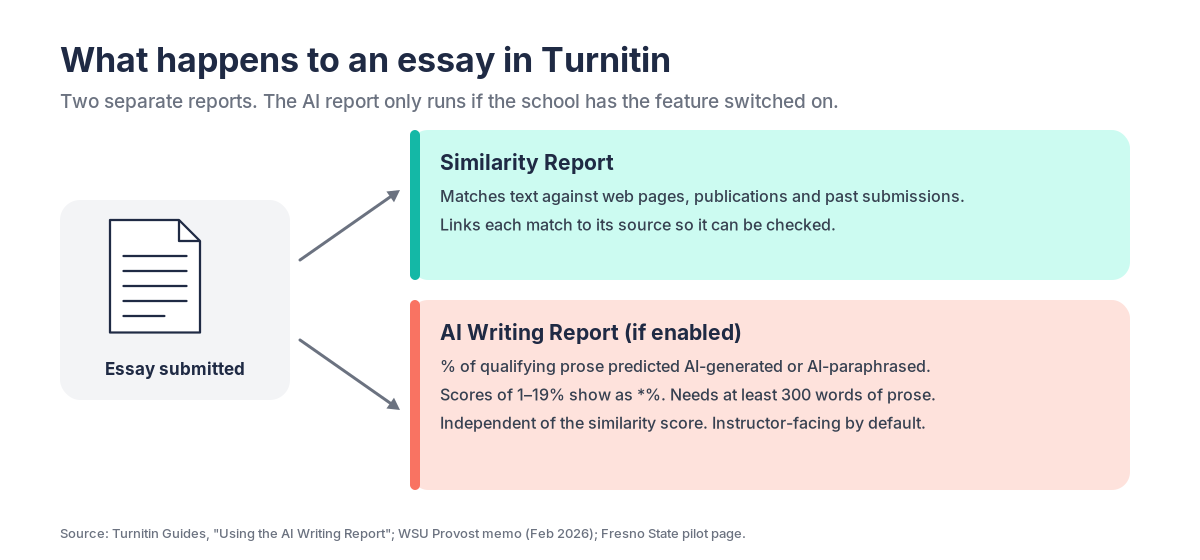
When the feature is on, Turnitin produces an AI Writing Report alongside the familiar Similarity Report. Here's what its documentation says (Turnitin Guides):
- One overall percentage. It shows how much of the "qualifying text" (prose sentences in long-form writing) the model thinks was AI-generated, or AI-generated and then run through a paraphraser or "bypasser" tool.
- Highlights. Flagged passages are highlighted in the submission.
- An asterisk for low scores. Since July 8, 2024, scores from 1% to 19% show as "*%" with no highlights, because Turnitin found a higher incidence of false positives in that range.
- Length and language limits. A file needs at least 300 words of prose and no more than 30,000 words. Supported languages are English, Spanish, Japanese, Arabic, German, Dutch, and Turkish. AI paraphrasing and bypasser detection is English-only.
- A separate number from similarity. The AI percentage is "different from and independent of the similarity score."
- A warning. The model "may not always be accurate... so it should not be used as the sole basis for adverse actions against a student."
[
By default, students often can't see the AI report. Washington State's memo listed this as one reason for cancelling: the output "is instructor facing and is not student facing," so students "are not aware of potential issues with their work prior to the detector's report to the instructor." Fresno State's pilot page likewise says the analysis "is visible to instructors only." Turnitin does let institutions share the report with students, so this varies.
For a deeper look at how the AI score is calculated, see how AI detectors work. For how it differs from the similarity score, see AI detector vs plagiarism checker.
What about GPTZero, Copyleaks, and Originality.ai?
Individual instructors sometimes paste student work into standalone detectors. The University of Minnesota names CopyLeaks, Originality.ai, and GPTZero as examples, then states that it "does not centrally support or recommend the use of any GenAI detection tool," citing reliability, bias, and student privacy (University of Minnesota).
Some universities go further and restrict that practice. UT Austin's provost office says the university "does not endorse the use of AI Detection Software" and has no central contracts for it. It classifies AI detection software as "High Risk Software" that can't be bought with a university purchasing card or personal credit card, and it raises student privacy (FERPA) and intellectual property concerns about uploading student work to third-party tools without a contract (UT Austin).
Others still use detectors with conditions attached. Singapore Management University told CNA it continues to use AI detection tools, but "never as the sole basis" for finding misconduct (CNA).
Universities that have switched AI detection off
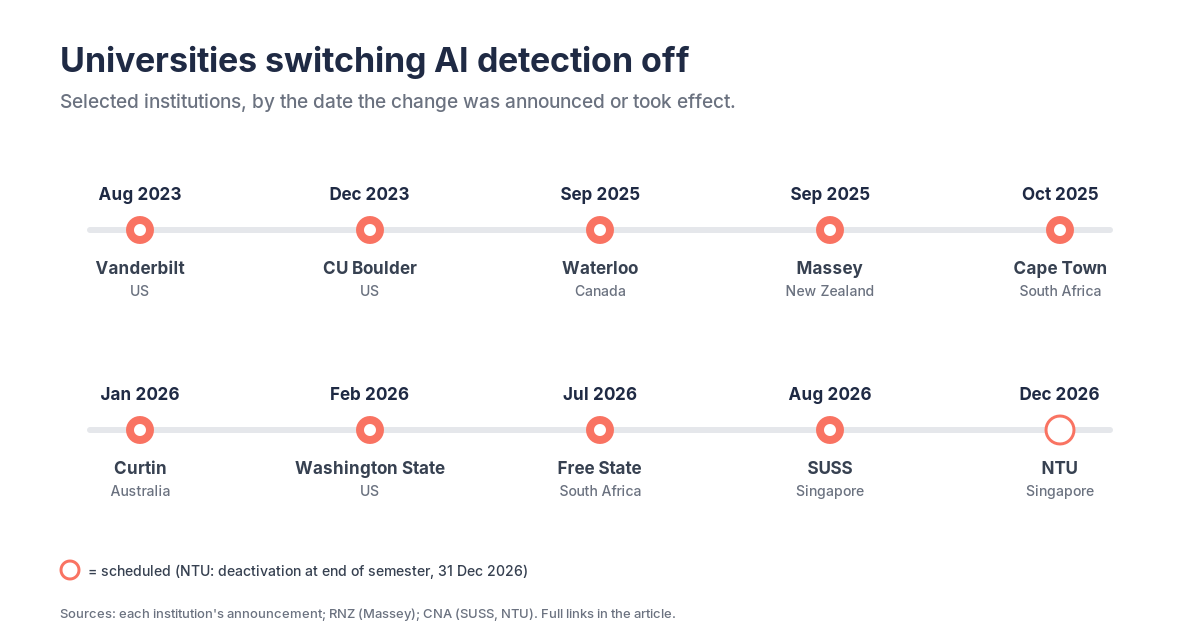
The list is long enough now to be a trend. These are institutions whose own announcements, or news reports quoting them, confirm the change.
| Institution | What changed | When | Source |
|---|---|---|---|
| Vanderbilt University (US) | Disabled Turnitin's AI detector "for the foreseeable future" | August 2023 | Vanderbilt |
| University of Colorado Boulder (US) | Didn't renew after free trial ended | December 2023 | CU Boulder OIT |
| University of Waterloo (Canada) | AI detection "no longer available" to users | September 2025 | Waterloo |
| Massey University (New Zealand) | Stopped using AI detection software; Auckland and Victoria also don't use it | Reported September 2025 | RNZ |
| University of Cape Town (South Africa) | No longer uses tools like Turnitin's AI Score | From 1 October 2025 | UCT News |
| Curtin University (Australia) | AI writing detection disabled; text matching stays | From 1 January 2026 | Curtin |
| Washington State University (US) | Cancelled Turnitin AI detection contract; plagiarism checking stays | February 2026 | WSU |
| University of the Free State (South Africa) | Discontinued AI detection; similarity checking stays | From 1 July 2026 | UFS |
| Singapore University of Social Sciences | Disabled its university-wide AI writing detector | From August 2026 | CNA |
| Nanyang Technological University (Singapore) | Will deactivate its AI detector; no AI detector from 2027 | From 31 December 2026 | CNA |
A few more for context. WSU's memo says its decision aligns it with other research universities "who have banned its use in academic integrity, including UC-Berkeley, Colorado State University, Indiana University, Michigan State University, Oregon State University, and the University of Washington." CNA reports that NUS, SUTD, and SIT in Singapore don't use automated AI detectors. Those are second-hand descriptions, so check each school's current policy directly if it matters to you.
Why universities are turning detectors off
Read the announcements side by side and the same reasons come up again and again.
False positives add up at university scale. Vanderbilt did the math on Turnitin's launch claim of a 1% false positive rate: it had submitted 75,000 papers in 2022, so "around 750 student papers could have been incorrectly labeled." Washington State ran 148,547 assessments through Turnitin in fall 2024, meaning "almost 1,485" could have been wrongly flagged even at 1%. The false positives guide goes deeper on this.
Some students are hit harder. WSU's memo notes that other studies put false positive rates higher "especially for students who are neurodivergent or have English as a second language."
A score isn't evidence. NTU's associate vice-provost wrote that these tools "lack empirical validity" and that NTU "will not rely on AI probability scores as evidence of academic misconduct." At WSU, 33% of hearing board cases involving alleged AI misuse between 2023 and 2025 ended in a finding of not responsible "because AI detection was submitted independent of any other supporting evidence."
Transparency and trust. Vanderbilt said Turnitin's AI feature was enabled "with less than 24-hour advance notice, no option at the time to disable the feature, and, most importantly, no insight into how it works."
Courts are paying attention. In a January 2026 New York decision, a student with Level 2 Autism Spectrum Disorder had received a zero on an essay after his professor relied on a Turnitin "AI-generated score of 100%." The court found the resulting academic integrity violation "without valid basis and devoid of reason" (Newby v. Adelphi University).
Schools still using AI detection, and how
Plenty of institutions still have it switched on. Fresno State's pilot is a useful example of how careful rollouts look. AI detection is "enabled by default for all courses using Turnitin," but "faculty are not required to act on the reports and are encouraged to use them as one piece of contextual information." Students are notified of the pilot through a Canvas announcement, and the page notes the tool "cannot identify which AI tool was used."
The common thread, even among schools that keep detectors, is the same caution Turnitin gives: a score can start a conversation, not end one.
What replaces detectors
Schools that drop AI detection don't stop caring about integrity. They shift the focus to process. The University of Minnesota puts it plainly: "The most effective way to determine the role Generative AI played in a student's work is to have a conversation about their process for completing the activity." The University of the Free State paired its decision with a move toward authentic assessment and responsible AI use, and Curtin and UFS both kept similarity checking for plagiarism.
For students, that means your drafts, notes, and version history matter more than ever, wherever you study.
How to find out what your school uses
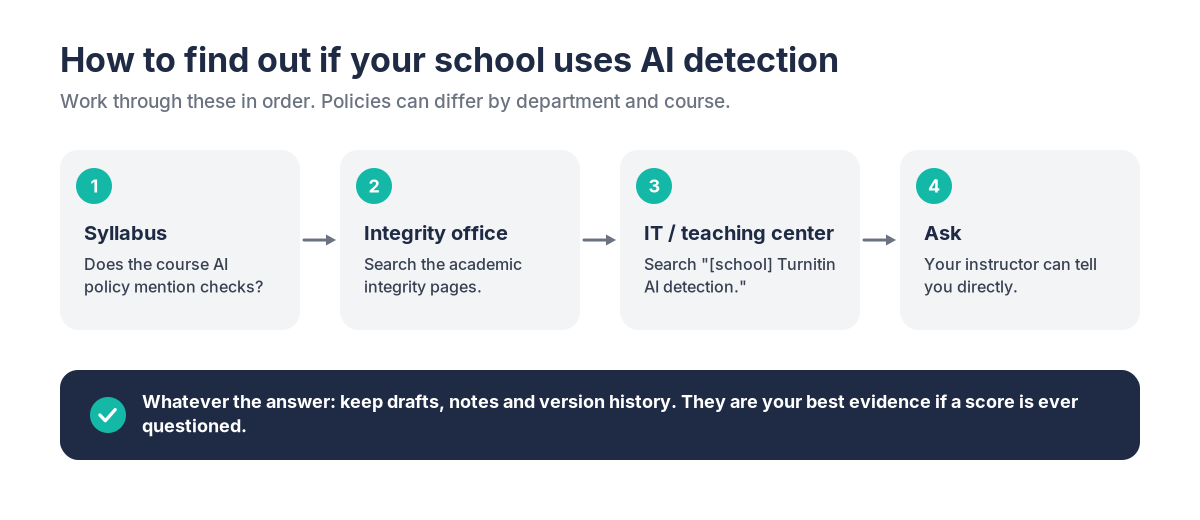
- Read the syllabus and course AI policy. Many instructors state whether AI use is allowed and whether submissions are checked.
- Search your university's academic integrity pages. Policies like the ones linked above are usually public.
- Check IT or teaching center pages about Turnitin. These often say whether the AI writing feature is enabled. Search "[your university] Turnitin AI detection."
- Ask your instructor. It's a reasonable question, and the answer can differ by department or course.
- Keep your drafts either way. If you're ever flagged, version history and notes are your strongest evidence. The guide on why writing gets flagged as AI covers what to do next.
Curious how often detectors get it wrong? Read AI detector false positives explained.
Using AI where your course allows it? The Zhumanizer AI Humanizer has an Academic mode that helps turn stiff AI-assisted drafts into clear writing in your own voice. Use it only within your instructor's rules, disclose AI help when required, and remember that no tool can guarantee a particular detector score.
A note on responsible use
Knowing which detector your school runs isn't a reason to work around it. Follow your university's and instructor's AI policy, disclose AI assistance when it's required, and ask when the rules aren't clear.
FAQ
What AI detector do most universities use?
Turnitin is the most common, because it's already integrated into university learning platforms for plagiarism checking. Its AI writing detection is a separate feature, though, and many schools that use Turnitin for plagiarism have chosen not to enable it or have switched it off.
Do all universities use AI detectors?
No. Universities including Vanderbilt, Waterloo, Cape Town, Curtin, Washington State, and the University of the Free State have disabled AI detection, and NTU Singapore plans to stop at the end of 2026. Others, such as the University of Minnesota and UT Austin, don't centrally support or endorse AI detection tools.
Can students see their Turnitin AI score?
It depends on the school's settings. Turnitin's AI report is instructor-facing by default, and some universities, including Washington State and Fresno State, have described it as visible to instructors only. Institutions can choose to make the report available to students.
Can a university punish you based only on an AI detector score?
Turnitin says its AI score shouldn't be the sole basis for adverse action, and many universities, including Washington State, don't allow a detector score as the only evidence. Policies vary, so read your school's academic integrity procedures and keep your drafts.
Do professors use GPTZero?
Some individual instructors do, along with tools like Copyleaks and Originality.ai. Several universities discourage or restrict that practice. UT Austin, for example, prohibits buying AI detection software with university or personal cards and raises privacy concerns about uploading student work without a contract.
How can you find out if your university uses AI detection?
Check your syllabus and course AI policy, search your university's academic integrity and IT pages for Turnitin AI detection, and ask your instructor directly. Policies can differ between departments and courses.