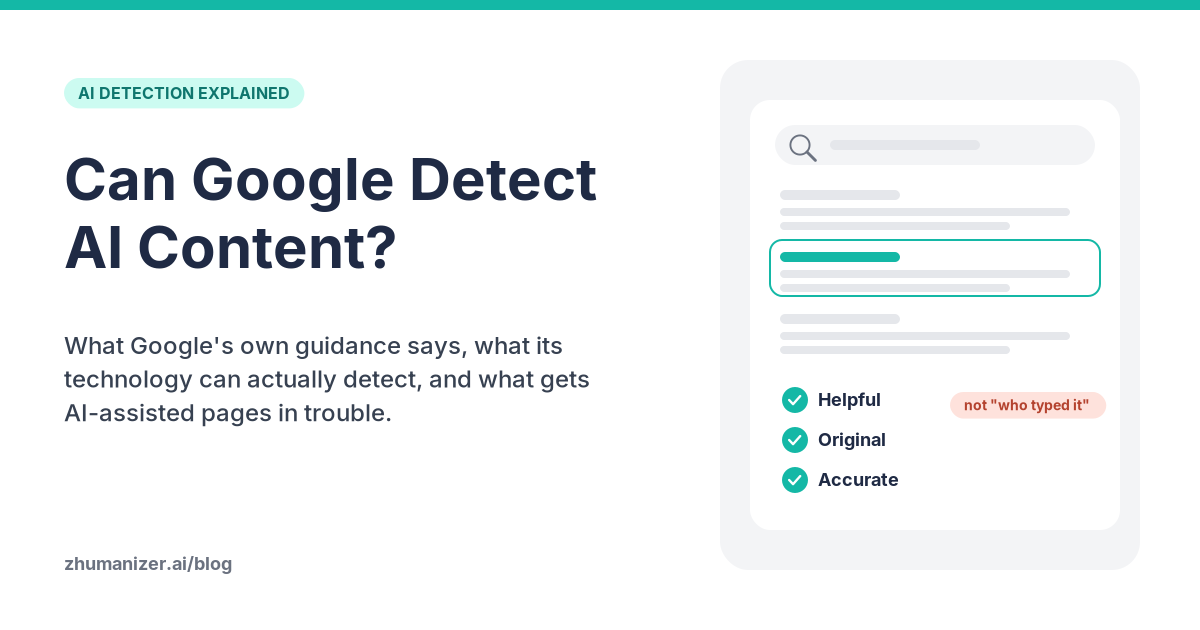
You've used AI to help draft a batch of pages. Now you're wondering whether Google can tell, and whether it will hold that against you.
The honest answer has two parts. Google has some real technical ability to recognize AI output, mainly through watermarks in its own models. But its public guidance is clear that "was this written by AI?" isn't the question its ranking systems are trying to answer. The question is whether the page is useful, original, and made for people.
This guide sticks to what Google has actually published, separates it from SEO folklore, and turns it into a practical checklist. If you want the penalty-focused version, see Zhumanizer's earlier guide on whether Google penalizes AI content.
Key takeaways
- Google says it rewards high-quality content "however it is produced," and that appropriate use of AI is not against its guidelines.
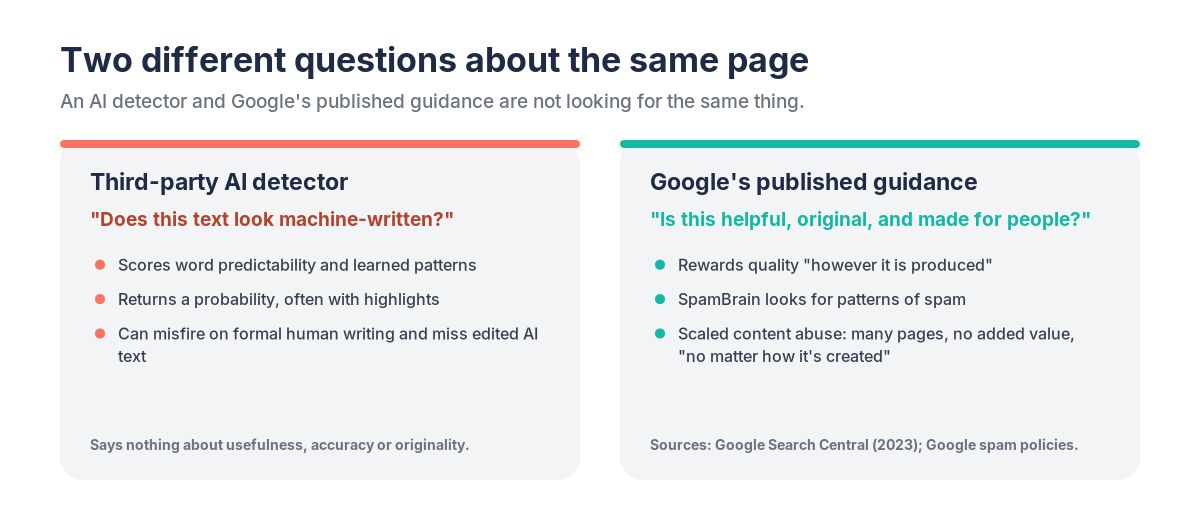
- Its spam systems, including SpamBrain, look for patterns of spam and manipulation, not authorship.
- Using AI to mass-produce pages without adding value can violate the scaled content abuse policy, which applies "no matter how it's created."
- Google can watermark and detect text from its own Gemini models with SynthID. That doesn't extend to every AI tool, and heavy rewriting weakens it.
- Running your pages through a third-party AI detector tells you very little about how Google will treat them.
The short answer
Can Google detect AI content? In some cases, at least partly. Does Google rank pages down simply because AI helped write them? Its own guidance says no.
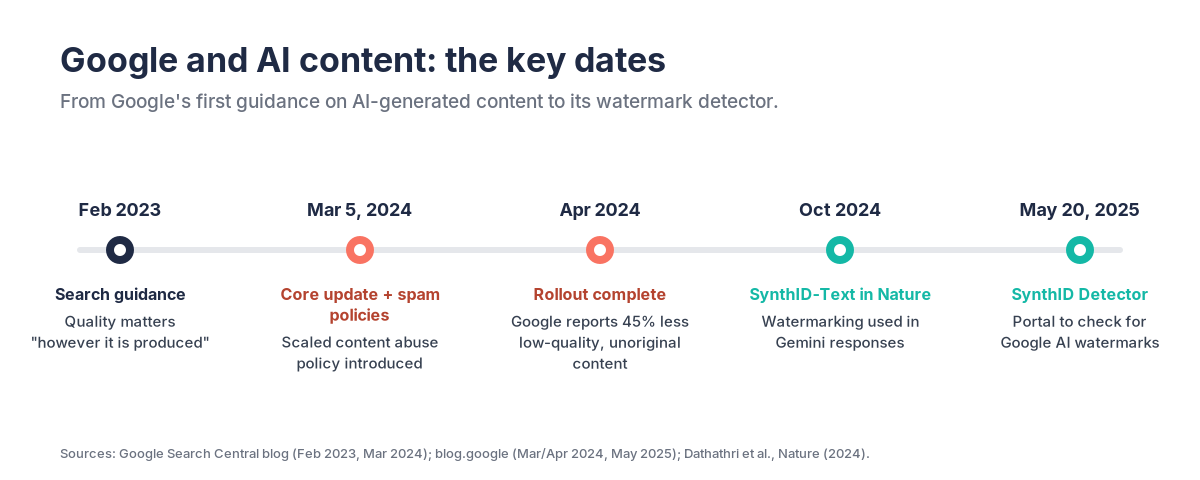
Here's how Google framed it in its February 2023 guidance on AI-generated content: "Appropriate use of AI or automation is not against our guidelines. This means that it is not used to generate content primarily to manipulate search rankings, which is against our spam policies." And, more bluntly: "Using AI doesn't give content any special gains. It's just content" (Google Search Central).
The same post explains why Google doesn't ban AI content outright: "Automation has long been used in publishing to create useful content." Think sports scores, weather updates, and transcripts.
What Google is actually looking for
Google's spam-fighting is built around behavior and outcomes. In its own words, it has "a variety of systems, including SpamBrain, that analyze patterns and signals to help us identify spam content, however it is produced."
That phrase, however it is produced, keeps coming back in Google's documentation. The clearest example is the scaled content abuse policy, introduced in March 2024. Google defines it as "when many pages are generated for the primary purpose of manipulating search rankings and not helping users," typically "creating large amounts of unoriginal content that provides little to no value to users, no matter how it's created." The first example on the list: "Using generative AI tools or other similar tools to generate many pages without adding value for users" (Google spam policies).
Notice what that policy targets. Not AI itself, but scale without value. A thousand thin pages written by underpaid humans fall under the same rule.
Google backed that policy with results. When it announced the March 2024 core update and the new spam policies, Google said it expected to cut low-quality, unoriginal content in search results by 40%. After the rollout finished, it reported "45% less low-quality, unoriginal content in search results" (Google).
Can Google technically identify AI-written text?
This is where most articles get vague. There are two very different technologies to separate.
Watermarks in Google's own AI output
Google DeepMind built SynthID, which embeds an invisible statistical watermark into content as it's generated. A paper in Nature described SynthID-Text and reported that it had been used to watermark Gemini responses, with a live experiment across nearly 20 million responses showing no drop in quality (Dathathri et al., 2024).
In May 2025, Google announced the SynthID Detector portal. It said over 10 billion pieces of content had already been watermarked, covering text, images, audio, and video from its Gemini, Imagen, Lyria, and Veo models. Upload a file and the portal scans it for a SynthID watermark, highlighting the parts most likely to carry one. Google rolled it out to early testers first, with a waitlist for journalists, media professionals, and researchers (Google).
Three limits matter for publishers:
- It recognizes SynthID watermarks. Text from a model that doesn't embed SynthID has nothing for it to find. Google has open-sourced SynthID text watermarking so other developers can adopt it, but that's opt-in.
- Editing weakens it. Google's developer documentation says SynthID Text survives cropping, a few changed words, or mild paraphrasing, but "detector confidence scores can be greatly reduced when an AI-generated text is thoroughly rewritten, or translated to another language" (Google AI for Developers).
- It works less well on facts. The same page notes watermarking "is less effective on factual responses," which describes a lot of informational web content.
Google has not said SynthID is used as a ranking signal in Search. Its published guidance on AI content focuses on quality and spam, not provenance.
Statistical AI detectors
The second technology is the kind of AI detector you can paste text into. These tools estimate whether writing looks machine-generated by analyzing predictability and learned patterns (how AI detectors work). They're known to misfire on human writing and to miss edited AI text. A 14-tool academic study found none of the tools scored above 80% accuracy (Weber-Wulff et al., 2023).
None of Google's published guidance on AI content says it runs a detector like this as part of ranking. Given how noisy these tools are on edited text, a ranking system that leaned on them would also mislabel plenty of human pages.
What actually gets AI-assisted pages in trouble
Pulling Google's documents together, the risks are specific and mostly avoidable.
Mass-producing pages without added value. This is the scaled content abuse pattern. Generating hundreds of near-identical location pages, keyword variants, or rewritten competitor articles is the textbook case.
Publishing inaccuracies. Google's guidance on generative AI content warns that "generative models don't retrieve facts, but predict a likely sequence of words," so outputs "may contain inaccuracies (also known as hallucinations)." It calls it "critical to manually factcheck and review all AI-generated content," and says that review should cover metadata too: title elements, meta descriptions, structured data, and image alt text (Google Search Central).
Thin, low-effort main content. The same guidance points to two sections of Google's Search Quality Rater Guidelines: scaled content abuse (section 4.6.5) and main content created with little to no effort, originality, or added value (section 4.6.6). Google adds that raters' assessments "don't directly influence ranking," but the sections describe what its systems are designed to reward and demote.
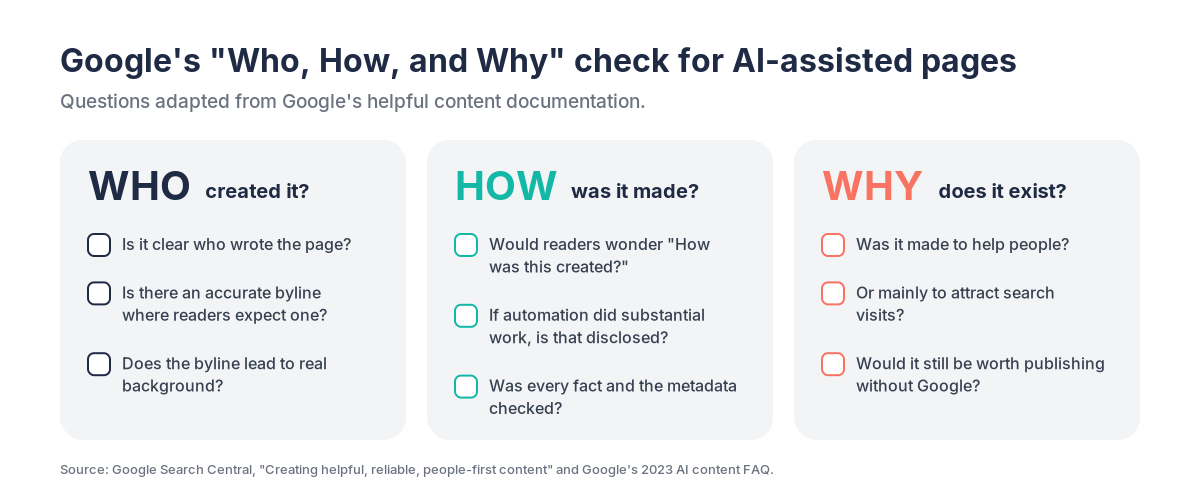
Hiding how content was made, where readers would want to know. Google's helpful content documentation suggests asking "Who, How, and Why" about every page. On the "How," it asks: "Is the use of automation, including AI-generation, self-evident to visitors through disclosures or in other ways?" (Google Search Central). Its 2023 FAQ adds that AI disclosures are useful "for content where someone might think 'How was this created?'"
Should you run your pages through an AI detector first?
You can, but don't treat the result as a Google forecast. A third-party detector asks "does this look machine-written?" Google's documentation asks whether the page is helpful, accurate, original, and made for people. A page can score 90% "AI" on a detector and still be genuinely useful. Another can score 0% and still be thin, copied, or wrong.
Detector scores also disagree with each other, and they misfire on plenty of human writing. For a broader look at what these scores mean, see AI detector false positives explained.
Time is better spent on the checklist below.
A practical checklist for AI-assisted content
- Start with a real reason for the page to exist. If it duplicates ten other pages on your site, merge or cut it.
- Add what only you have. First-hand testing, original data, screenshots, customer questions, expert quotes. Google's quality framework includes experience for a reason.
- Fact-check every claim, number, and name. Then check the metadata: title, meta description, structured data, and alt text.
- Put a real person on it. Use accurate bylines where readers would ask "Who wrote this?" Google says giving AI an author byline "is probably not the best way to follow our recommendation to make clear to readers when AI is part of the content creation process."
- Disclose automation where it's reasonably expected. A short note on how a dataset page or product comparison was produced can build trust.
- Edit for voice, not for a score. Cut generic intros, stock transitions, and padding. Read it aloud.
- Mind special rules. For ecommerce, Google Merchant Center requires AI-generated images to carry IPTC "TrainedAlgorithmicMedia" metadata and AI-generated product titles and descriptions to be labeled separately.
- Publish at a pace you can review. If nobody has time to fact-check it, it isn't ready.
Turning AI-assisted drafts into pages people want to read? The Zhumanizer AI Humanizer has an SEO mode that rewrites stiff, generic drafts into clearer, more natural copy. Use it as one editing step alongside fact-checking and your own expertise. It doesn't add value a page doesn't already have, and no tool can promise rankings.
A note on responsible use
If you write for clients, an employer, or a publication, follow their AI policies and disclosure rules, which may be stricter than Google's. Students should follow their school's AI policy; search guidelines don't override academic rules.
FAQ
Can Google detect AI-generated content?
Partly. Google can detect SynthID watermarks in content from its own AI models, though heavy rewriting or translation weakens that signal. For text from other tools, Google hasn't said it runs an AI-authorship detector in ranking. Its spam systems look for patterns of spam and low-value content, however that content is produced.
Does Google penalize AI content?
Google says appropriate use of AI is not against its guidelines and that it rewards quality content however it's produced. What it does act on is spam, including using AI or other tools to generate many pages without adding value for users, which falls under its scaled content abuse policy.
What is scaled content abuse?
It's Google's spam policy for generating many pages primarily to manipulate search rankings rather than to help users. It typically involves large amounts of unoriginal, low-value content, and it applies no matter how the content is created, whether by AI, people, or both.
Does Google use SynthID to rank websites?
Google hasn't said that it does. SynthID is a watermarking system for content generated by Google's AI models, with a separate SynthID Detector portal for checking content. Google's published Search guidance on AI content focuses on quality, accuracy, and spam policies, not on watermarks.
Should you disclose AI use on your website?
Google suggests disclosures where readers would reasonably ask "How was this created?" and recommends accurate human bylines where readers expect them. For ecommerce, Google Merchant Center has specific labeling rules for AI-generated images and product data.
Will passing an AI detector help my Google rankings?
There's no evidence for that in Google's guidance. AI detectors measure whether text looks machine-written, while Google says it focuses on helpful, original, reliable content. Improving accuracy, originality, and usefulness is a better use of time than chasing a detector score.