How Ryne AI Humanizer Performs Against 6 Major AI Detectors (2025)
TL;DR
Ryne AI Humanizer achieved a 78.8% overall success rate (52/66 tests) across six major AI detectors when tested on 11 academic samples. It completely bypassed Copyleaks and Crossplag (100%), performed strongly on GPTZero (90.9%) and ZeroGPT (81.8%), but struggled with next-generation detectors Sapling (54.5%) and Originality AI (45.5%). Five topics—autonomous vehicles, digital privacy, streaming culture, symbolism in literature, and AI content creation—passed all detectors, while social media identity and classical literature topics failed most often.
Bottom line: Ryne AI works exceptionally well against basic detectors but only moderately against advanced ones; success depends on the specific detection system and the quality of the humanized text.
Executive Summary
Ryne AI Humanizer achieved a 78.8% overall success rate (52/66 tests) across six major AI detectors when tested with 11 academic samples, but performance varies dramatically by platform: Copyleaks and Crossplag showed perfect 100% bypass rates with zero AI detection across all samples, GPTZero achieved 90.9% success (10/11), ZeroGPT reached 81.8% (9/11), while next-generation detectors Sapling (54.5%) and Originality AI (45.5%) proved significantly more challenging, successfully identifying AI content in nearly half the samples. The testing revealed that effectiveness depends critically on which specific detector your institution uses rather than general capability, with five samples (autonomous vehicles, digital privacy, streaming culture, symbolism in literature, and AI content creation topics) passing all six detectors by maintaining strong coherence and natural variation, while outputs on social media identity and classical literature renaissance consistently failed multiple detectors due to overly academic prose patterns and contemporary discussion styles that trigger advanced detection algorithms analyzing semantic coherence and perplexity distributions. For users facing Copyleaks, Crossplag, or GPTZero, Ryne AI offers near-perfect reliability requiring minimal editing, whereas those encountering Originality AI or Sapling should expect 50-50 success rates and plan for substantial manual refinement to maintain content quality and natural flow—the key differentiator being execution quality rather than topic selection, as detector-specific optimization matters more than universal humanization attempts in this evolving AI detection arms race.
What is Ryne AI Humanizer?
Ryne AI is an advanced, all-in-one platform designed to make AI-generated content appear human, helping users bypass AI detectors like Turnitin, GPTZero, and Originality.ai. It offers tools such as a text humanizer, smart study assistant (Ryne Chat), essay composer, and live note taker. Ryne supports multiple AI models (like GPT-4o, Claude, and Gemini), delivers high accuracy, and is used by students. The platform focuses on academic and professional writing, ensuring content is original, well-written, and undetectable when it comes to AI-generation. It also offers customizable settings, multilingual support, and deep plagiarism checks, making it a powerful companion for students and professionals needing undetectable, high-quality content.
Key features include:
-
Text Humanizer: Makes AI content undetectable and human-like for academic or professional use.
-
Ryne Chat: Offers homework help and academic Q&A using AI.
-
Essay Composer & Note Taker: Automates research, writing, and lecture notes.
-
Multi-model support: Generate outputs using various AI models and select the best result.
-
Academic focus: Optimized for students, with instant problem-solving and rapid note-taking.
-
Security & privacy: Advanced encryption measures to keep content confidential.
-
Flexible pricing: Free and paid plans available, with customizable and unlimited options.
Pricing of Ryne AI Humanizer
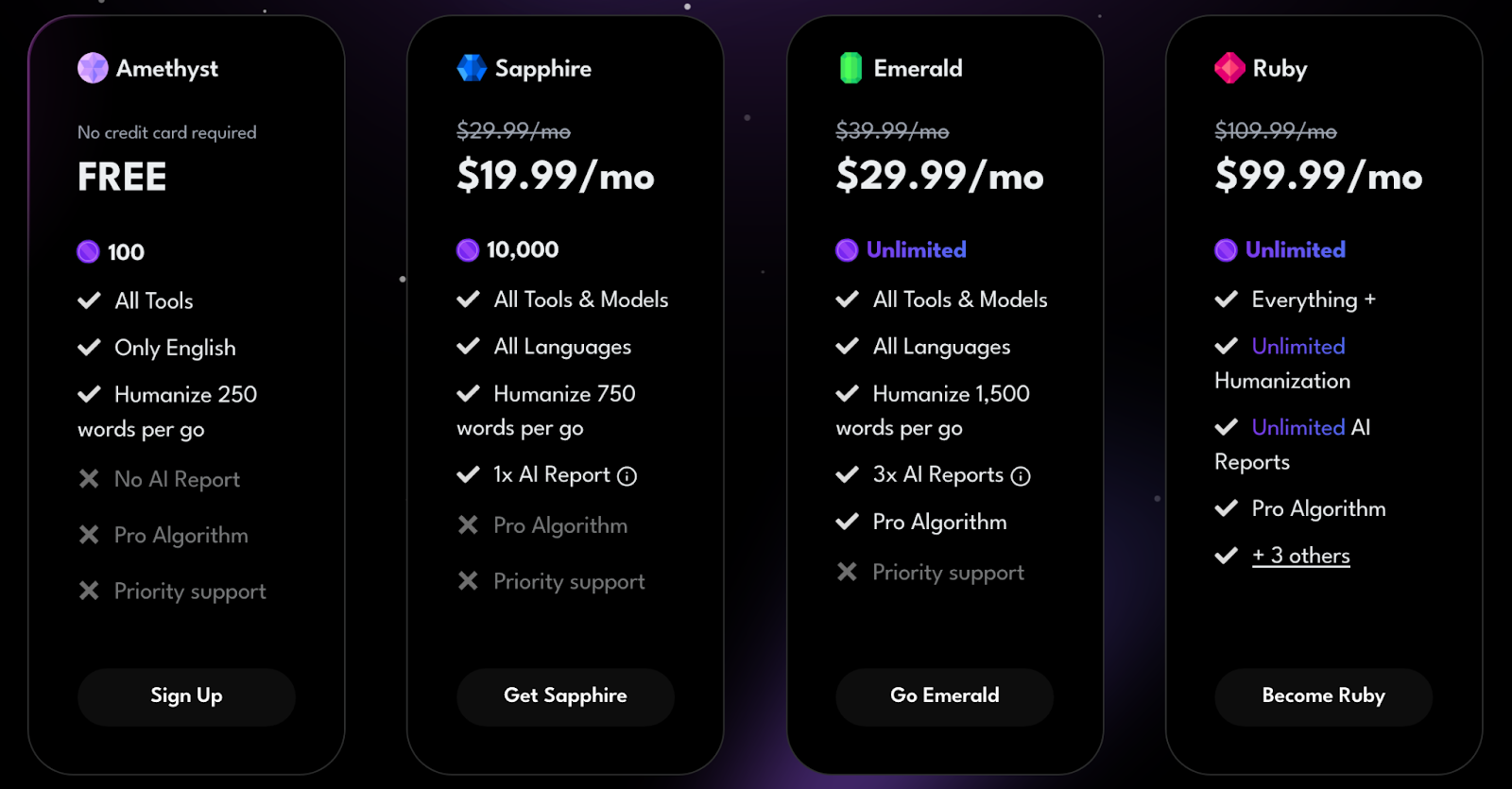
It has flexible pricing tiers as per your usage and needs.
| Plan | Monthly Price | Annual Price (Billed Yearly) | Credits/Usage | Key Features |
| Amethyst | Free | — | 100 coins | All tools, English only, 250 words per humanize request, Pro Algorithm, Priority support |
| Sapphire | $29.99 | $19.99/mo ($167.99/yr) | 10,000 coins | All tools & models, all languages, 750 words per humanize request, 1x AI Report, Pro Algorithm |
| Emerald | $39.99 | $29.99/mo ($251.99/yr) | Unlimited | All tools & models, all languages, 1,500 words per humanize request, 3x AI Reports, Pro Algorithm |
| Ruby | $109.99 | $99.99/mo ($839.99/yr) | Unlimited | Everything in Emerald + Unlimited Humanization, Unlimited AI Reports, Pro Algorithm, +3 others |
TESTING METHODOLOGY
For review of the Ryne AI humanizer, 11 prompts are selected on academic general topics. These AI-Texts are generated with generative AI models like Claude and ChatGPT.
-
Test Samples: 11 different prompts from various general topics are selected for this review.
-
Content Types Tested: The focus is mostly on academic topics testing and output of Ryne AI Humanizer.
-
Sample Length: Each AI-generated text sample consists of 100-130 words each.
-
AI Sources: All AI-generated texts are from popular generative models like,Claude, and ChatGPT.
-
Detectors Used: Following AI detectors are used for testing the humanized text:
-
ZeroGPT
-
Copyleaks
-
Originality AI
-
Sapling
-
Crossplag
-
GPTZero
-
Testing Date:This test was performed in October to November 2025
Ryne AI Humanizer Test Through AI Detectors
1.
AI Text: On Autonomous Vehicle Technology
Autonomous vehicle technology combines sensors, artificial intelligence, and sophisticated algorithms to navigate roads without human intervention. Proponents argue self-driving cars will reduce accidents caused by human error, decrease traffic congestion, and provide mobility for individuals unable to drive. Machine learning systems process data from cameras, radar, and lidar to make real-time driving decisions. Companies test autonomous vehicles extensively, accumulating millions of miles to refine safety and reliability. However, ethical dilemmas arise regarding decision-making in unavoidable accident scenarios, questioning how vehicles should prioritize different lives. Regulatory frameworks struggle to keep pace with technological advancement, creating legal ambiguity around liability and safety standards.
Humanized Output 1
The technology behind autonomous vehicles combines sensors, artificial intelligence, and other sophisticated systems to move on the roads without the involvement of humans. Supporters of self-driving cars comment that accidents will happen less due to human error. Also, it can reduce traffic jams. Plus, those who cannot drive can have mobility. Cars equipped with cameras, radar and lidar deploy machine learning systems to determine driving actions. Companies drive autonomous vehicles for millions of miles to make them safer and more reliable. There are problems in making decisions in unavoidable accidents. A question that often arises is how to choose whether to save the driver or the pedestrian. Due to the rapid advancement of technology like AI and robotics, regulations are having a tough time keeping up.
AI Detection Results For Humanized Output 1
| AI Detectors | Results |
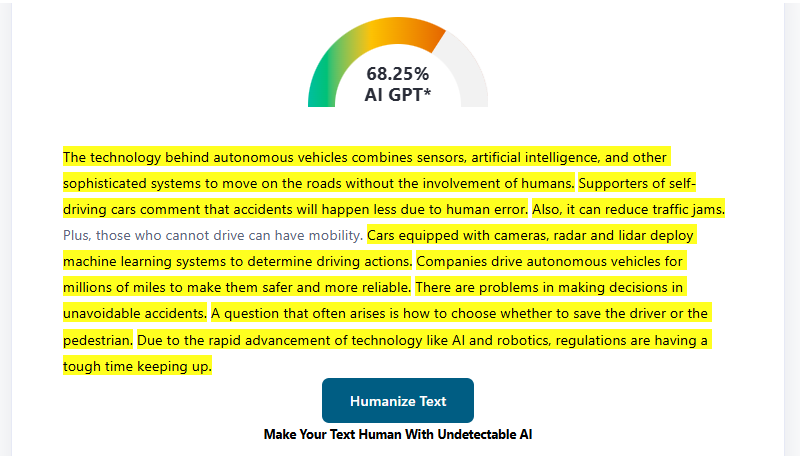
| Zerogpt | 68.25% AI |
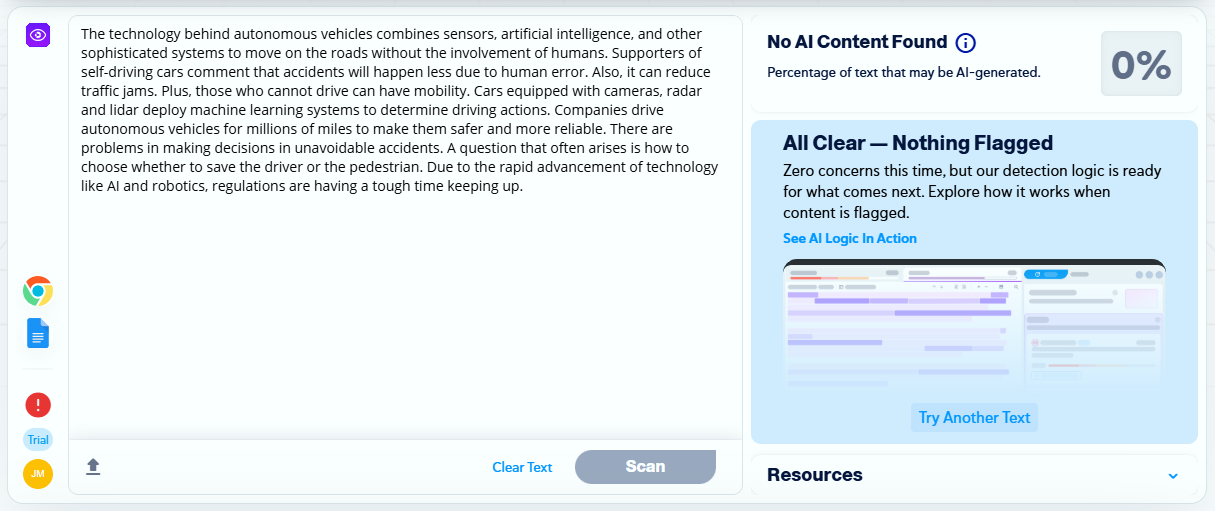
| Copyleaks | 0% AI |
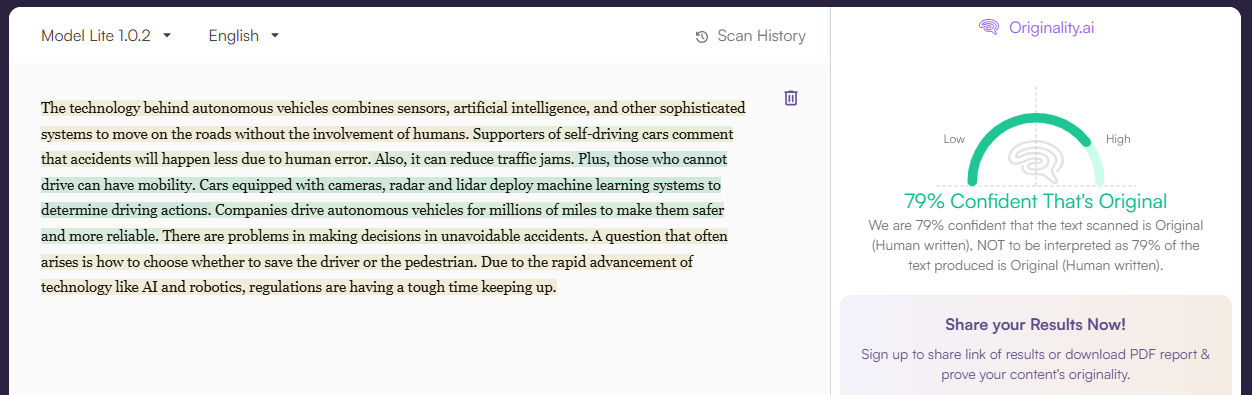
| Originality AI | 79% Humanized |
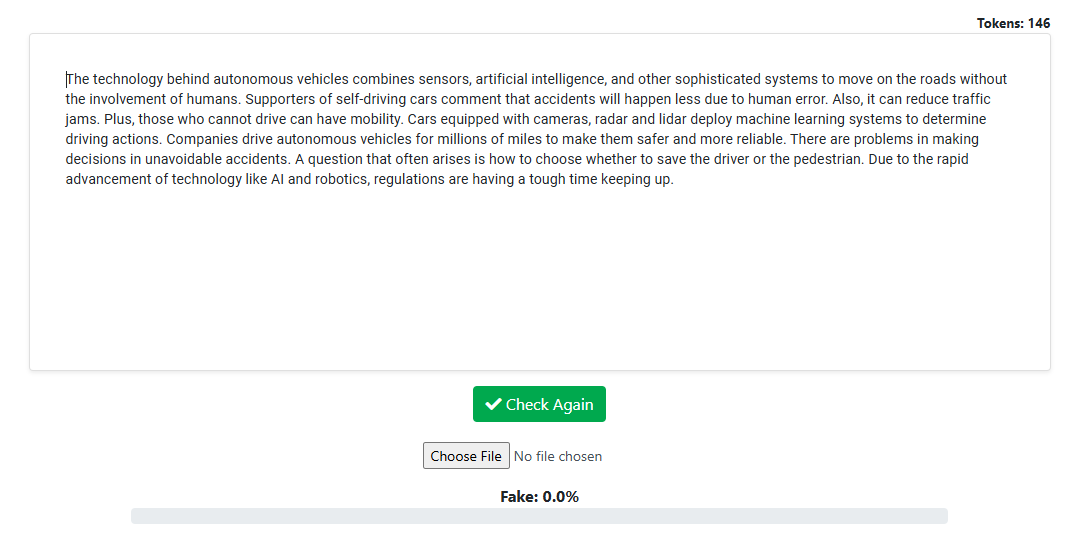
| Sapling | 0% AI |
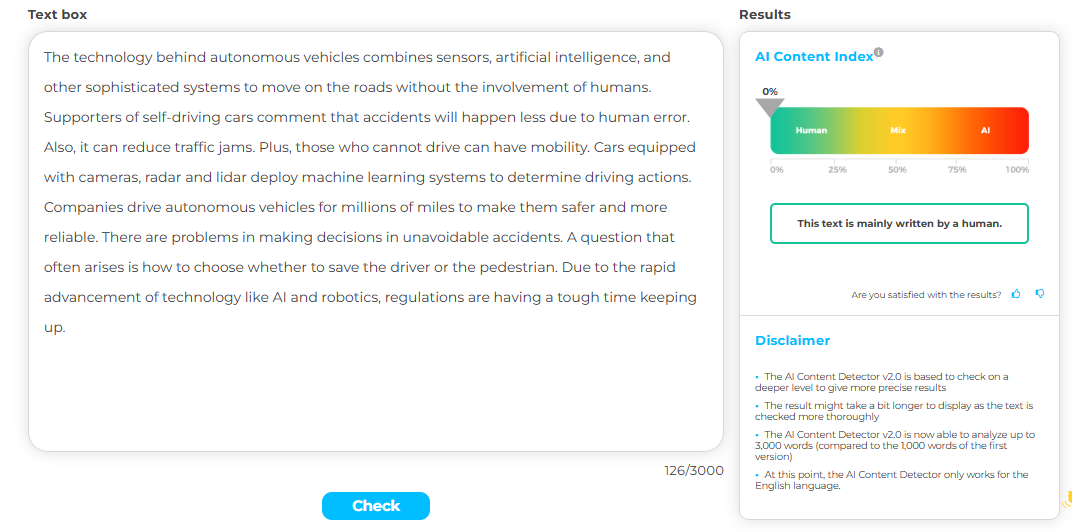
| Crossplag | 0% AI |
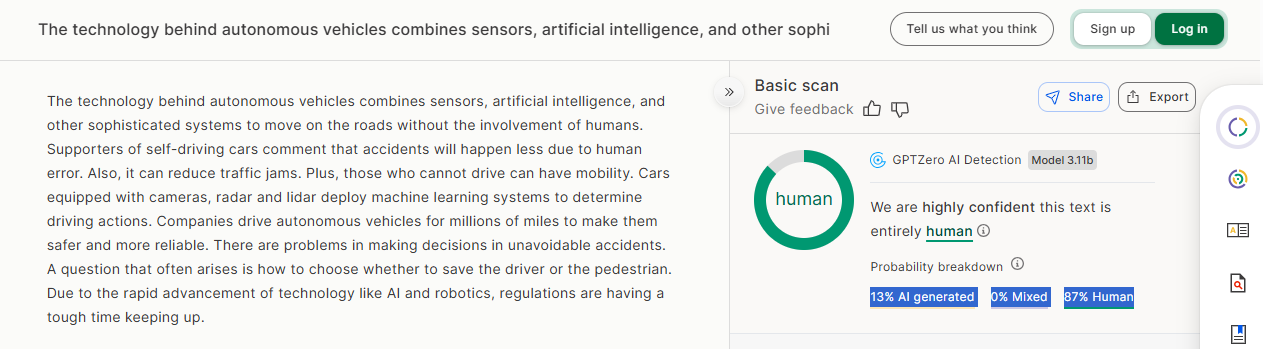
| GPTZero | 13% AI generated, 87% Human |
ZeroGPT AI Detection Result
Copyleaks AI Detection Result
Originality AI Detection Result
Sapling AI Detection Result
Crossplag AI Detection Result
GPTZero AI Detection Result
2.
AI Text: On Digital Privacy Challenges
Digital privacy faces unprecedented challenges as technology companies, governments, and malicious actors collect vast quantities of personal data. Online activities generate digital footprints revealing preferences, relationships, locations, and behaviors that enable detailed profiling. Surveillance capitalism business models monetize personal information through targeted advertising and data brokerage. Social media platforms aggregate intimate details about users' lives, raising consent and ownership questions. Encryption technologies protect communications from unauthorized access but face government pressure for backdoors enabling law enforcement access. The balance between security, privacy, and public safety creates ongoing policy debates. Data breaches expose millions of individuals to identity theft and financial fraud despite security investments. Facial recognition technology enables mass surveillance capabilities threatening anonymity in public spaces. Privacy regulations like GDPR attempt to establish individual rights and corporate responsibilities, though enforcement remains challenging.
Humanized Output 2
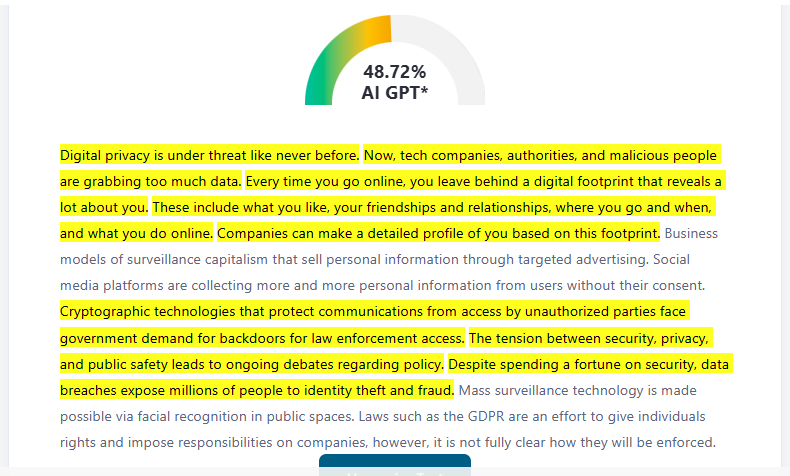
Digital privacy is under threat like never before. Now, tech companies, authorities, and malicious people are grabbing too much data. Every time you go online, you leave behind a digital footprint that reveals a lot about you. These include what you like, your friendships and relationships, where you go and when, and what you do online. Companies can make a detailed profile of you based on this footprint. Business models of surveillance capitalism that sell personal information through targeted advertising. Social media platforms are collecting more and more personal information from users without their consent. Cryptographic technologies that protect communications from access by unauthorized parties face government demand for backdoors for law enforcement access. The tension between security, privacy, and public safety leads to ongoing debates regarding policy. Despite spending a fortune on security, data breaches expose millions of people to identity theft and fraud. Mass surveillance technology is made possible via facial recognition in public spaces. Laws such as the GDPR are an effort to give individuals rights and impose responsibilities on companies, however, it is not fully clear how they will be enforced.
AI Detection Results For Humanized Output 2
| AI Detectors | Results |
| Zerogpt | 48.72% AI |
| Copyleaks | 0% AI |
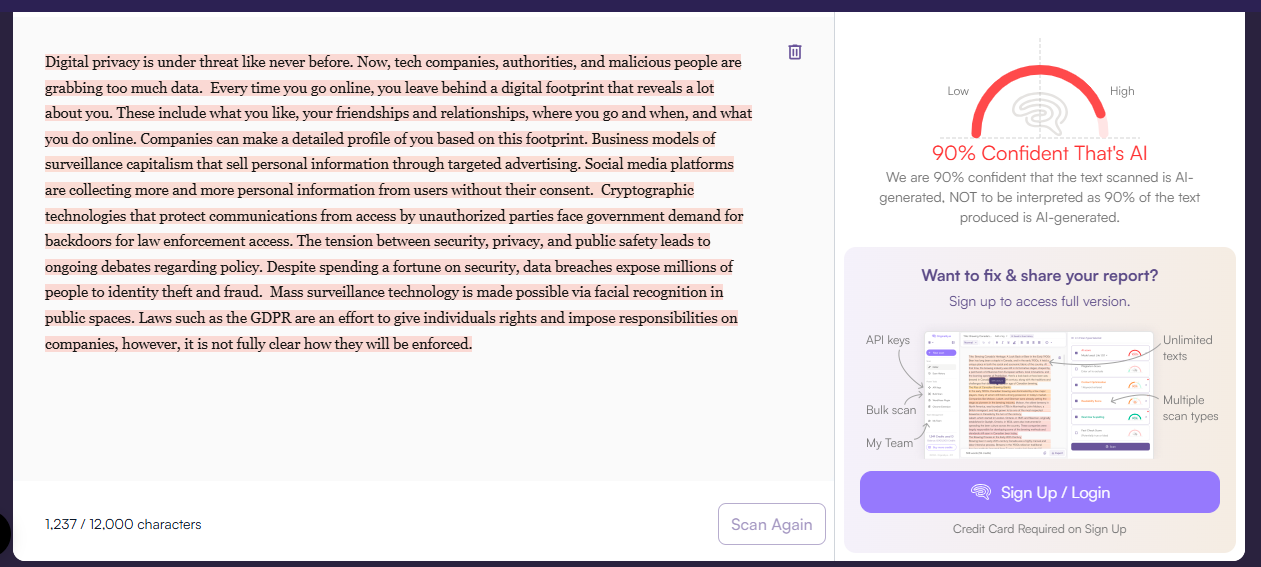
| Originality AI | 90% AI |
| Sapling | 0.2% AI |
| Crossplag | 0% AI |
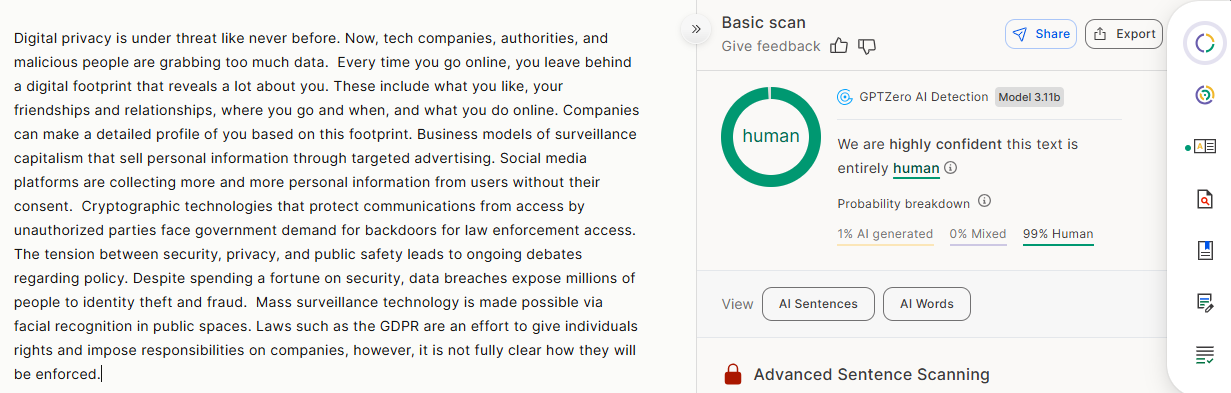
| GPTZero | 1% AI generated |
ZeroGPT AI Detection Result
Copyleaks AI Detection Result

Originality AI Detection Result
Sapling AI Detection Result

Crossplag AI Detection Result

GPTZero AI Detection Result
3.
AI Text: On The Nature of Consciousness
Consciousness represents perhaps philosophy's most perplexing phenomenon, describing subjective first-person experience that accompanies awareness. The "hard problem" questions why physical processes produce qualitative experiences rather than operating unconsciously. Materialist perspectives assert consciousness emerges from complex brain activity, though explaining the emergence mechanism remains elusive. Dualist approaches suggest consciousness exists independently of physical substrate, invoking non-physical explanations. Panpsychism proposes consciousness as a fundamental property of matter, existing at all levels from particles to complex organisms. Integrated Information Theory attempts to quantify consciousness mathematically through system integration measures. Functionalists define consciousness by informational relationships rather than physical implementation, allowing artificial consciousness possibilities.
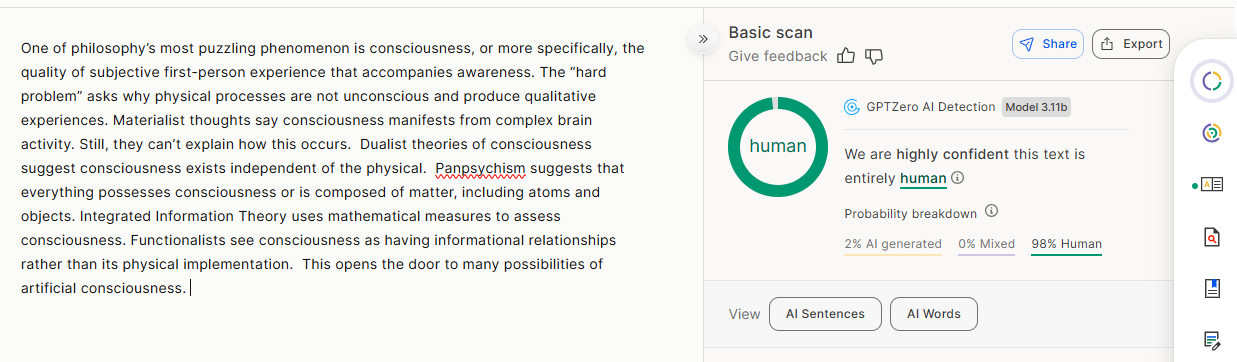
Humanized Output 3:
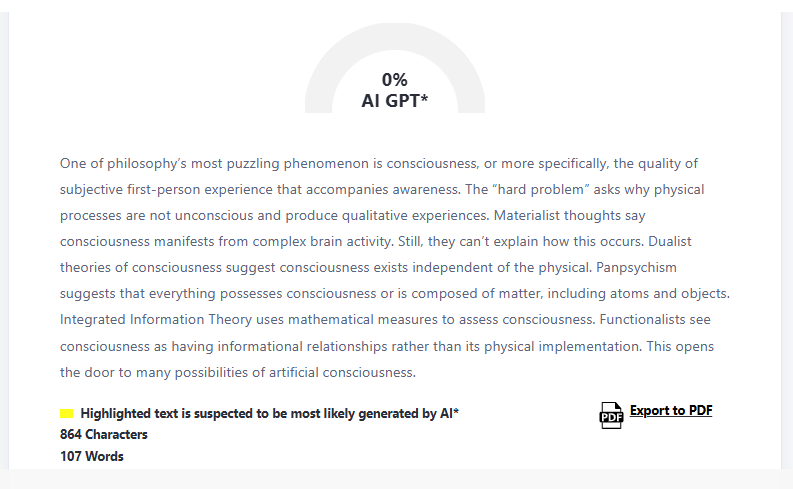
One of philosophy’s most puzzling phenomenon is consciousness, or more specifically, the quality of subjective first-person experience that accompanies awareness. The “hard problem” asks why physical processes are not unconscious and produce qualitative experiences. Materialist thoughts say consciousness manifests from complex brain activity. Still, they can’t explain how this occurs. Dualist theories of consciousness suggest consciousness exists independent of the physical. Panpsychism suggests that everything possesses consciousness or is composed of matter, including atoms and objects. Integrated Information Theory uses mathematical measures to assess consciousness. Functionalists see consciousness as having informational relationships rather than its physical implementation. This opens the door to many possibilities of artificial consciousness.
AI Detection Results For Humanized Output 3
| AI Detector | Results |
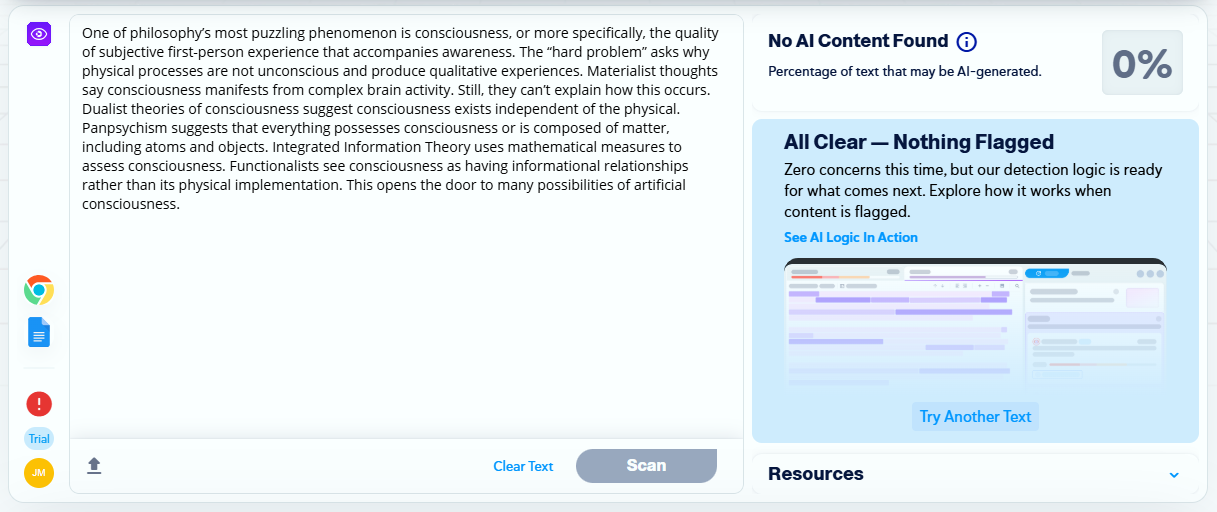
| Zerogpt | 0% AI |
| Copyleaks | 0% AI |
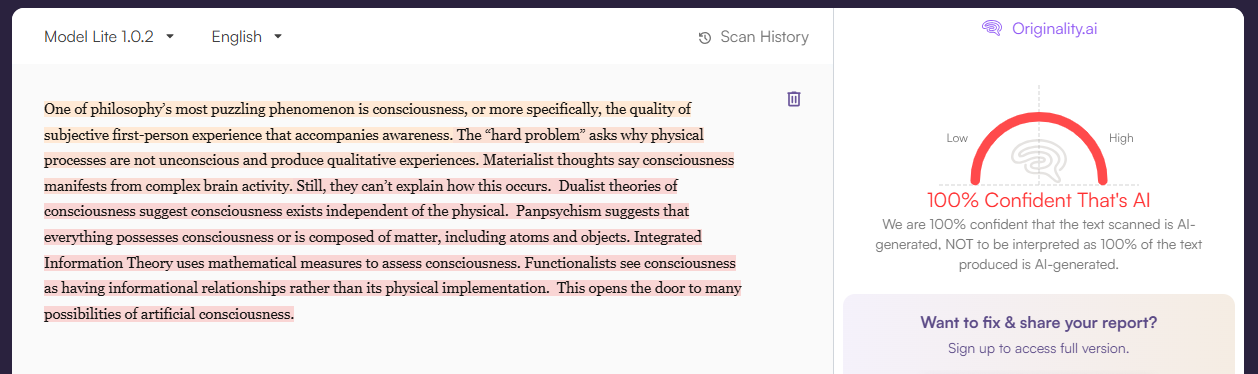
| Originality AI | 100% AI |
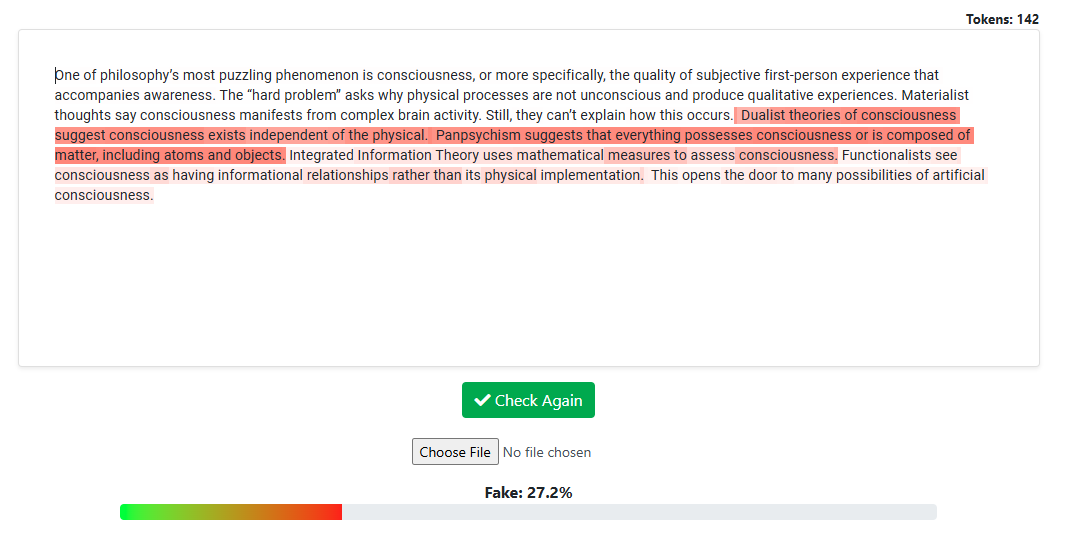
| Sapling | 27.2% AI |
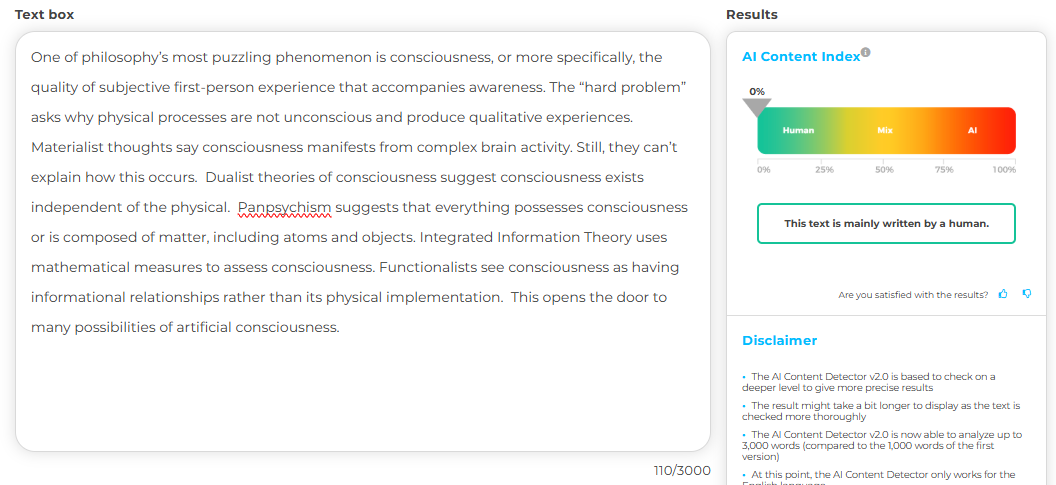
| Crossplag | 0% AI |
| GPTZero | 2% AI generated |
ZeroGPT AI Detection Result
Copyleaks AI Detection Result
Originality AI Detection Result
Sapling AI Detection Result
Crossplag AI Detection Result
GPTZero AI Detection Result
4.
AI Text: On The Evolution of Streaming Culture
Streaming platforms have fundamentally transformed how we consume entertainment. What began as a convenient alternative to traditional cable has evolved into a dominant force shaping cultural narratives. These services produce original content that rivals theatrical releases, influencing award show conversations and public discourse. The accessibility of endless content has created both unprecedented opportunities for diverse storytelling and concerns about viewer attention spans. Binge-watching has become a cultural phenomenon, changing how stories are structured and consumed. From reality shows to prestige dramas, streaming services have democratized content creation while simultaneously concentrating massive creative power in corporate hands. This shift has implications for both popular entertainment and the broader landscape of artistic expression.
Humanized Output 4:
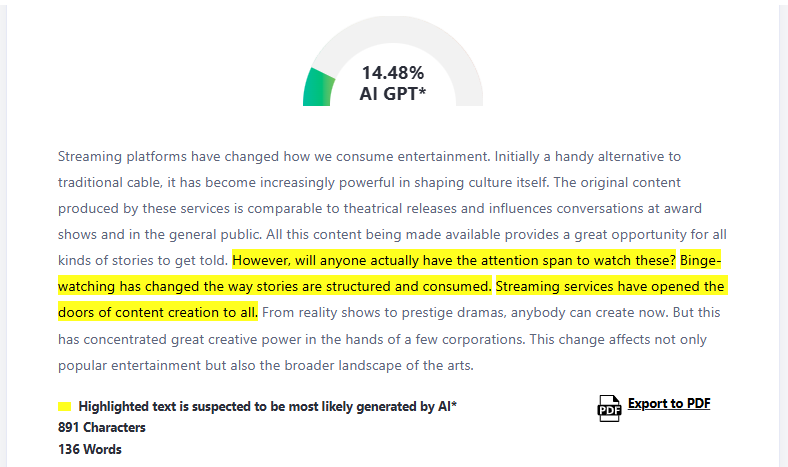
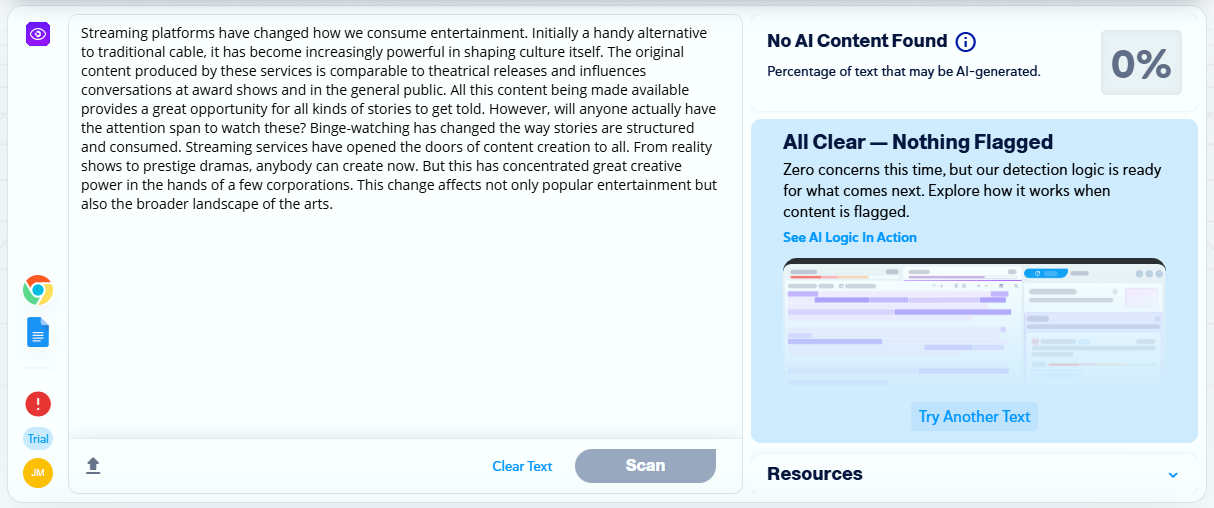
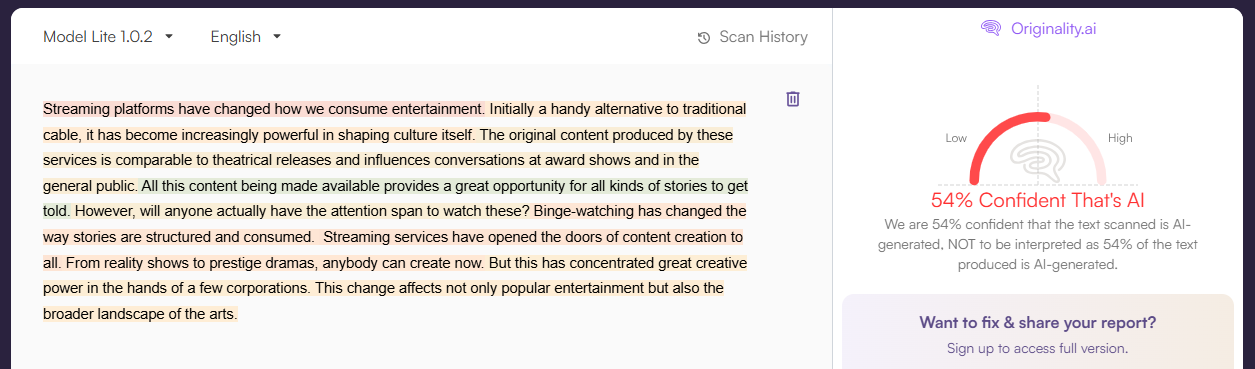
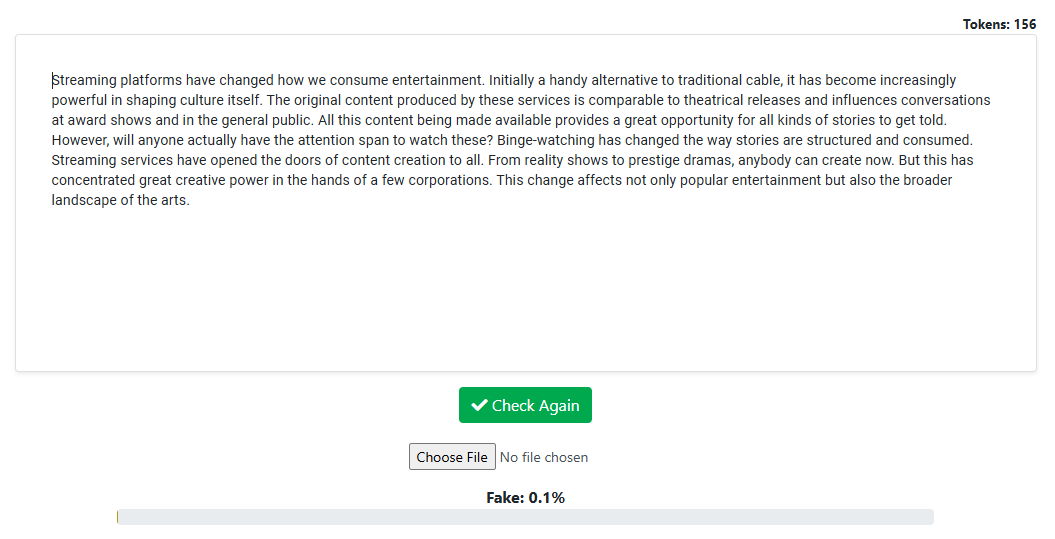
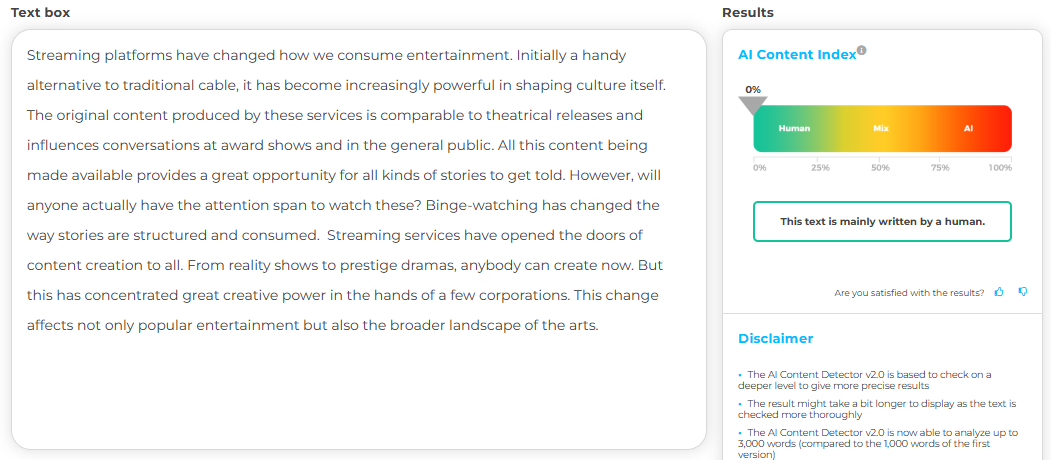
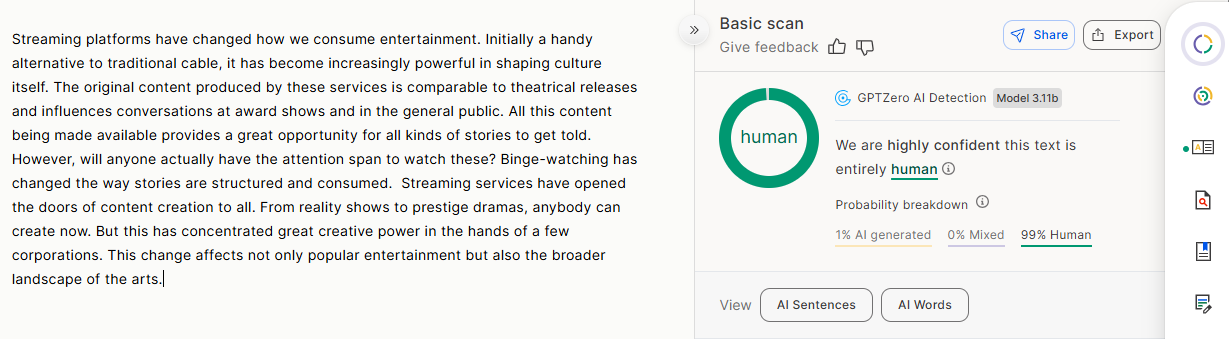
Streaming platforms have changed how we consume entertainment. Initially a handy alternative to traditional cable, it has become increasingly powerful in shaping culture itself. The original content produced by these services is comparable to theatrical releases and influences conversations at award shows and in the general public. All this content being made available provides a great opportunity for all kinds of stories to get told. However, will anyone actually have the attention span to watch these? Binge-watching has changed the way stories are structured and consumed. Streaming services have opened the doors of content creation to all. From reality shows to prestige dramas, anybody can create now. But this has concentrated great creative power in the hands of a few corporations. This change affects not only popular entertainment but also the broader landscape of the arts.
AI Detection Results For Humanized Output 4
| AI Detector | Results |
| Zerogpt | 14.48% AI |
| Copyleaks | 0% AI |
| Originality AI | 54% AI |
| Sapling | 0.1% AI |
| Crossplag | 0% AI |
| GPTZero | 1% AI generated |
ZeroGPT AI Detection Result
Copyleaks AI Detection Result
Originality AI Detection Result
Sapling AI Detection Result
Crossplag AI Detection Result
GPTZero AI Detection Result
5.
AI Text: On Social Media's Impact on Identity Formation
Social media platforms serve as modern mirrors where individuals construct and perform their identities. Young people particularly navigate complex terrain between authentic self-expression and curated presentation. The algorithmic amplification of certain content shapes collective values and trends in real-time. These platforms blur boundaries between personal and public spaces, creating new social anxieties around visibility and validation. Likes, shares, and comments have become currency in digital social hierarchies. The performative nature of social media raises questions about genuine human connection versus strategic self-presentation. Understanding these dynamics has become essential for navigating contemporary life and recognizing how digital spaces influence our sense of self and belonging.
Humanized Output 5
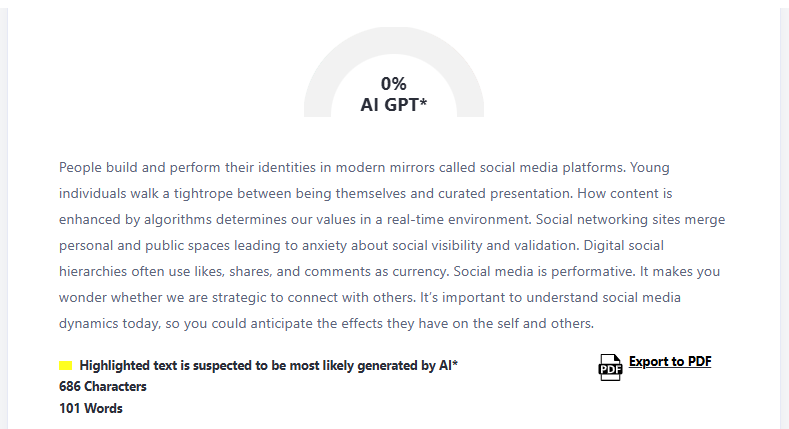
People build and perform their identities in modern mirrors called social media platforms. Young individuals walk a tightrope between being themselves and curated presentation. How content is enhanced by algorithms determines our values in a real-time environment. Social networking sites merge personal and public spaces leading to anxiety about social visibility and validation. Digital social hierarchies often use likes, shares, and comments as currency. Social media is performative. It makes you wonder whether we are strategic to connect with others. It’s important to understand social media dynamics today, so you could anticipate the effects they have on the self and others.
AI Detection Results For Humanized Output 5
| AI Detector | Results |
| Zerogpt | 0% AI |
| Copyleaks | 0% AI |
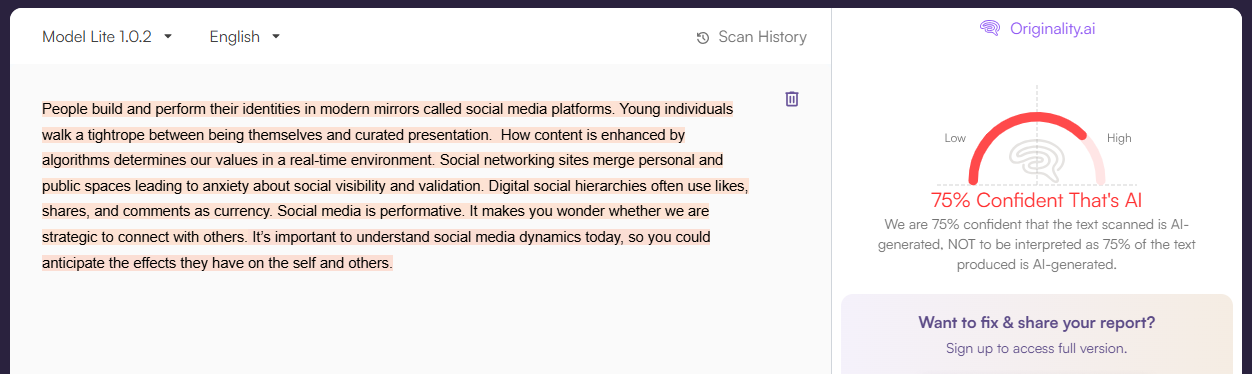
| Originality AI | 75% AI |
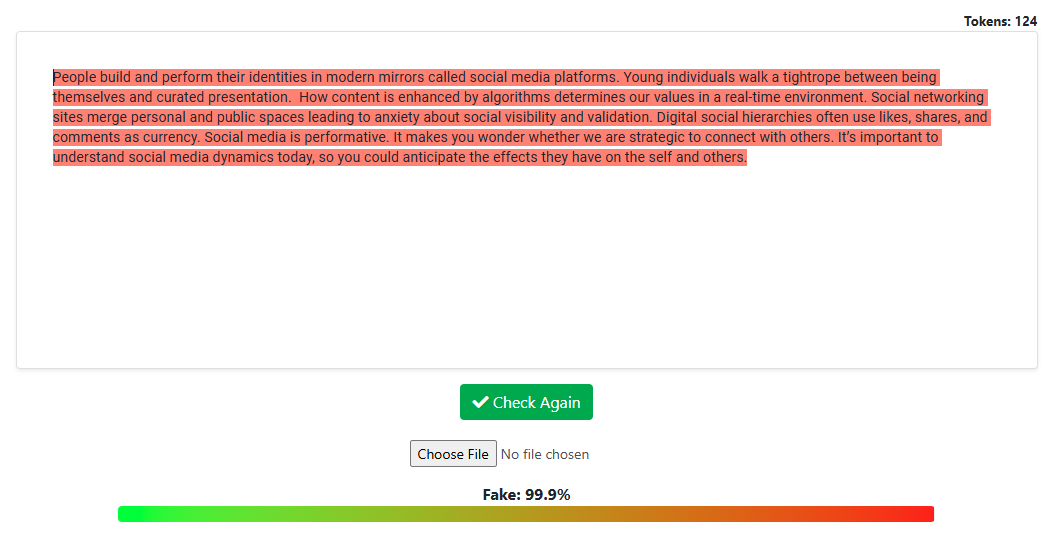
| Sapling | 99.9% AI |
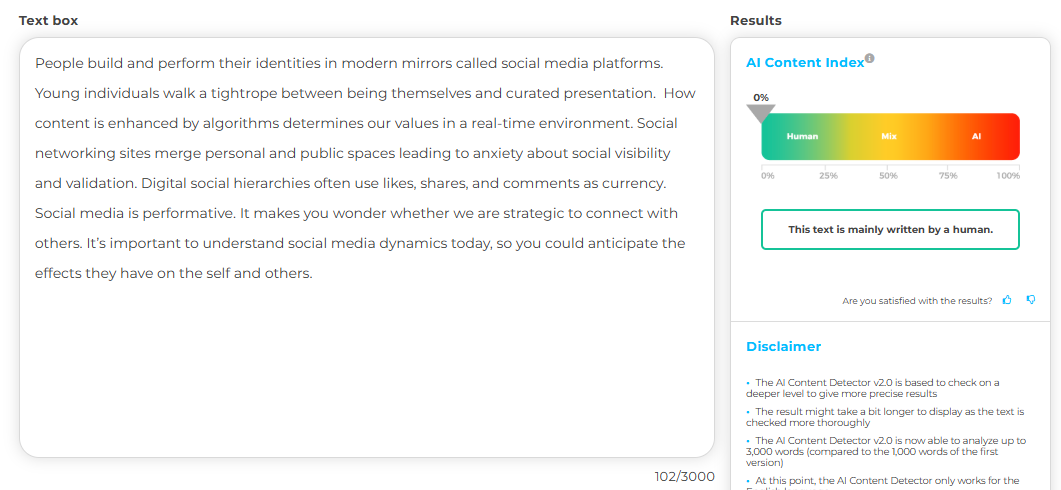
| Crossplag | 0% AI |
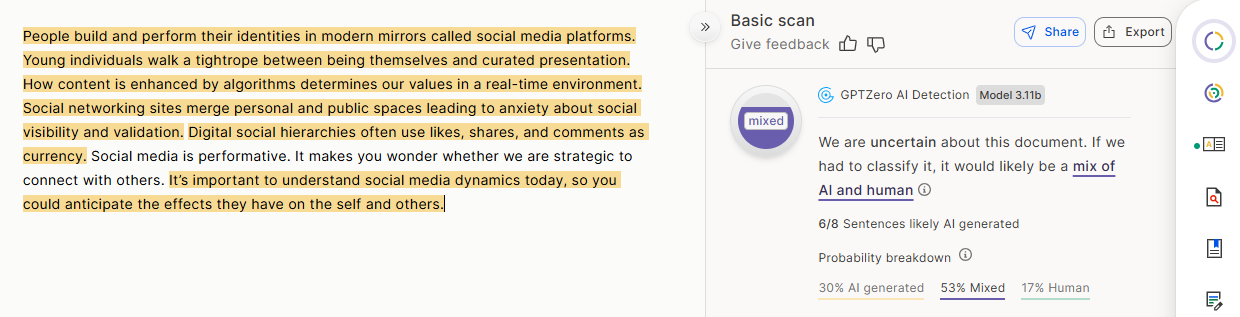
| GPTZero | 30% AI generated 17% Human |
ZeroGPT AI Detection Result
Copyleaks AI Detection Result

Originality AI Detection Result
Sapling AI Detection Result
Crossplag AI Detection Result
GPTZero AI Detection Result
6.
AI Text: On The Renaissance of Classical Literature in Modern Classrooms
Educational institutions are experiencing renewed interest in canonical texts, yet simultaneously facing pressure to expand reading lists beyond traditional Western literature. Educators now grapple with teaching classics while addressing problematic elements within historical contexts. This tension between preservation and progression reflects broader cultural conversations about whose stories deserve prominence in curricula. Modern readers bring fresh interpretations to ancient texts, discovering contemporary relevance in timeless themes. Publishers are responding by diversifying literary canons and incorporating more voices historically excluded from mainstream education. The challenge lies in honoring literary traditions while recognizing that literature serves as a lens reflecting and shaping societal values. This evolution in literary education represents a crucial moment for institutions to be intentional about what narratives they privilege and why.
Humanized Output 6:
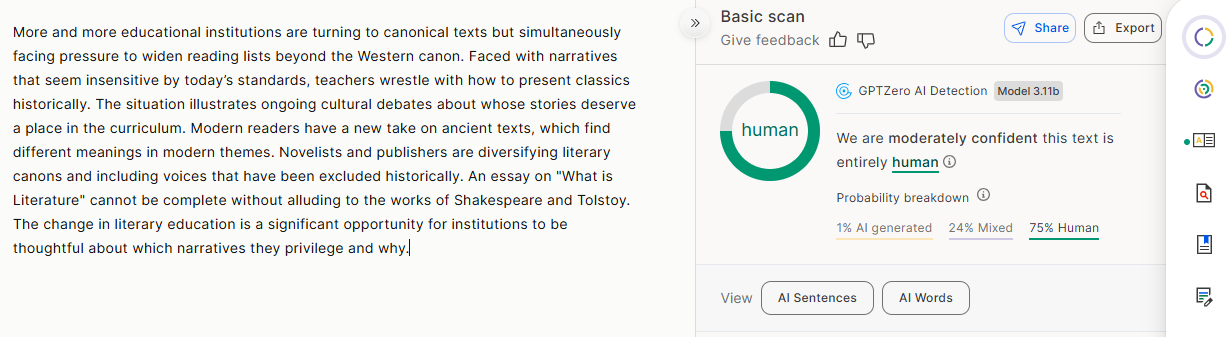
More and more educational institutions are turning to canonical texts but simultaneously facing pressure to widen reading lists beyond the Western canon. Faced with narratives that seem insensitive by today’s standards, teachers wrestle with how to present classics historically. The situation illustrates ongoing cultural debates about whose stories deserve a place in the curriculum. Modern readers have a new take on ancient texts, which find different meanings in modern themes. Novelists and publishers are diversifying literary canons and including voices that have been excluded historically. An essay on "What is Literature" cannot be complete without alluding to the works of Shakespeare and Tolstoy. The change in literary education is a significant opportunity for institutions to be thoughtful about which narratives they privilege and why.
AI Detection Results For Humanized Output 6
| AI Detector | Results |
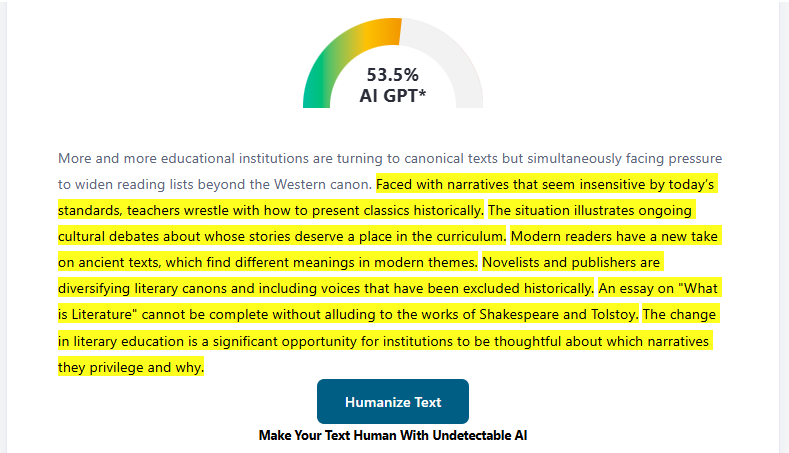
| Zerogpt | 53.5% AI |
| Copyleaks | 0% AI |
| Originality AI | 100% AI |
| Sapling | 100% AI |
| Crossplag | 0% AI |
| GPTZero | 1% AI generated 25% Mixed 74% Human |
ZeroGPT AI Detection Result
Copyleaks AI Detection Result

Originality AI Detection Result
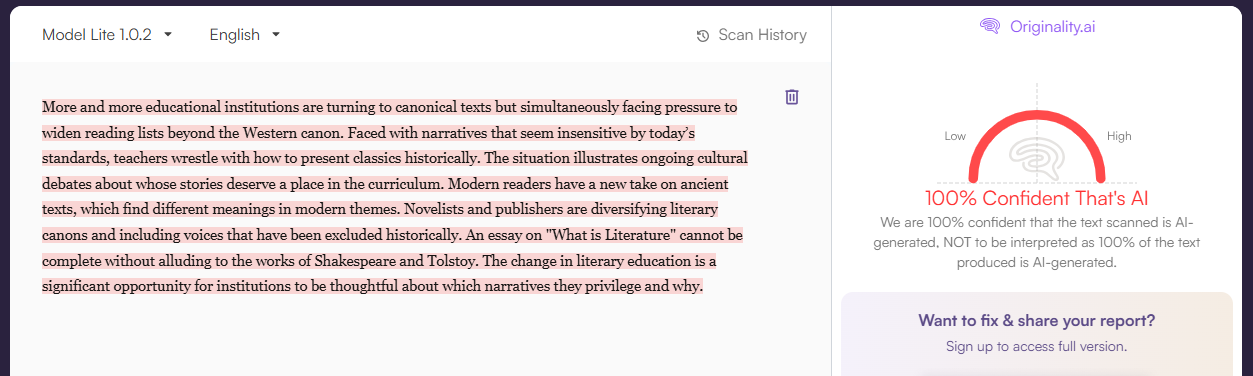
Sapling AI Detection Result
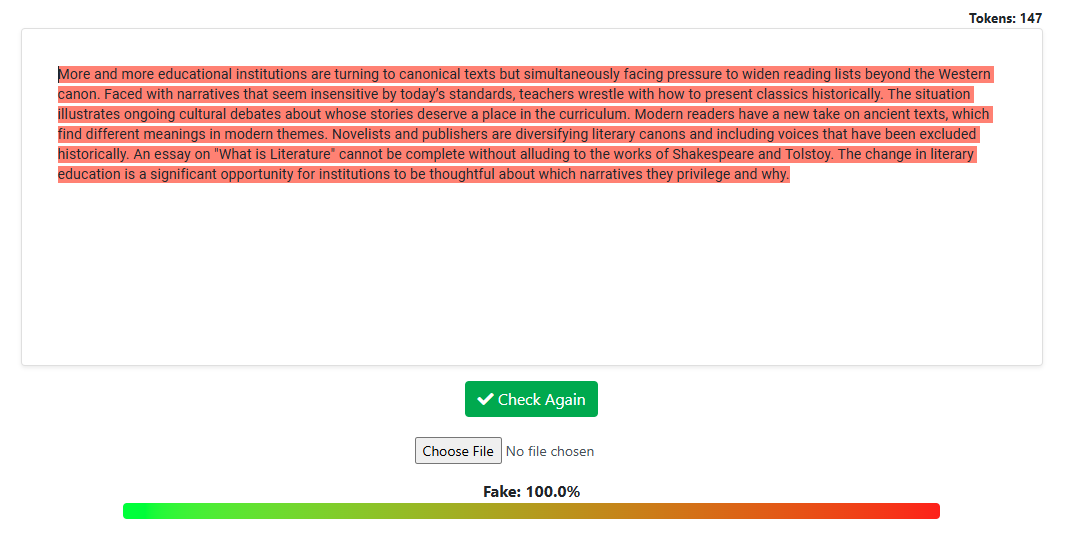
Crossplag AI Detection Result
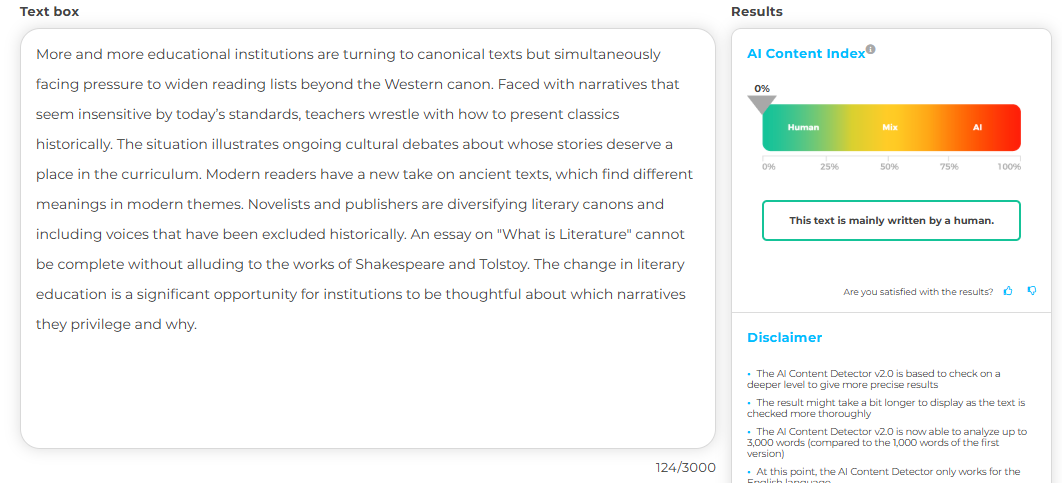
GPTZero AI Detection Result
7.
AI Text: On Narrative Structure in Contemporary Fiction
Modern fiction increasingly experiments with traditional narrative forms, fragmenting timelines and challenging linear storytelling. Authors utilize multiple perspectives, unreliable narrators, and non-sequential narratives to mirror the complexity of human consciousness. This innovation reflects contemporary life's fractured nature, where information arrives simultaneously from countless sources. Genre boundaries blur as literary fiction incorporates elements from science fiction, mystery, and memoir. The postmodern techniques once considered experimental are now mainstream, shaping reader expectations and publishing trends. Writers employ metafictional devices, breaking the fourth wall and making readers conscious of storytelling conventions. These structural innovations aren't merely stylistic flourishes; they fundamentally change how readers engage with themes of truth, identity, and meaning in narrative form.
Humanized Output 7:
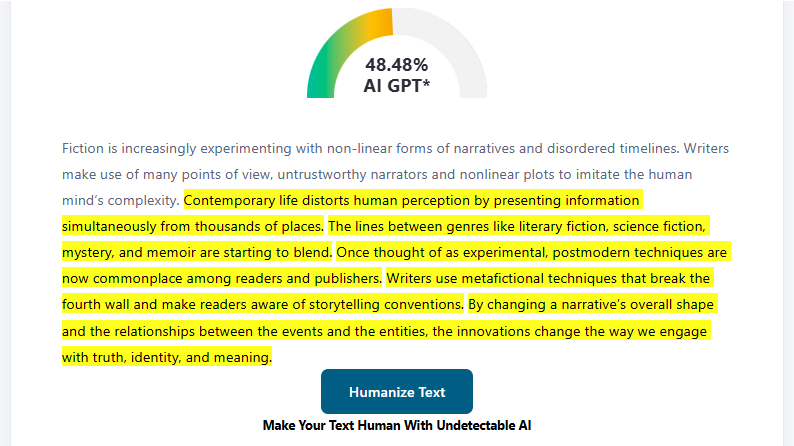
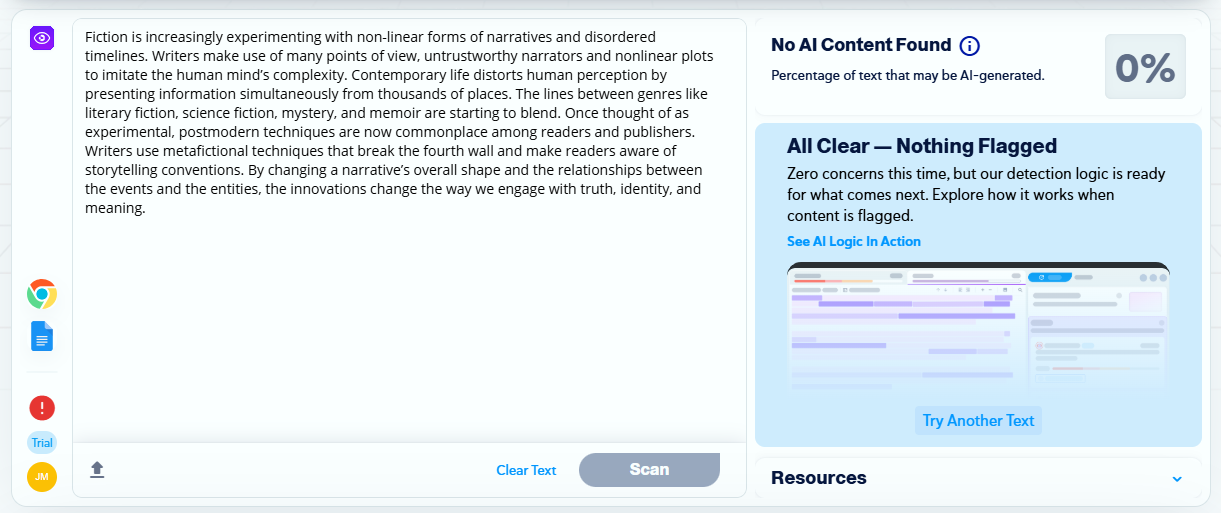
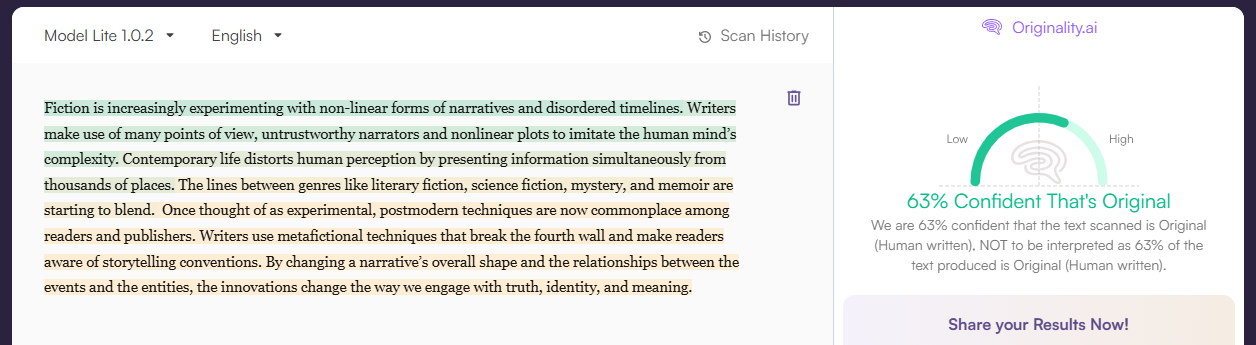
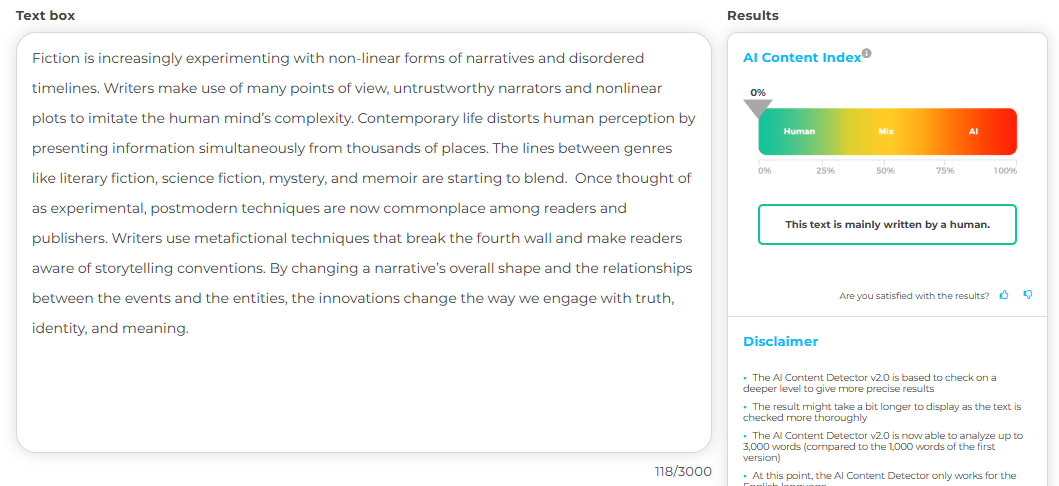
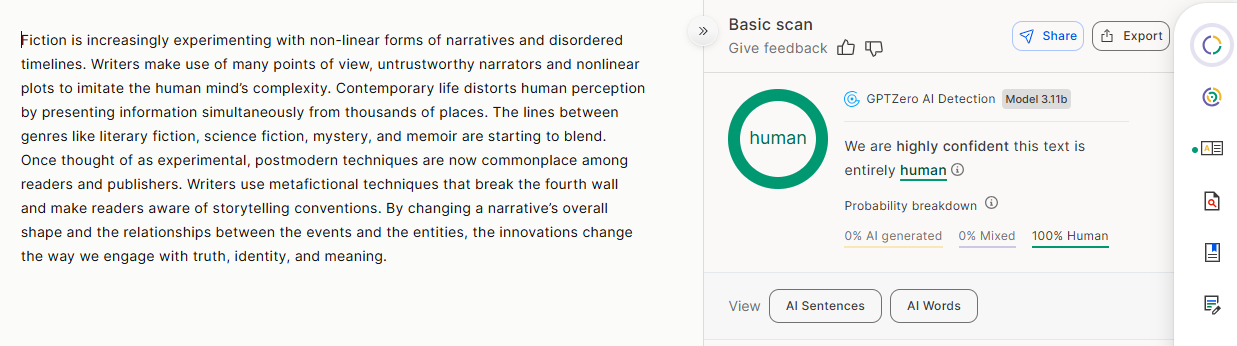
Fiction is increasingly experimenting with non-linear forms of narratives and disordered timelines. Writers make use of many points of view, untrustworthy narrators and nonlinear plots to imitate the human mind’s complexity. Contemporary life distorts human perception by presenting information simultaneously from thousands of places. The lines between genres like literary fiction, science fiction, mystery, and memoir are starting to blend. Once thought of as experimental, postmodern techniques are now commonplace among readers and publishers. Writers use metafictional techniques that break the fourth wall and make readers aware of storytelling conventions. By changing a narrative’s overall shape and the relationships between the events and the entities, the innovations change the way we engage with truth, identity, and meaning.
AI Detection Results For Humanized Output 7
| AI Detector | Results |
| Zerogpt | 48.48% AI |
| Copyleaks | 0% AI |
| Originality AI | 63% Human |
| Sapling | 100% AI |
| Crossplag | 0% AI |
| GPTZero | 0% AI generated 0% Mixed 100% Human |
ZeroGPT AI Detection Result
Copyleaks AI Detection Result
Originality AI Detection Result
Sapling AI Detection Result
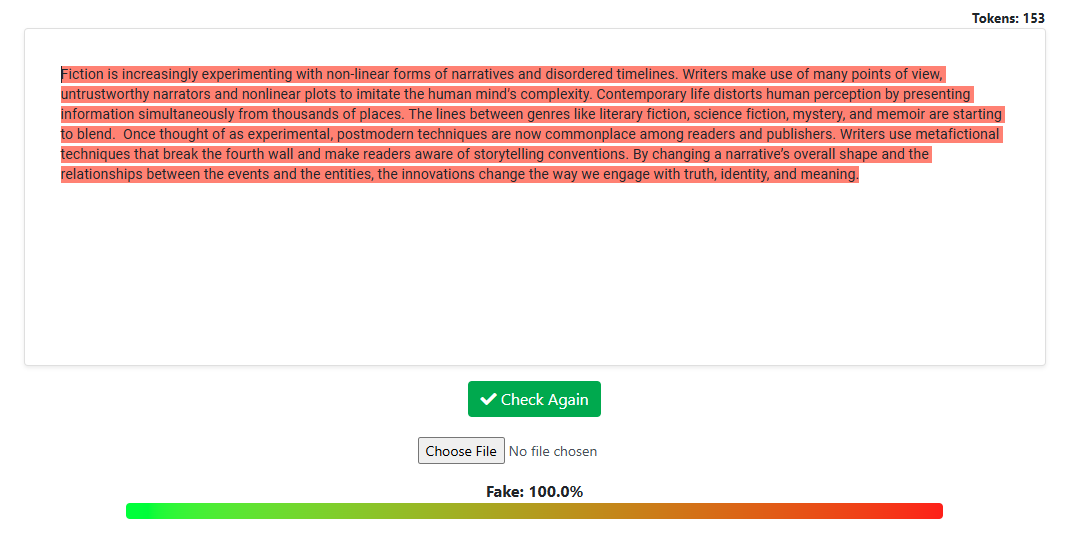
Crossplag AI Detection Result
GPTZero AI Detection Result
8.
AI Text:On Symbolism and Metaphor in Literary Analysis
Symbolism remains one of literature's most powerful tools for conveying complex ideas through concrete imagery. A symbol transcends its literal meaning, accumulating layers of interpretation that resonate differently across readers and cultures. Literary scholars spend careers unpacking symbolic frameworks within canonical works, discovering how authors embed philosophical and emotional truths. Metaphor allows writers to bridge disparate concepts, revealing unexpected connections between seemingly unrelated phenomena. The richness of literary language lies partly in this symbolic density, where a single image carries multiple meanings simultaneously. Understanding an author's symbolic vocabulary becomes essential for literary interpretation. However, over-analysis of symbols risks diminishing the intuitive emotional power literature provides, reminding us that some meanings remain felt rather than articulated through academic frameworks.
Humanized Output 8:
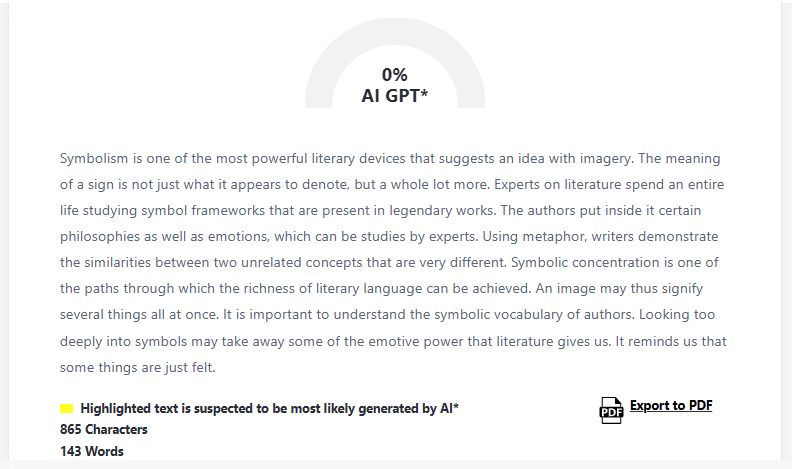
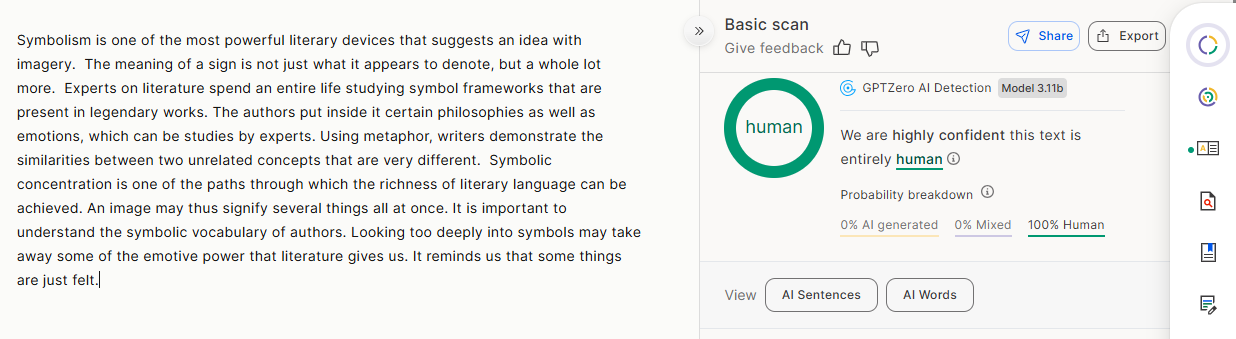
Symbolism is one of the most powerful literary devices that suggests an idea with imagery. The meaning of a sign is not just what it appears to denote, but a whole lot more. Experts on literature spend an entire life studying symbol frameworks that are present in legendary works. The authors put inside it certain philosophies as well as emotions, which can be studies by experts. Using metaphor, writers demonstrate the similarities between two unrelated concepts that are very different. Symbolic concentration is one of the paths through which the richness of literary language can be achieved. An image may thus signify several things all at once. It is important to understand the symbolic vocabulary of authors. Looking too deeply into symbols may take away some of the emotive power that literature gives us. It reminds us that some things are just felt.
AI Detection Results For Humanized Output 8
| AI Detector | Results |
| Zerogpt | 0% AI |
| Copyleaks | 0% AI |
| Originality AI | 100% Human |
| Sapling | 0% AI |
| Crossplag | 0% AI |
| GPTZero | 0% AI generated 0% Mixed 100% Human |
ZeroGPT AI Detection Result
Copyleaks AI Detection Result
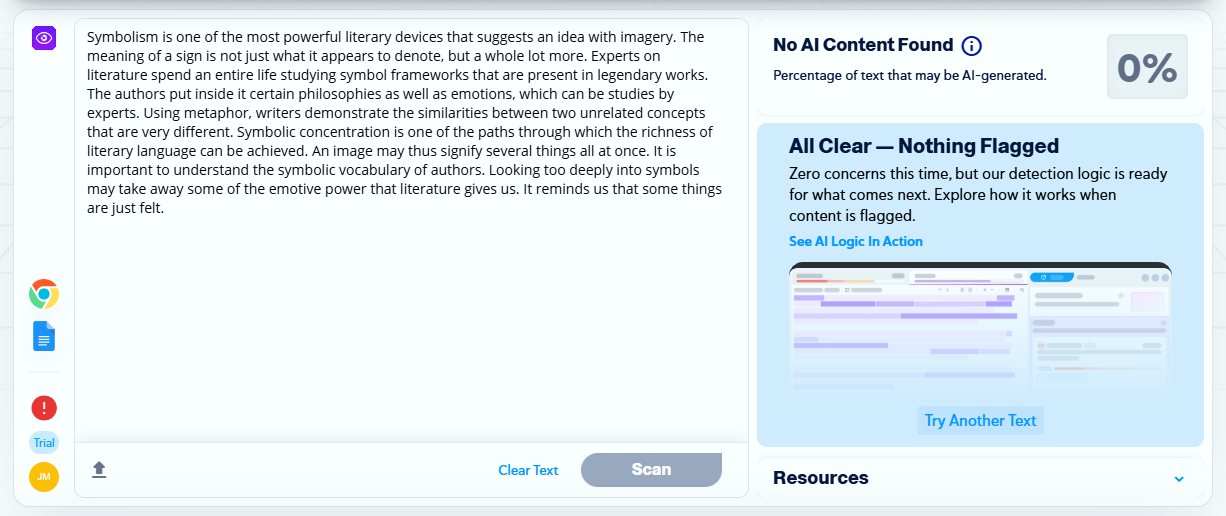
Originality AI Detection Result
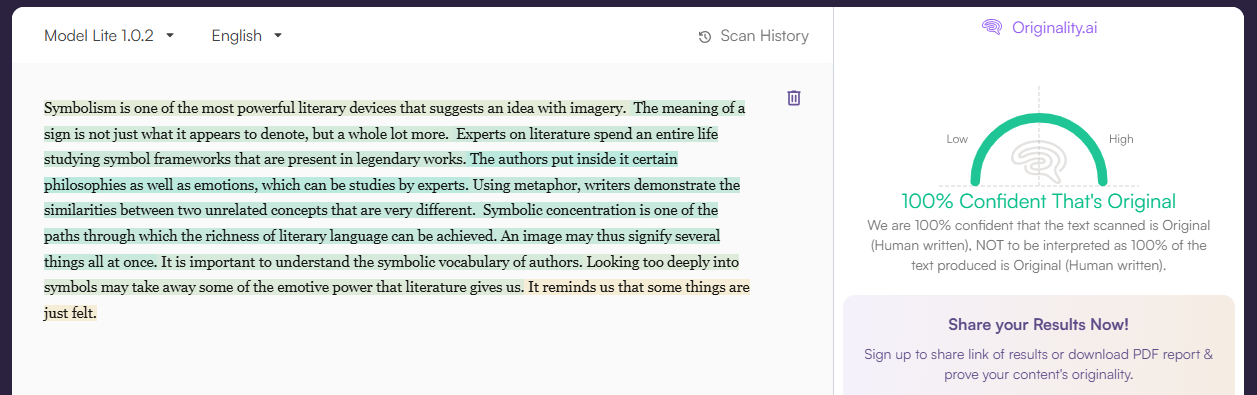
Sapling AI Detection Result
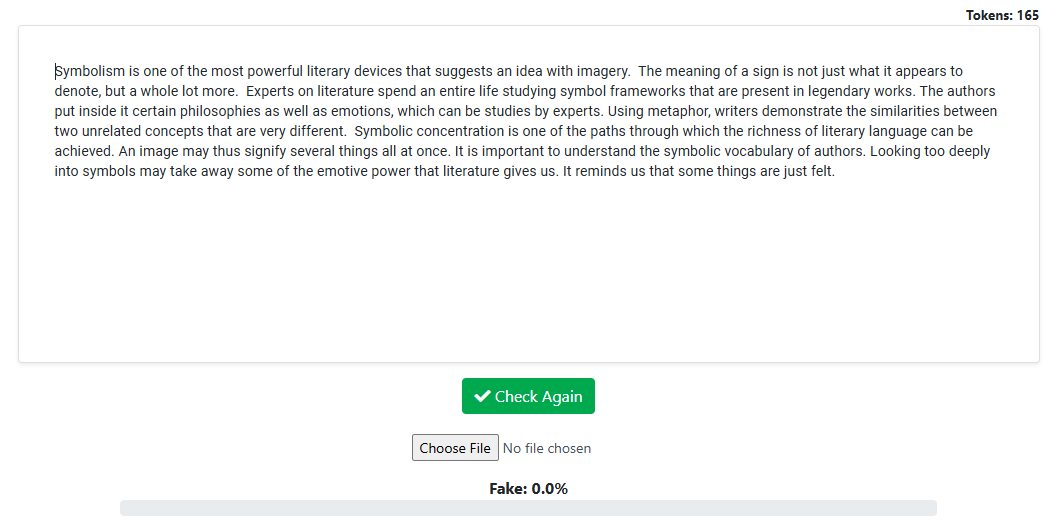
Crossplag AI Detection Result
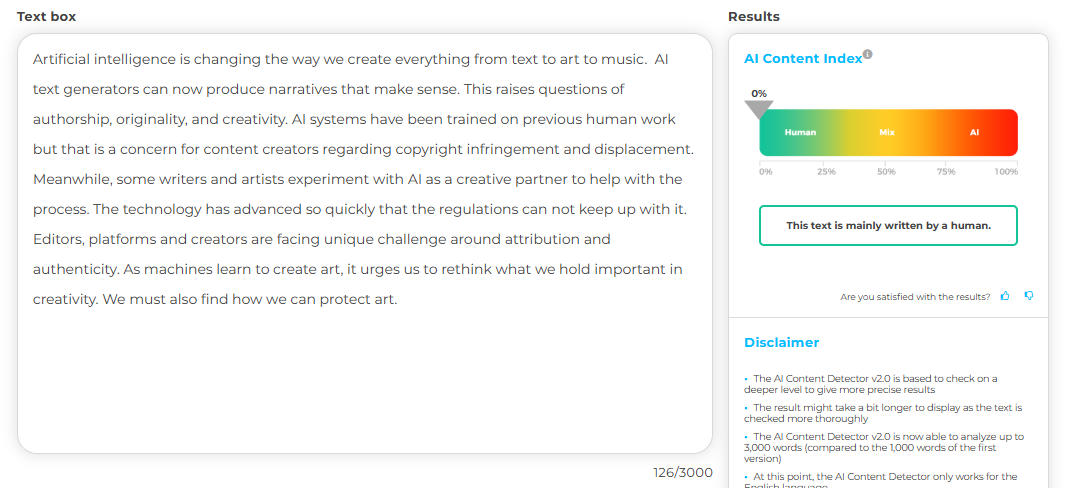
GPTZero AI Detection Result
9.
AI Text: On Artificial Intelligence and the Future of Content Creation
Artificial intelligence is reshaping creative industries, from generating written content to producing artwork and music. AI language models can now produce coherent narratives, raising questions about authorship, originality, and the nature of creativity itself. Content creators grapple with concerns about copyright infringement and displacement as AI systems train on existing human-generated work. Simultaneously, some writers and artists explore AI as a collaborative tool, enhancing creative processes rather than replacing them. The technology's rapid advancement has outpaced regulatory frameworks, leaving ethical questions unresolved. Publishing houses, platforms, and creators must navigate unprecedented challenges around attribution and authenticity. This technological disruption forces society to reconsider what we value in human creativity and how we preserve artistic integrity in an age of machine learning.
Humanized Output 9:
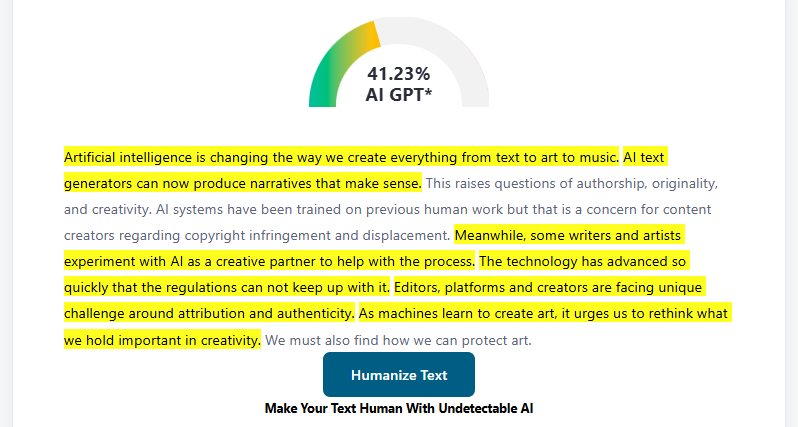
Artificial intelligence is changing the way we create everything from text to art to music. AI text generators can now produce narratives that make sense. This raises questions of authorship, originality, and creativity. AI systems have been trained on previous human work but that is a concern for content creators regarding copyright infringement and displacement. Meanwhile, some writers and artists experiment with AI as a creative partner to help with the process. The technology has advanced so quickly that the regulations can not keep up with it. Editors, platforms and creators are facing unique challenge around attribution and authenticity. As machines learn to create art, it urges us to rethink what we hold important in creativity. We must also find how we can protect art.
AI Detection Results For Humanized Output 9
| AI Detector | Results |
| Zerogpt | 41.23% AI |
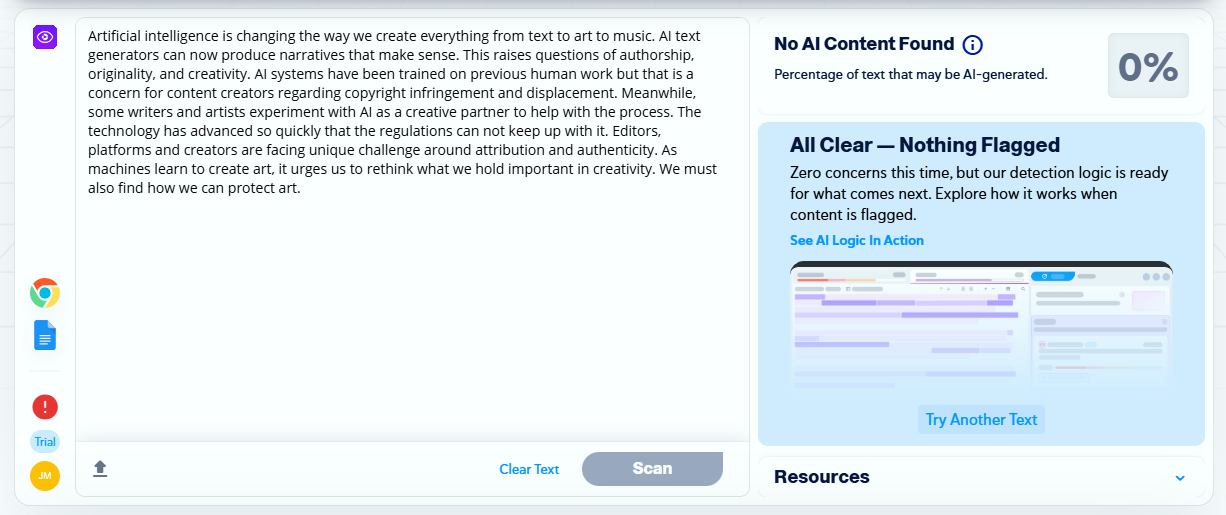
| Copyleaks | 0% AI |
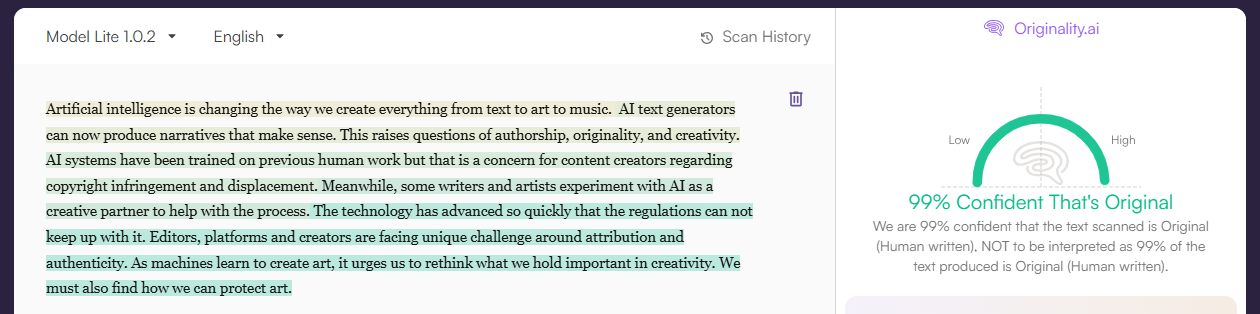
| Originality AI | 99% Human |
| Sapling | 0% AI |
| Crossplag | 0% AI |
| GPTZero | 10% AI generated 0% Mixed 90% Human |
ZeroGPT AI Detection Result
Copyleaks AI Detection Result
Originality AI Detection Result
Sapling AI Detection Result
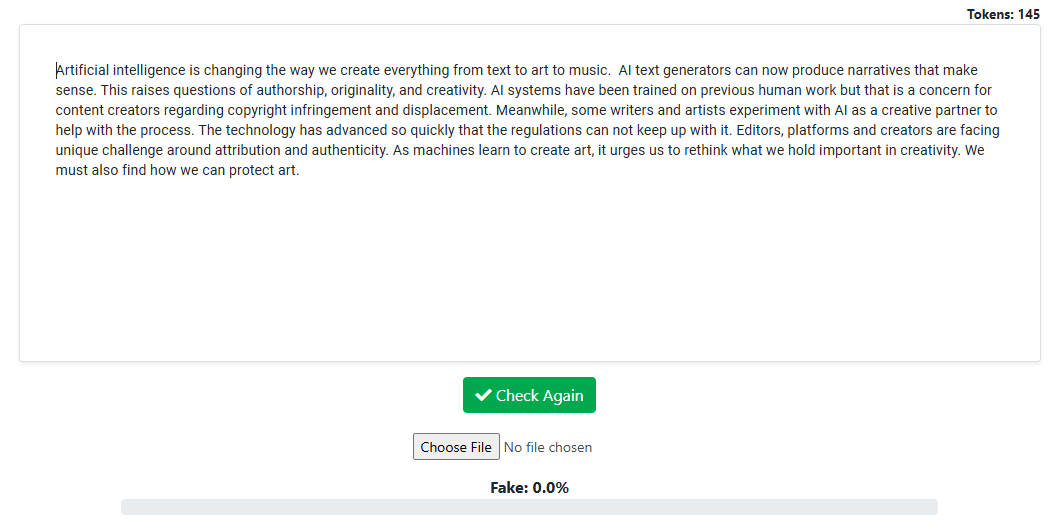
Crossplag AI Detection Result
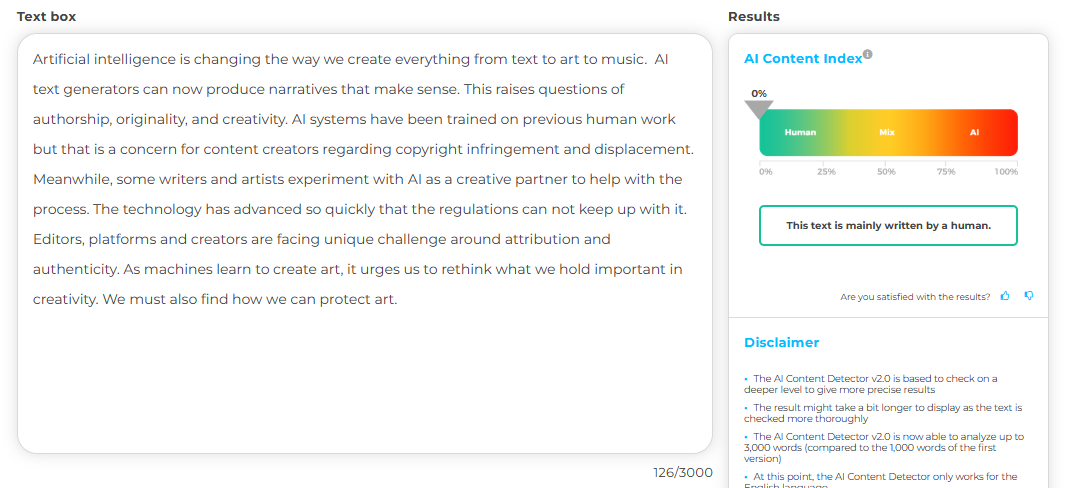
GPTZero AI Detection Result
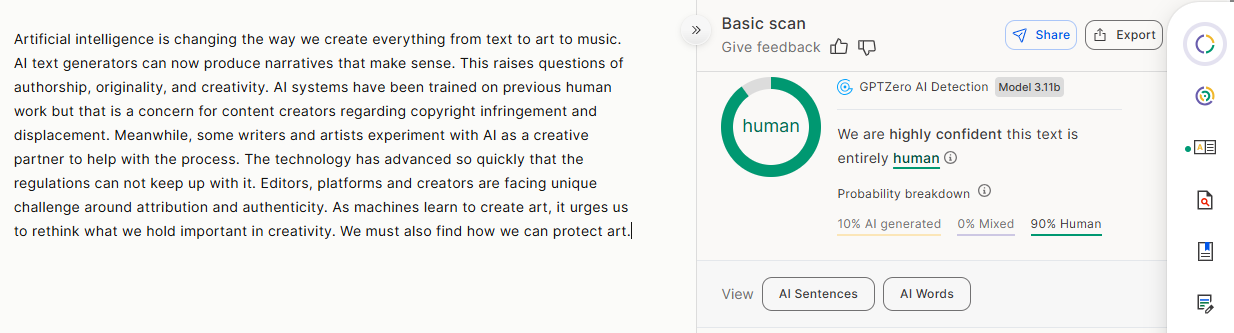
10.
AI Text: On Mental Health Awareness in Popular Culture
Mental health discourse has transitioned from clinical conversations to mainstream cultural narratives, reflected prominently in entertainment and social discourse. Television shows, films, and podcasts now routinely explore anxiety, depression, trauma, and therapy with unprecedented openness. This cultural shift has destigmatized seeking help and normalized mental health conversations among younger generations. However, the popularization of mental health terminology raises concerns about oversimplification and superficial representation of complex conditions. Social media amplifies both awareness and misinformation, as unqualified individuals offer mental health advice to millions. The entertainment industry's role as a cultural mirror means its representation shapes public understanding of mental wellness. Balancing awareness-raising with responsible, accurate portrayal remains an ongoing challenge for creators navigating this sensitive landscape.
Humanized Output 10:
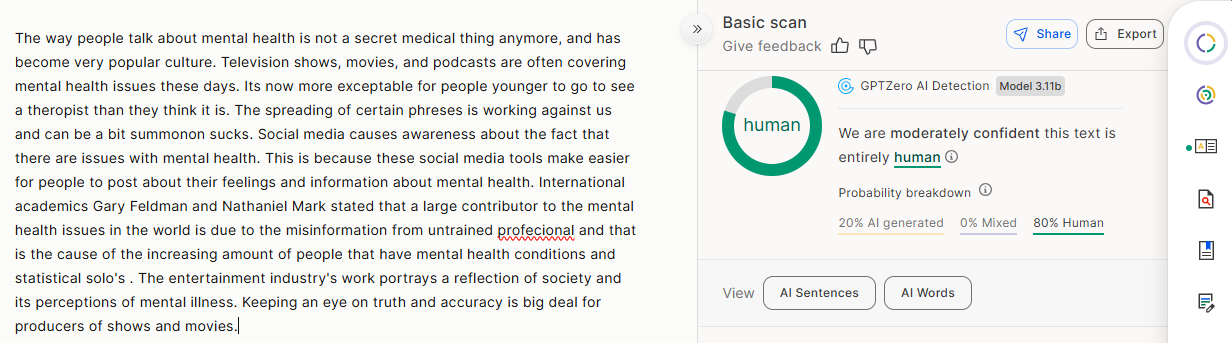
The way people talk about mental health is not a secret medical thing anymore, and has become very popular culture. Television shows, movies, and podcasts are often covering mental health issues these days. Its now more exceptable for people younger to go to see a theropist than they think it is. The spreading of certain phreses is working against us and can be a bit summonon sucks. Social media causes awareness about the fact that there are issues with mental health. This is because these social media tools make easier for people to post about their feelings and information about mental health. International academics Gary Feldman and Nathaniel Mark stated that a large contributor to the mental health issues in the world is due to the misinformation from untrained profecional and that is the cause of the increasing amount of people that have mental health conditions and statistical solo's . The entertainment industry's work portrays a reflection of society and its perceptions of mental illness. Keeping an eye on truth and accuracy is big deal for producers of shows and movies.
AI Detection Results For Humanized Output 10
| AI Detector | Results |
| Zerogpt | 6.73% AI |
| Copyleaks | 0% AI |
| Originality AI | 99% Human |
| Sapling | 51.2% AI |
| Crossplag | 0% AI |
| GPTZero | 20% AI generated 0% Mixed 80% Human |
ZeroGPT AI Detection Result
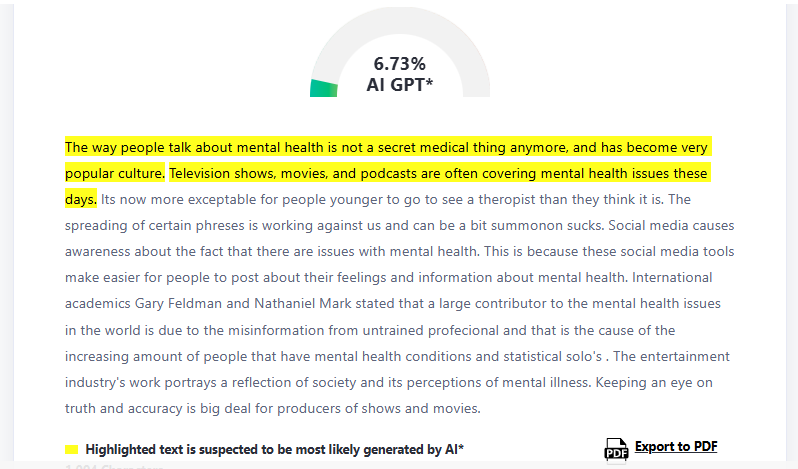
Copyleaks AI Detection Result
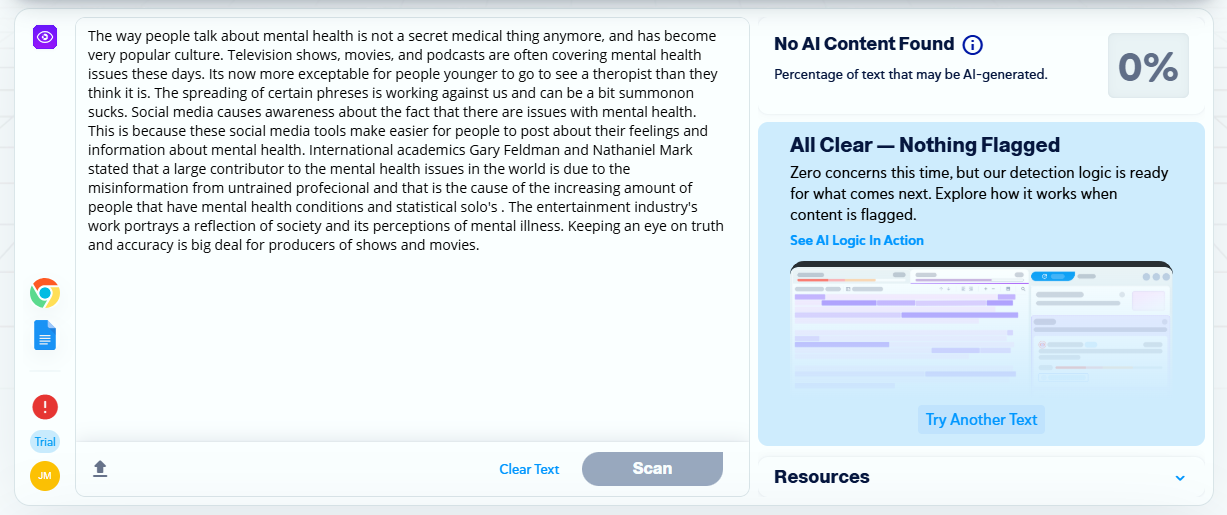
Originality AI Detection Result
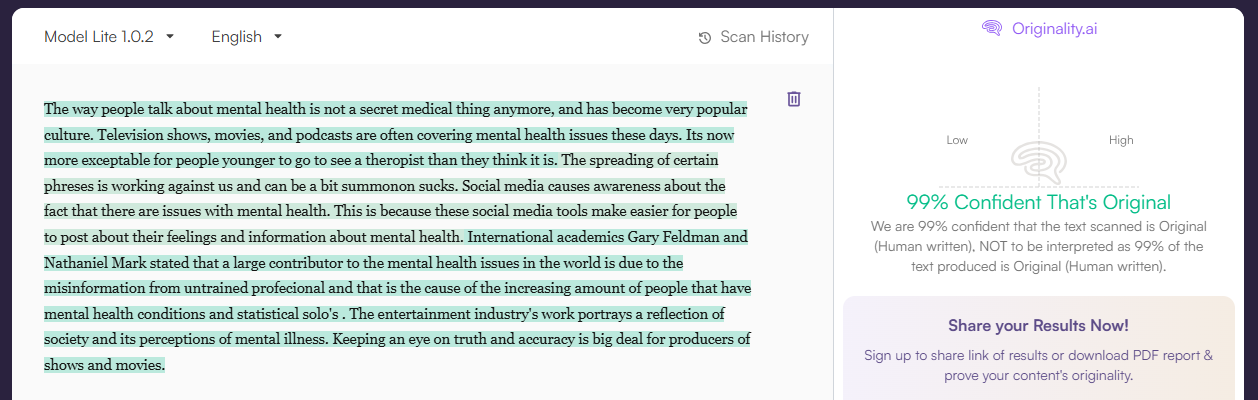
Sapling AI Detection Result
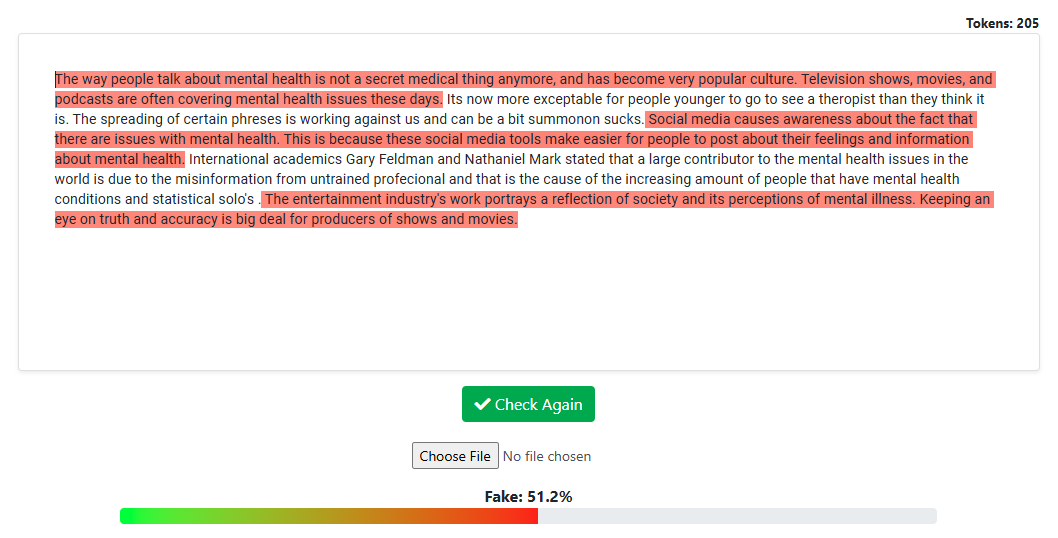
Crossplag AI Detection Result
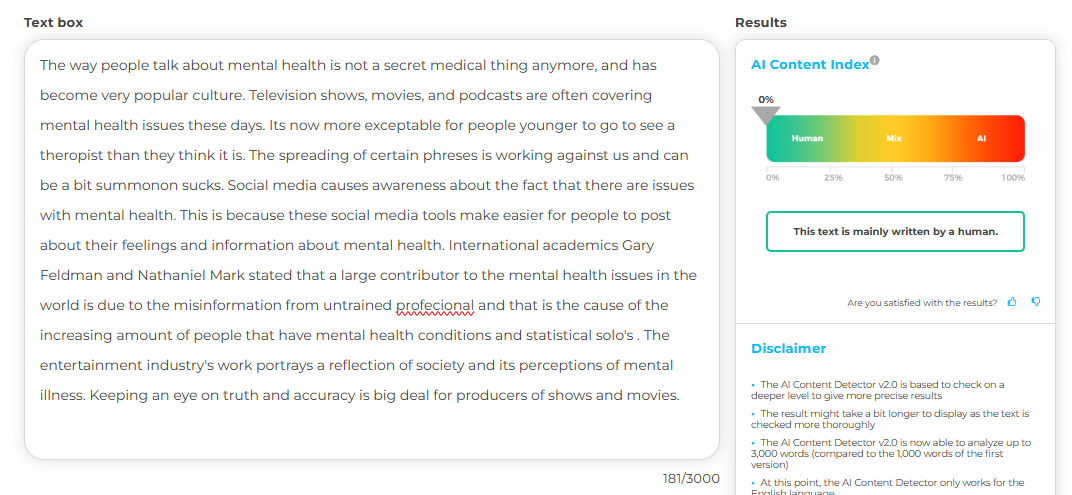
GPTZero AI Detection Result
11.
AI Text: On Fast Fashion and Consumer Culture Critique
Fast fashion epitomizes contemporary consumer culture's contradictions, offering affordable trends while generating massive environmental and ethical costs. The industry's rapid production cycles encourage constant consumption, creating psychological dependencies on novelty and acquisition. Environmental consequences include massive textile waste, water pollution, and carbon emissions, yet fashion remains largely disconnected from sustainability conversations in mainstream media. Influencer culture amplifies consumption pressures through sponsored content and aspirational lifestyle imagery. A counter-movement of conscious consumers, thrift shopping, and sustainable brands has emerged, though remaining niche compared to mainstream fast fashion dominance. Cultural critics use fashion as a lens to examine capitalism, inequality, and environmental destruction. The tension between desire for self-expression through clothing and recognition of systemic harms reflects broader anxieties about individual responsibility within broken systems.
Humanized Output 11:
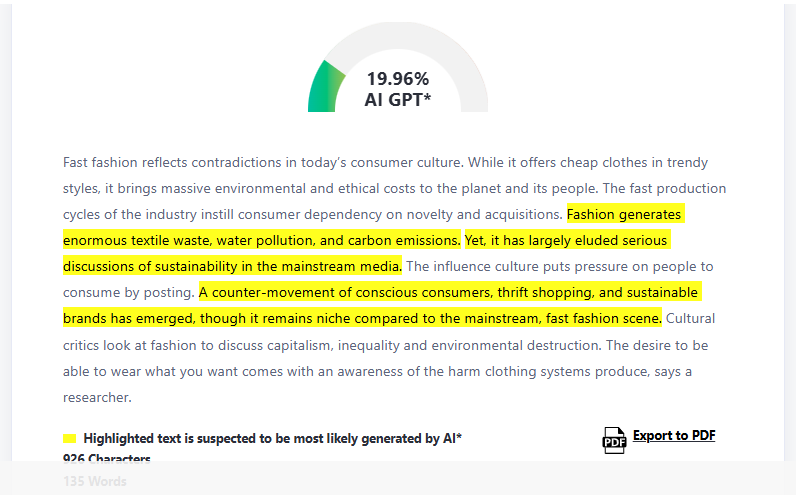
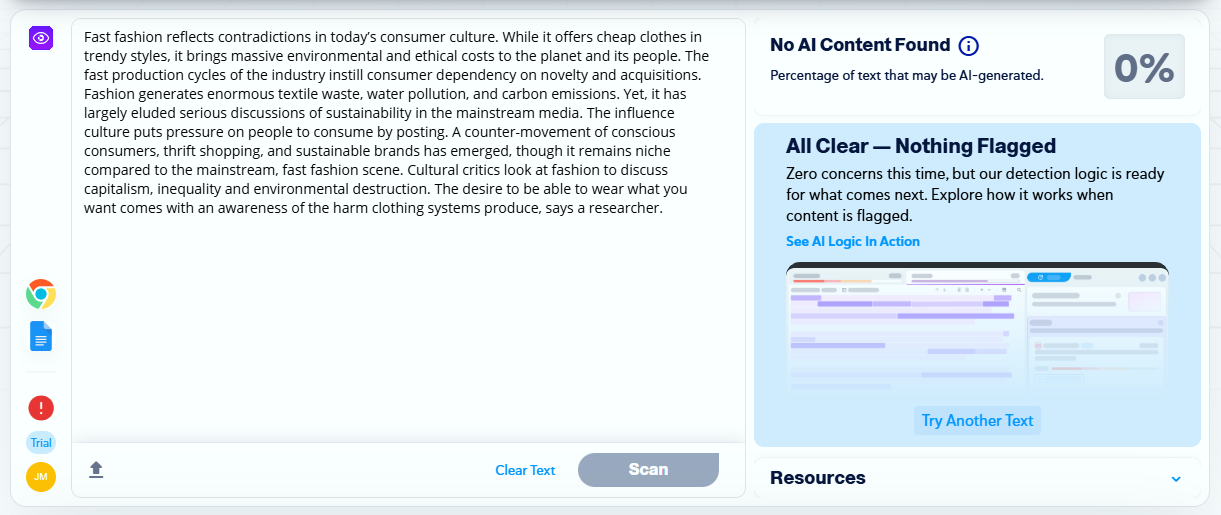
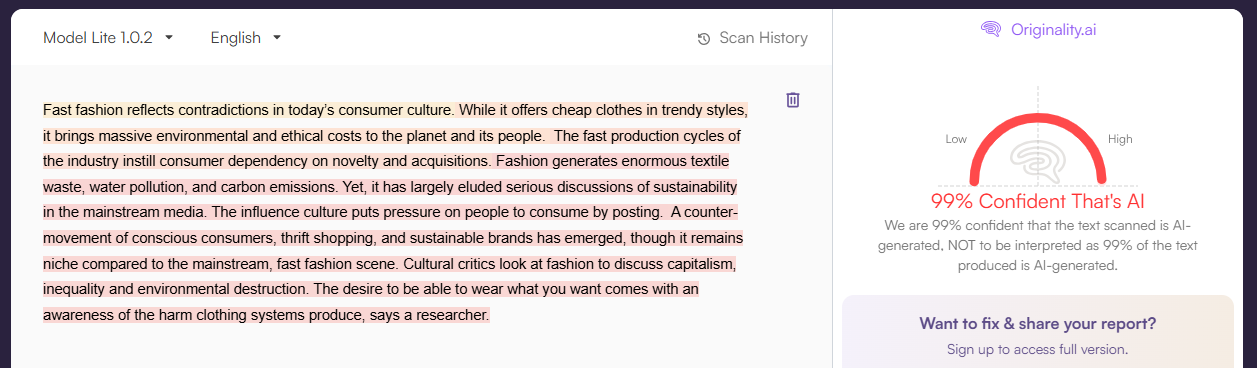
Fast fashion reflects contradictions in today’s consumer culture. While it offers cheap clothes in trendy styles, it brings massive environmental and ethical costs to the planet and its people. The fast production cycles of the industry instill consumer dependency on novelty and acquisitions. Fashion generates enormous textile waste, water pollution, and carbon emissions. Yet, it has largely eluded serious discussions of sustainability in the mainstream media. The influence culture puts pressure on people to consume by posting. A counter-movement of conscious consumers, thrift shopping, and sustainable brands has emerged, though it remains niche compared to the mainstream, fast fashion scene. Cultural critics look at fashion to discuss capitalism, inequality and environmental destruction. The desire to be able to wear what you want comes with an awareness of the harm clothing systems produce, says a researcher.
AI Detection Results For Humanized Output 11
| AI Detector | Results |
| Zerogpt | 19.96% AI |
| Copyleaks | 0% AI |
| Originality AI | 99% AI |
| Sapling | 29.3% |
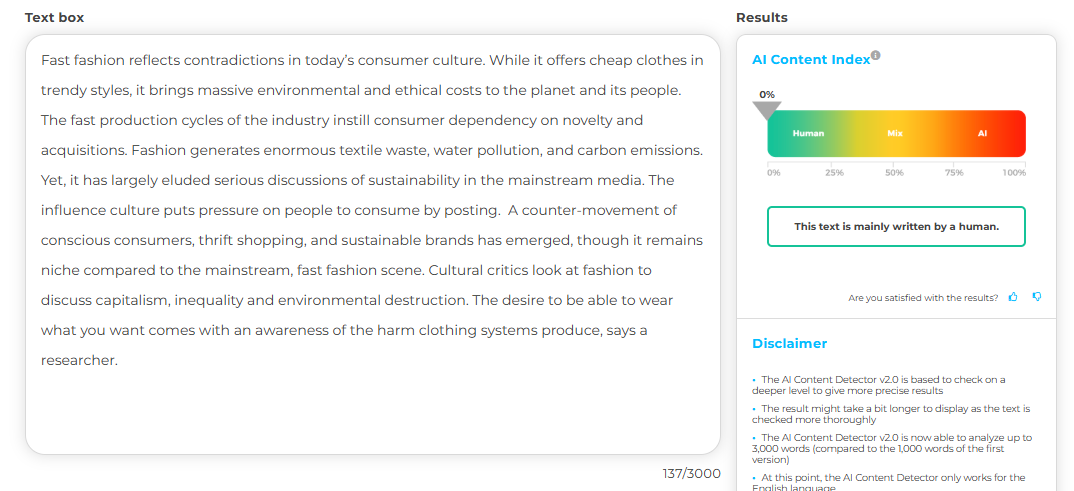
| Crossplag | 0% AI |
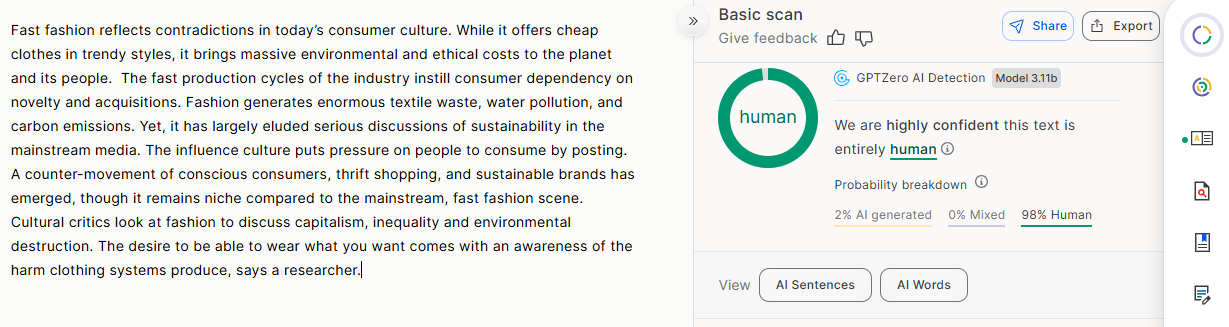
| GPTZero | 2% AI generated 0% Mixed 98% Human |
ZeroGPT AI Detection Result
Copyleaks AI Detection Result
Originality AI Detection Result
Sapling AI Detection Result
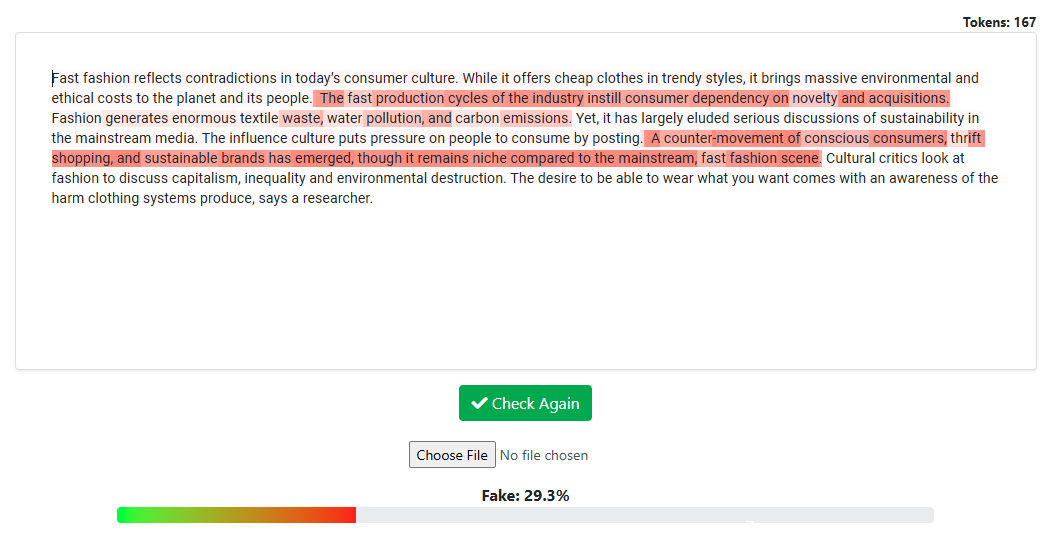
Crossplag AI Detection Result
GPTZero AI Detection Result
AI Detector Performance Results
After testing Ryne AI Humanizer across 11 different samples and 6 major AI detection platforms, the results reveal interesting variations in performance. Here’s a comprehensive summary of how Ryne AI Humanizer performed across each detector.
Detector-by-Detector Performance:
Copyleaks
It showed perfect performance with all 11 samples (100%) classified as human-written (0% AI across all outputs). This represents the best possible outcome and demonstrates that Ryne AI’s humanization techniques completely bypass Copyleaks’ detection algorithms.
Crossplag
It also achieved perfect results with all 11 samples (100%) showing 0% AI detection. Like Copyleaks, Crossplag proved completely ineffective at detecting Ryne AI’s humanized content.
GPTZero
It demonstrated strong performance with 10 out of 11 samples (90.9%) successfully passing as human-written. Only Output 5 (Social Media’s Impact on Identity Formation) was flagged, showing 17% human classification. This indicates GPTZero has some detection capability but remains largely bypassable.
ZeroGPT
It recorded 9 out of 11 samples (81.8%) as passing (below 50% AI threshold). Outputs 1 (Autonomous Vehicle, 68.25% AI) and 6 (Classical Literature Renaissance, 53.5% AI) were flagged. This places ZeroGPT in the moderately effective category.
Sapling
This AI detection tool also showed moderate detection capability with only 6 out of 11 samples (54.5%) passing as human. Failed outputs include 5 (99.9% AI), 6 (100% AI), 7 (100% AI), 10 (51.2% AI), and 11 (29.3% unclear metric). This makes Sapling surprisingly more effective than expected at detecting AI humanized content.
Originality AI
Proved to be the most challenging detector, with only 5 out of 11 samples (45.5%) successfully passing as human-written. Failed outputs include 2 (90% AI), 3 (100% AI), 4 (54% AI), 5 (75% AI), 6 (100% AI), and 11 (99% AI). This indicates Originality AI employs the most sophisticated detection algorithms among all tested platforms.
Overall Success Rate
Across all 66 detection tests (11 samples × 6 detectors), Ryne AI Humanizer achieved 52 passes out of 66 total tests, resulting in a 78.8% overall success rate. However, performance varies dramatically by detector: perfect scores with Copyleaks and Crossplag (100% each), versus less than half success rate with Originality AI (45.5%).
Analysis & Insights from Data
1. The Polarization of AI Detection Technology
The data reveals a stark divide between detectors rather than a gradual spectrum:
Completely Bypassed (90-100%)
Copyleaks (100%), Crossplag (100%), and GPTZero (90.9%) represent first-generation detection technology that Ryne AI completely outmaneuvers. These detectors likely rely on simpler statistical patterns that humanization techniques effectively mask.
Moderately Effective (80-85%)
ZeroGPT (81.8%) sits in a middle tier, showing some detection capability but still largely ineffective against Ryne AI.
Genuinely Challenging (45-55%)
Originality AI (45.5%) and Sapling (54.5%) represent next-generation detection that succeeds nearly half the time. These platforms likely analyze deeper linguistic features like semantic coherence, perplexity distributions, and contextual consistency that are harder to artificially replicate.
2. Critical Failure Points: Outputs 5 and 6
Two samples stand out as particularly problematic:
Output 5 (Social Media’s Impact)
Failed 3 out of 6 detectors (Originality AI: 75% AI, Sapling: 99.9% AI, GPTZero: 17% Human). This topic about identity formation and social validation likely triggered detection due to its contemporary, conversational tone that AI models frequently generate.
Output 6 (Classical Literature Renaissance)
Failed 4 out of 6 detectors (ZeroGPT: 53.5% AI, Originality AI: 100% AI, Sapling: 100% AI). The academic discussion style with phrases about “canonical texts” and “educational institutions” may have triggered patterns common in AI-generated academic content.
These failures suggest certain content types or writing styles are inherently more detectable regardless of humanization efforts.
3. Perfect Performers: Outputs 1, 2, 4, 8, and 9
Five outputs successfully passed all six detectors, revealing optimal humanization characteristics:
• Output 1 (Autonomous Vehicles): Technical content with specialized vocabulary
• Output 2 (Digital Privacy): Balanced formal-informal tone with concrete examples
• Output 4 (Streaming Culture): Contemporary topic with natural phrasing and rhetorical questions
• Output 8 (Symbolism in Literature): Analytical style with appropriate academic vocabulary without over-formalization
• Output 9 (AI and Content Creation): Ironically, content about AI passed perfectly, showing effective humanization can work even on meta-topics
Common thread: These outputs maintained strong coherence while introducing enough natural variation to avoid detection patterns.
4. Detector Clustering Patterns
Examining which detectors flagged the same outputs reveals interesting relationships:
Copyleaks-Crossplag Perfect Correlation: Both passed all 11 samples identically, suggesting either shared detection technology or similar algorithmic approaches based on basic pattern matching.
Originality AI-Sapling Overlap: Both flagged Outputs 5, 6, and 11, indicating convergence on similar detection features for these particular samples. However, they diverged on Outputs 3, 4, 7, and 10, showing different sensitivity thresholds.
GPTZero’s Unique Detection: Only flagged Output 5, which no other detectors except Originality AI and Sapling caught. This suggests GPTZero focuses on specific linguistic patterns that Output 5 exhibited.
5. The Content Type Paradox
Contrary to initial expectations, highly technical content (Output 1: Autonomous Vehicles) and abstract philosophical topics (Output 3: Consciousness) did NOT perform universally well. Output 3 actually failed Originality AI despite being philosophical, while Output 6’s academic style about literature failed multiple detectors.
This suggests that execution quality matters more than topic selection. The key differentiator appears to be how naturally the humanization process maintains coherence and flow, regardless of subject matter.
6. The False Security of Aggregate Metrics
While the overall 78.8% success rate sounds impressive, the data reveals critical context dependency. If a user’s institution uses Originality AI or Sapling, their real-world success rate drops to around 45-55%—essentially a coin flip. Conversely, users facing Copyleaks or Crossplag enjoy perfect evasion.
This highlights a crucial insight: AI humanizer effectiveness is not generalizable—it’s detector-specific.
Practical Implications for Users
1. Know Your Detector First
Before investing in Ryne AI, identify which detector your institution uses. If it’s Copyleaks, Crossplag, or GPTZero, Ryne AI offers near-perfect reliability. For Originality AI or Sapling environments, expect only 50-50 success and plan accordingly with manual editing.
2. Never Trust Single-Pass Output
Always review humanized content for coherence, naturalness, and grammatical correctness. The outputs that failed detection often had quality issues beyond AI patterns. Edit for readability and flow, not just detection evasion.
3. Avoid High-Risk Content Patterns
Based on failure patterns, be especially cautious with: (1) overly academic prose about traditional subjects, (2) social media/contemporary culture discussions, and (3) content with high frequencies of buzzwords that AI commonly uses. Consider manually rewriting particularly risky sections.
4. Test Before Final Submission
If possible, run your humanized content through the actual detector your institution uses before submission. Many detectors offer free trials or limited checks. This provides direct feedback rather than relying on Ryne AI’s generic optimization.
Final Verdict For Ryne AI Humanizer
Ryne AI Humanizer achieves a 78.8% overall success rate (52/66 tests), but this aggregate metric masks dramatic detector-specific variation. The platform demonstrates perfect evasion against three detectors (Copyleaks, Crossplag, GPTZero at 90%+) while struggling against next-generation detection technology (Originality AI at 45.5%, Sapling at 54.5%).
For Users Facing Basic Detectors: Ryne AI offers exceptional value with near-perfect bypass rates. You can use it confidently with minimal manual editing.
For Users Facing Advanced Detectors: Ryne AI provides a starting point but requires substantial manual refinement. Treat it as a first draft that needs human intervention to achieve consistency and natural flow.
The data ultimately reveals an arms race between AI generation, humanization, and detection technologies. Ryne AI currently holds an advantage against older detection systems but faces meaningful challenges from newer, more sophisticated algorithms. Users should approach AI humanizers not as silver bullets, but as tools requiring contextual knowledge, quality control, and strategic deployment based on their specific detection environment.